
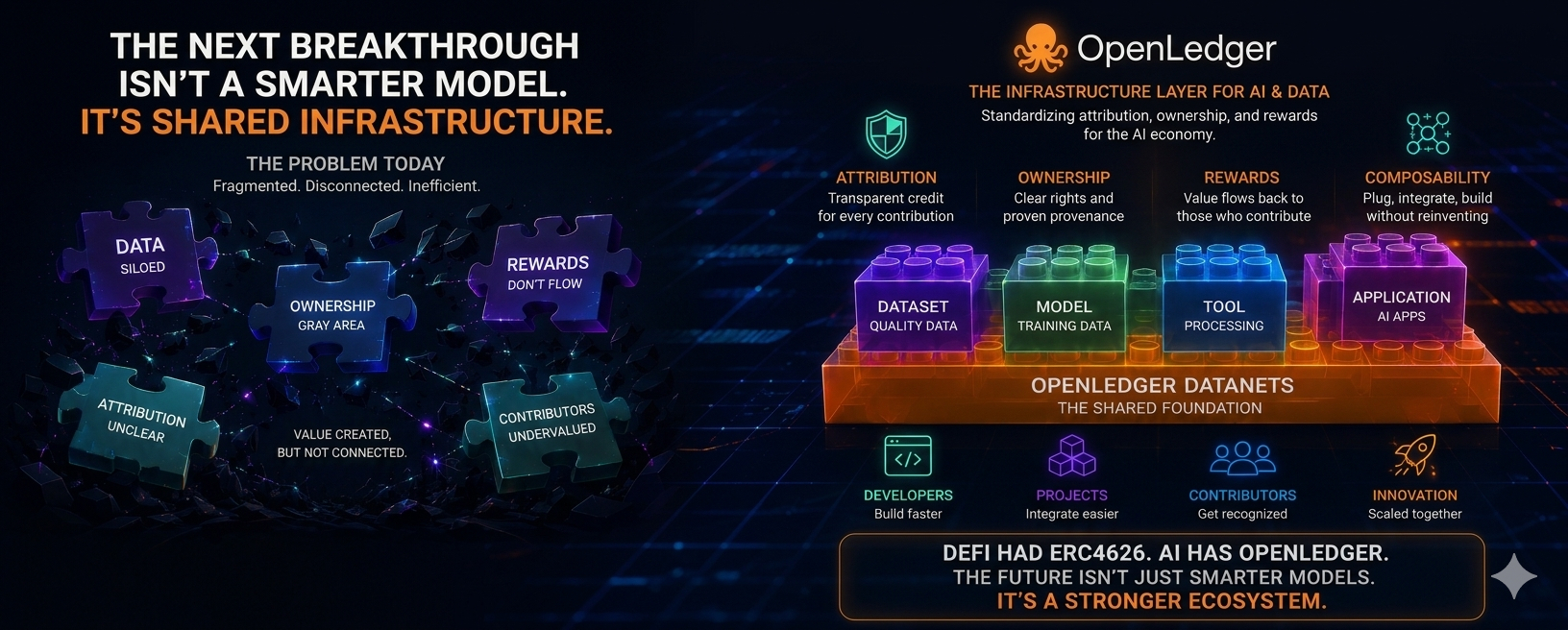
A few nights ago, I was going down a rabbit hole reading OpenLedger docs when I stumbled into a thought I can't seem to shake.
Everyone in AI is obsessed with the same race right now.
Which model will be smarter?
Which one will have more parameters?
Which one will reason better?
Which one will beat the benchmarks?
And honestly... I think a lot of people might be looking in the wrong direction.
That sounds crazy because model performance is what gets the headlines. It's what attracts funding. It's what dominates Crypto Twitter and AI discussions.
But the more I thought about it, the more it reminded me of something I watched happen in DeFi.
Most people remember the yield farming era. The insane APYs. The endless token incentives. The stories of people making life-changing money from protocols that barely existed a few months earlier.
What people rarely talk about is how messy the infrastructure was behind the scenes.
Every vault seemed to work differently.
Every integration required custom work.
Developers kept solving the same problems over and over again.
It wasn't glamorous work. Nobody was making threads about it. Nobody was celebrating it.
Then ERC4626 showed up.
At the time, it looked boring.
No hype.
No flashy narrative.
Just a standard.
But looking back, I think that's exactly why it mattered.
Instead of every protocol speaking a different language, vaults suddenly had a common framework. Developers could build faster. Integrations became easier. New products could plug into existing products without rebuilding everything from scratch.
The breakthrough wasn't yield.
The breakthrough was standardization.
And that's the part that keeps bringing me back to OpenLedger.
The more I look at AI today, the more I see the same fragmentation problem.
Data is everywhere, but it's disconnected.
Contributors create value, but attribution is often unclear.
Ownership exists in a gray area.
Rewards don't always flow back to the people creating the underlying value.
As AI scales, those problems don't disappear. They get bigger.
That's why OpenLedger's approach caught my attention.
What they're building with Datanets feels less like another AI application and more like an attempt to create shared infrastructure.
A common layer.
A system where data contributors, attribution, ownership, and rewards can interact in a transparent way.
Maybe I'm wrong, but it reminds me a lot of what ERC4626 did for capital.
DeFi became powerful when money became composable.
What happens if data becomes composable too?
That's where things get interesting.
People often call DeFi "Money Legos."
I love that description because it's actually true. Builders stopped starting from zero. They could take existing pieces, connect them together, and create something entirely new.
What if AI eventually gets its own version of that?
What if datasets become "Data Legos"?
What if developers can build on top of existing data ecosystems the same way DeFi builders stacked protocols on top of each other?
What if attribution isn't an afterthought anymore, but part of the infrastructure itself?
That's a much bigger idea than simply making a model 5% smarter.
And honestly, I think that's the part many people are overlooking.
The internet didn't become powerful because of a single website.
DeFi didn't become powerful because of a single protocol.
Both became powerful because ecosystems formed around shared standards.
That's where network effects come from.
That's where industries get built.
My personal take?
Everyone is chasing the next breakthrough model.
I think the bigger opportunity might be the layer that allows models, data, contributors, and applications to finally work together without friction.
Because if crypto taught me anything, it's this:
The technologies that change industries aren't always the ones making the most noise.
Sometimes they're the standards quietly connecting everything behind the scenes.
And years later, everyone realizes that was the real innovation all along.