
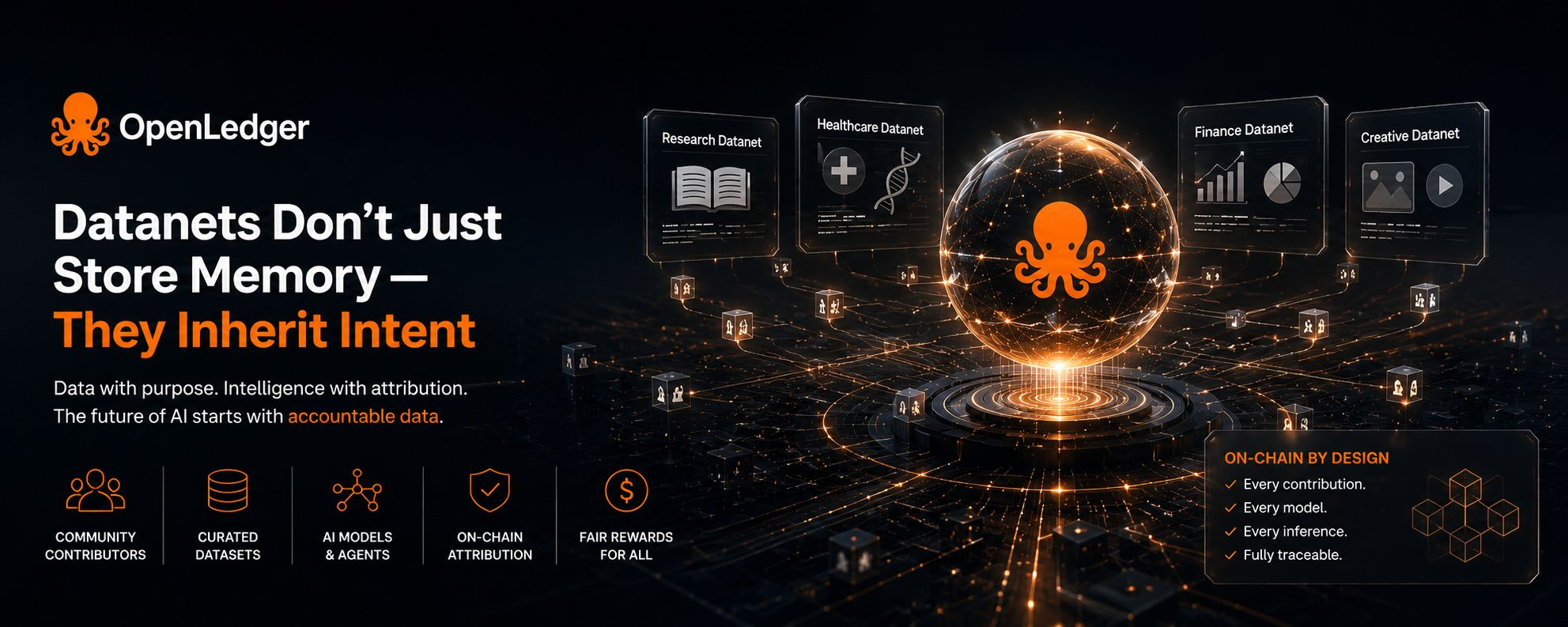

The more time I spend researching OpenLedger, the more I feel that many people are looking at the project through the lens of traditional AI infrastructure when something much deeper may be happening underneath.
Most AI discussions begin with models. How powerful are they? How quickly can they reason? How much data have they consumed? The industry has become obsessed with measuring intelligence itself.
But intelligence has never been the entire story.
What interests me more is the source of that intelligence.
Every AI model learns from data. Every prediction, every response, every insight ultimately traces back to information that was collected, organized, and prioritized by someone. The model may generate the output, but the foundation was built long before the output ever appeared.
This is where OpenLedger's vision starts to feel different.
When people hear the term Datanet, they often imagine a decentralized database or a network that stores information. That explanation is technically correct, but it misses what I believe is the more important idea.
Datanets don't simply preserve information.
They preserve the intent behind information.
Every dataset reflects choices. Someone decided what was worth collecting. Someone decided what was accurate. Someone decided what should be prioritized and what should be ignored.
Those decisions are not neutral.
They shape the intelligence that eventually emerges from the system.
A financial Datanet built by market analysts will produce different outcomes than one built from random internet discussions. A healthcare Datanet curated by medical professionals will carry different assumptions than a general-purpose dataset scraped from public sources.
The knowledge may overlap in some areas, but the intent behind the knowledge is completely different.
That intent becomes part of the intelligence itself.
This is one of the reasons I keep returning to OpenLedger's broader thesis. The project isn't just exploring how AI can access information. It is exploring how contributors, data, models, and economic incentives can remain connected instead of becoming separated.
Historically, the AI industry has operated with a simple flow. People create value. Data gets collected. Models get trained. Platforms capture most of the benefits.
The original contributors often disappear somewhere in the process.
Knowledge enters the system, but attribution rarely follows it.
OpenLedger appears to be approaching this problem from a different direction. Instead of treating data as a disposable resource, the ecosystem treats it as something capable of maintaining attribution, ownership, and economic significance over time.
That matters because AI is rapidly moving toward an agent-driven future.
The next generation of AI will not simply answer questions. Agents will perform tasks, coordinate actions, make decisions, and interact with digital economies. As these systems become increasingly autonomous, understanding where their intelligence originated becomes far more important than it is today.
Trust cannot be manufactured after the fact.
Trust is built through transparency.
If an AI system generates value, people will eventually ask where that value came from. Which datasets contributed? Which communities supplied the knowledge? Which contributors helped create the intelligence that produced the outcome?
These questions become even more important as AI becomes embedded into industries worth trillions of dollars.
What I find interesting about OpenLedger is that it seems to be building around those questions before they become impossible to ignore.
The project's focus on attribution, Datanets, AI agents, and contributor economies points toward a future where intelligence is not viewed as a mysterious black box but as a traceable network of contributions.
And that may ultimately become one of the most valuable properties in AI.
The industry often assumes that bigger models create better outcomes. I'm not convinced that will be the defining advantage forever. Models are becoming more accessible. Compute is becoming more competitive. Intelligence itself is gradually becoming a commodity.
When that happens, differentiation may come from something else.
The strongest systems may not be the ones with the largest models.
They may be the ones built on the richest, most accountable, and most intentional knowledge networks.
That's why the idea of Datanets stands out to me.
Not because they store memory.
The internet already stores more memory than humanity can realistically process.
What matters is the ability to preserve context, incentives, attribution, and purpose alongside that memory.
Because memory tells an AI what happened.
Intent influences what matters.
And in the long run, that difference may define the entire future of the AI economy that OpenLedger is trying to build.