
I'll say this honestly a few nights ago, I was sitting alone with cold coffee beside my keyboard, scrolling through OpenLedger docs while half the city was asleep. The funny thing is, I didn’t even open the whitepaper looking for investment ideas. I opened it because I’ve spent years around AI systems and distributed tech, and lately I can’t shake one uncomfortable feeling:
AI keeps getting smarter, but the people feeding it keep becoming more invisible.
That thought stayed in my head while reading OpenLedger.
At first, I honestly treated it like every other AI + crypto project. Same polished words. Same promises about ownership, decentralization, community contribution, fair rewards. After being in this space long enough, you build immunity to those slogans. Most projects sound revolutionary until you look closely and realize the “community” is just unpaid fuel for someone else’s machine.
But OpenLedger bothered me in a different way.
Not because it looked fake. Because parts of it looked a little too honest.
The deeper I read into the Datanets structure and contribution system, the more I realized this project is not really trying to sell some magical AI utopia. It feels more like an attempt to expose something the current AI industry quietly hides every day:
Machine intelligence is still heavily dependent on human labor.
Not glamorous labor either.
I’m talking about people correcting outputs at midnight. Annotators staring at medical images for hours. Developers cleaning broken datasets. Someone manually fixing edge cases that nobody notices except the model itself.
AI companies love presenting their systems like giant self-evolving brains. But behind every “smart” response is an absurd amount of invisible human effort stitched together over time.
And most of the people doing that work disappear from the story completely.
That’s the part OpenLedger seems obsessed with changing.
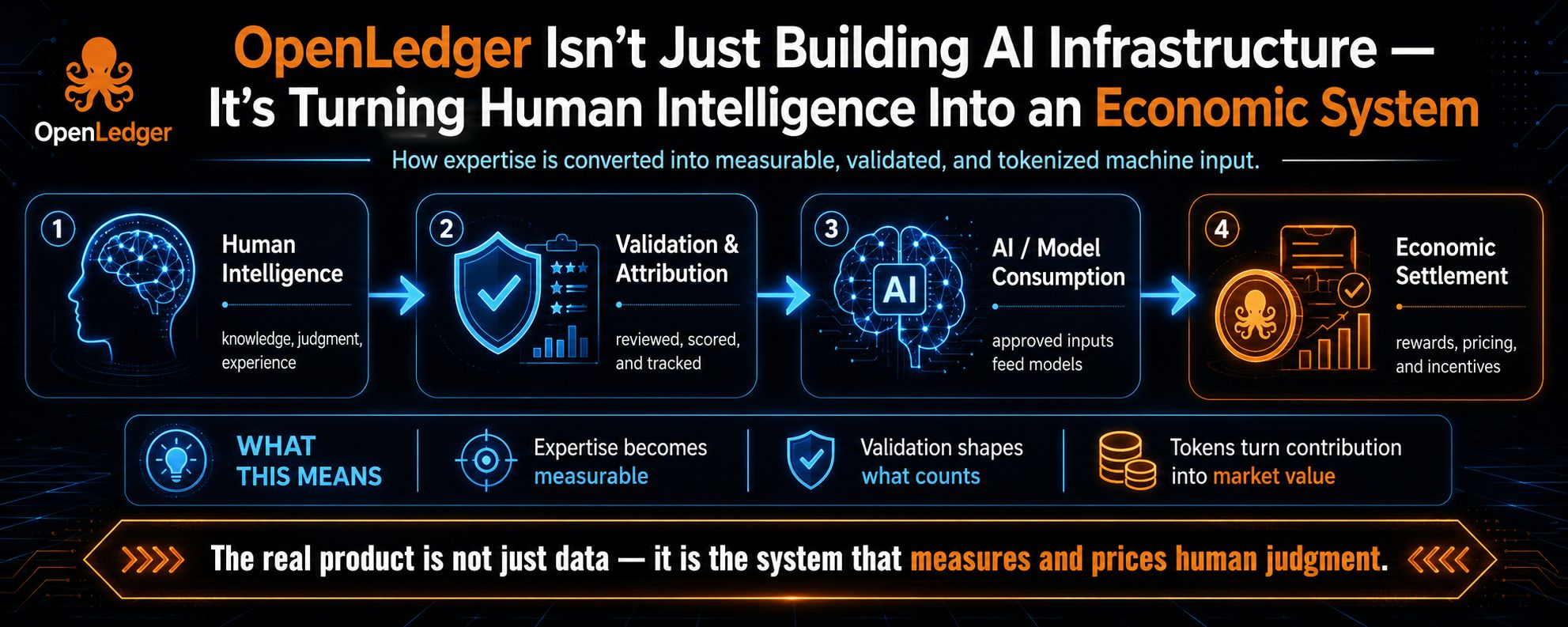
The whole attribution layer basically revolves around one idea: if humans are helping train and improve systems, there should at least be a visible trail connecting contribution to value. Not just emotionally. Economically too.
Honestly, when I first understood that, I thought: “Okay… this actually makes sense.”
Because the current internet is weirdly unfair.
People feed platforms constantly — data, conversations, fixes, behavior patterns, feedback — and somehow the system acts like all that value appeared out of thin air. OpenLedger is trying to build a ledger where contribution leaves fingerprints instead of vanishing into a black box forever.
That sounds fair on paper.
But the longer I sat with it, the more complicated it started feeling.
Because once you begin measuring human contribution, you also begin measuring humans themselves.
That changes the atmosphere completely.
Suddenly knowledge is no longer just knowledge. It becomes scored output. Ranked usefulness. Economic weight.
A correction is no longer “helping improve something.” It becomes a measurable unit. A contributor becomes a data point. Experience becomes infrastructure.
That’s where the project stopped feeling like simple AI infrastructure to me and started feeling more like a new type of labor system.
And I don’t even mean that as pure criticism.
In some strange way, OpenLedger feels more honest than most AI companies precisely because it stops pretending the labor does not exist. At least here, contributors are acknowledged instead of silently absorbed into the machine.
But there’s another side to that honesty too.
Once contribution becomes measurable, people naturally start adapting themselves to the system. They learn what type of work gets rewarded. What kind of submissions validators approve faster. What formats perform well economically. Slowly, contribution stops feeling organic and starts becoming optimized behavior.
We’ve already seen this happen everywhere online.
Social media started as self-expression. Then algorithms arrived. Eventually people stopped posting naturally and started posting for metrics.
I can’t help wondering if AI contribution economies slowly create the same psychological effect.
Not overnight. Quietly.
The validator layer especially kept bothering me while reading. Most people describe validators like security guards keeping bad data out. But honestly, they feel more like invisible editors shaping what kind of human intelligence becomes economically valuable inside the system.
That matters more than people think.
Because once a network decides what counts as “quality,” it also quietly decides what kinds of thinking deserve visibility and reward. Structured knowledge may win. Safe contributions may outperform creative ones. Weird but brilliant insights might get ignored simply because they are harder to score consistently.
And none of this even requires bad intentions.
It’s just what happens when human behavior collides with incentives.
The weird thing is, I don’t think OpenLedger is trying to create some dystopian system. If anything, the project feels like a very realistic response to the direction AI is already heading. The current model is already extracting human intelligence constantly. OpenLedger simply tries to document the extraction instead of hiding it.
Maybe that’s better. Maybe it’s also scarier.
Because once human expertise becomes permanently trackable and economically attached to identity, participation changes emotionally too. You’re no longer casually contributing to the internet. You’re building a visible economic history around your own thinking.
That’s a very different future from the internet most of us grew up with.
And honestly, I still don’t know whether that future feels empowering or exhausting.
Part of me respects the realism of the project. Unlike the usual AI hype, it doesn’t pretend blockchain will magically replace giant compute infrastructure. It understands the expensive part of AI will probably stay centralized for a long time. So instead of trying to own the machine itself, it focuses on organizing the human layer around the machine.
That’s smart.
But another part of me keeps wondering what happens when every piece of human judgment eventually needs to justify its economic value to a network.
What happens when curiosity becomes contribution? When experience becomes measurable? When helping improve a system slowly turns into another form of digital labor?
Maybe OpenLedger is building something important. Maybe it’s simply revealing what the future of AI already looks like underneath the marketing.
And honestly, that’s the reason I can’t stop thinking about it.
Because for the first time in a while, an AI project didn’t make me ask, “Can this technology work?”
It made me ask something much more uncomfortable:
If every part of human intelligence can eventually be tracked, priced, and rewarded by systems… will we still know how to create things without thinking about our market value first?