
People often call data “the new oil,” but most of the time nobody really explains how that value should move, who should earn from it, or how ownership should actually work.
That confusion becomes even bigger when AI enters the conversation.
Right now, almost every week a new AI project appears. Some get attention because of hype, some because of narratives, and some because traders simply expect momentum. But underneath all of that, there is still one important question the market has not fully solved:
How do data, models, and AI agents create real economic value in a transparent way?
That is the reason OpenLedger caught my attention.
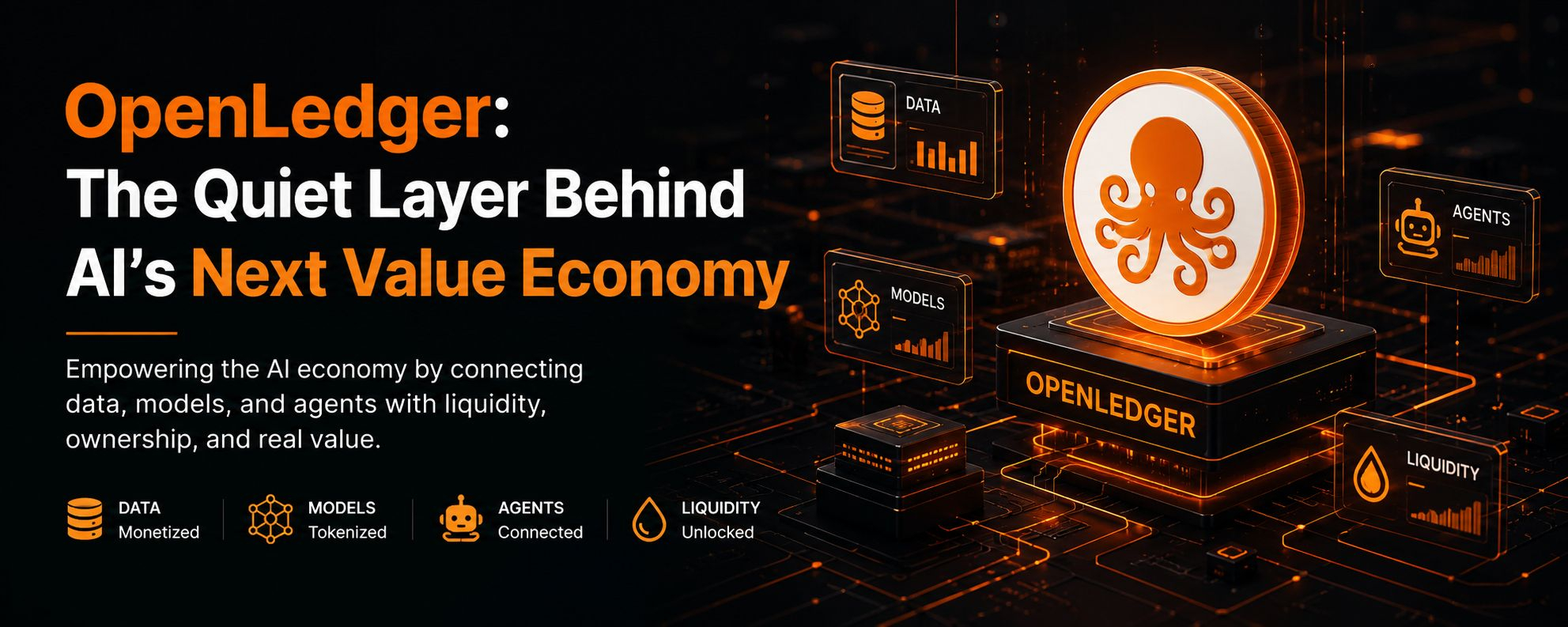
From what I understand, OpenLedger is trying to build infrastructure where AI data, models, and autonomous agents can be connected to an actual value system. In simple words, it is attempting to create a blockchain layer where contributors, developers, and AI systems can interact economically instead of operating in disconnected environments.
It is not the easiest concept to explain in one sentence.
But the direction behind it feels important.
I do not want to overhype the project.
Crypto has already shown us many platforms with strong marketing but weak execution. Good narratives alone do not create demand, liquidity, or long-term adoption.
So I still look at OpenLedger with both curiosity and caution.
The interesting part for me is not just the “AI blockchain” label.
It is the larger question behind the idea.
If AI agents begin handling more work in the future — whether that is content generation, automation, decision-making, research, or financial interaction — then questions around ownership become extremely important.
Who owns the data? Who gets rewarded for useful models? How do we track where intelligence and value actually came from? And how do contributors participate fairly in that economy?
These are not small questions anymore.
I think the market still treats most AI projects as short-term narratives instead of possible infrastructure layers.
But infrastructure is usually understood late.
For regions like Asia and the Middle East, this conversation could become even more relevant over time. Local AI models, local languages, digital identity, payments, and trusted data systems may eventually matter far more than people currently expect.
A network that can organize, verify, and monetize those layers could become valuable — but only if real adoption happens.
And that is the hard part.
Execution.
Liquidity is not created by ambitious words. Real ecosystems are built through users, developers, contributors, and actual demand.
That is why I still see OpenLedger as a quiet project to watch rather than something to blindly chase.
Not because it promises everything.
But because it touches a problem that may grow much bigger with time.
Sometimes the market notices these things late.
And maybe that is the real question surrounding OpenLedger right now.
Is the market simply looking at another AI token?
Or is it slowly starting to look at a new framework for value, ownership, memory, and coordination inside the future AI economy?
