
OpenLedger is one of the few projects lately that made me stop scrolling and actually think for a while.
Not because it promised something impossible.
Not because it claimed to be the fastest chain ever created.
And honestly, not even because of the AI angle itself.
What caught my attention was something much smaller and much more important.
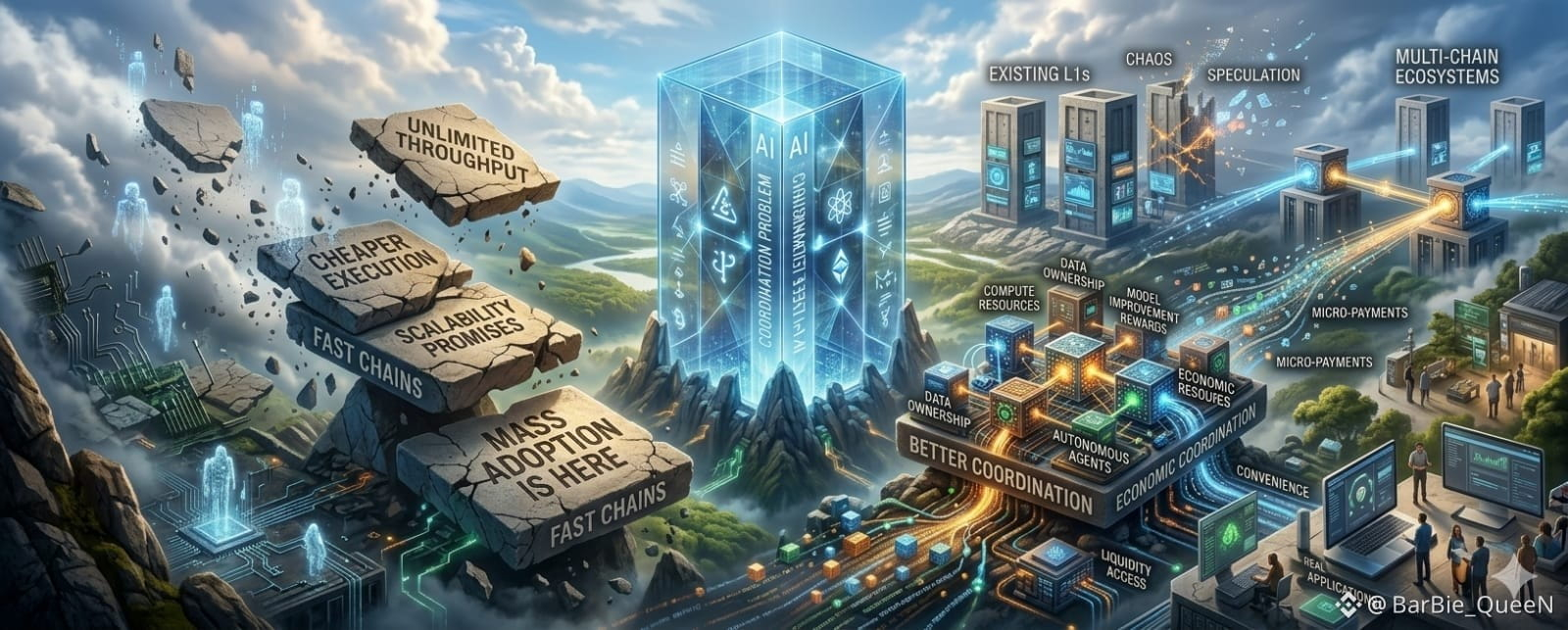
It feels like the project is trying to solve a coordination problem most of the industry still treats like background noise.
I’ve been thinking about this a lot recently:
what are we actually building in crypto anymore?
Because if we are being honest, the industry has spent years repeating the same Layer 1 cycle over and over again. A new chain appears. It promises better throughput, lower latency, cheaper execution, smoother scalability, better developer experience, and some version of “mass adoption is finally here.”
Then real users arrive.
And suddenly the conversation changes completely.
That’s the part people still underestimate. Infrastructure rarely breaks during presentations or benchmark demos. Systems usually break when human behavior enters the picture. Panic. Speculation. Meme coin mania. Liquidations. Traffic spikes. Emotional trading. Thousands of users trying to move at the same time.
That’s the real stress test.
I think crypto sometimes forgets this because the industry became too focused on theoretical performance instead of social pressure. But real adoption has always been emotional before technical.
People don’t experience blockchains through whitepapers.
They experience them during chaos.
And after enough cycles, you start noticing something uncomfortable:
most Layer 1 discussions sound almost identical now.
The names change.
The narratives change.
But the structure stays the same.
That’s probably why the phrase “AI blockchain” immediately makes many people skeptical today. The industry attached AI to almost everything over the last two years. Suddenly every product became AI-powered. Every roadmap became agent infrastructure. Every ecosystem claimed it was building the future of intelligence coordination.
Most of it sounded impressive until you asked a simple question:
where does real usage come from?
That’s where OpenLedger started feeling slightly different to me.
Not because it magically solved AI.
But because underneath the futuristic language, the project seems focused on something surprisingly practical:
how data, compute, models, and machine-driven contributions get coordinated economically.
And honestly, boring problems are usually the real problems.
If AI systems continue becoming economically important, then ownership becomes messy very quickly. Who owns the data feeding these systems? Who gets rewarded when models improve? Who contributes resources? Who captures value when autonomous systems interact with each other financially?
Existing infrastructure can technically support parts of this already, sure.
But most networks were originally designed around financial activity first. Trading. Lending. Settlement. Speculation. Everything else got layered on afterward.
OpenLedger feels like it’s approaching things from the opposite direction.
Instead of treating data and AI contribution as secondary application behavior, the project seems to treat them as native economic activity from the beginning.
That distinction matters more than people think.
At the same time, I don’t think any of this guarantees success.@OpenLedger
Crypto has a long history of technically intelligent systems that never reached meaningful adoption. People love talking about architecture as if good engineering automatically creates users. But users rarely move because something is technically elegant.
They move because liquidity is there.
Attention is there.
Applications are there.
Convenience is there.
Liquidity has memory.
Users do too.
That’s why migration is brutally difficult even when new infrastructure works well.
And this becomes even more important now that the industry is slowly accepting something many maximalists hated admitting for years:
the future probably becomes multi-chain.
Not one dominant network controlling everything.
Not one universal winner.
Just different systems specializing in different types of activity while liquidity moves between them.
In theory that sounds realistic.
In practice it still feels messy.
Bridges create friction.
Liquidity fragments.
User experience breaks apart.
Coordination becomes difficult.
Most ordinary users still hesitate when moving assets across ecosystems because complexity creates uncertainty very quickly.
OpenLedger seems to operate under the assumption that specialized infrastructure connected through broader liquidity systems is more realistic than trying to become the single chain replacing everything else.
Personally, I think that assumption feels healthier than older “Ethereum killer” style thinking.
But specialization creates pressure too.
Because if you are not the center of gravity, then execution quality matters even more. You need a very clear reason for developers, users, and liquidity to route through your ecosystem at all.
And execution is where most crypto stories quietly collapse.
Not because every founder lacks intelligence.
But because building infrastructure, maintaining performance, attracting developers, coordinating incentives, and surviving after the excitement disappears is extremely difficult.
The real challenge for Layer 1s now is not launching.
It’s surviving long enough to become useful after attention fades away.
That’s the phase where you discover whether a network is infrastructure or decoration.
I don’t think OpenLedger looks unserious.
If anything, it feels more grounded than many AI-chain narratives floating around lately. Less obsessed with sounding infinite. More focused on a specific coordination problem that could become more important over time.
Still, uncertainty remains everywhere.
Maybe AI-native economies eventually need infrastructure designed around machine coordination and contribution systems.
Or maybe centralized platforms continue dominating because users consistently choose convenience over decentralization.
Both outcomes feel realistic to me.
And honestly, that uncertainty is probably the healthiest way to think about projects like this now.
Not blind optimism.
Not automatic dismissal.
Just observation.
Because sometimes the most important infrastructure starts quietly, solving problems most people still don’t fully notice yet.
What do you think crypto is actually missing right now: faster chains or better coordination?
Do AI-native economies eventually need their own infrastructure layer, or will existing ecosystems absorb everything over time?
And maybe the biggest question is this:
are we building systems people truly need…
or just creating new narratives every cycle and hoping users eventually follow them?
Right now, I think OpenLedger sits somewhere inside that uncertainty.
And that’s exactly why I’m still watching it.
$OPEN @OpenLedger #open #OpenLedger
