
For the last few years, the conversation around artificial intelligence has been dominated by capability. Every new model is judged by the same criteria: Is it smarter? Is it faster? Can it reason better? Can it generate higher-quality outputs? The entire industry seems obsessed with intelligence itself. Yet the more time I spend thinking about AI, the less convinced I become that intelligence is the biggest challenge ahead. What increasingly captures my attention is something much less visible: traceability.
Not because traceability sounds exciting. Most people rarely think about it at all. But the more powerful and interconnected AI systems become, the easier it becomes for contributions to disappear. And that disappearance may eventually become one of the most important problems in the entire AI economy.
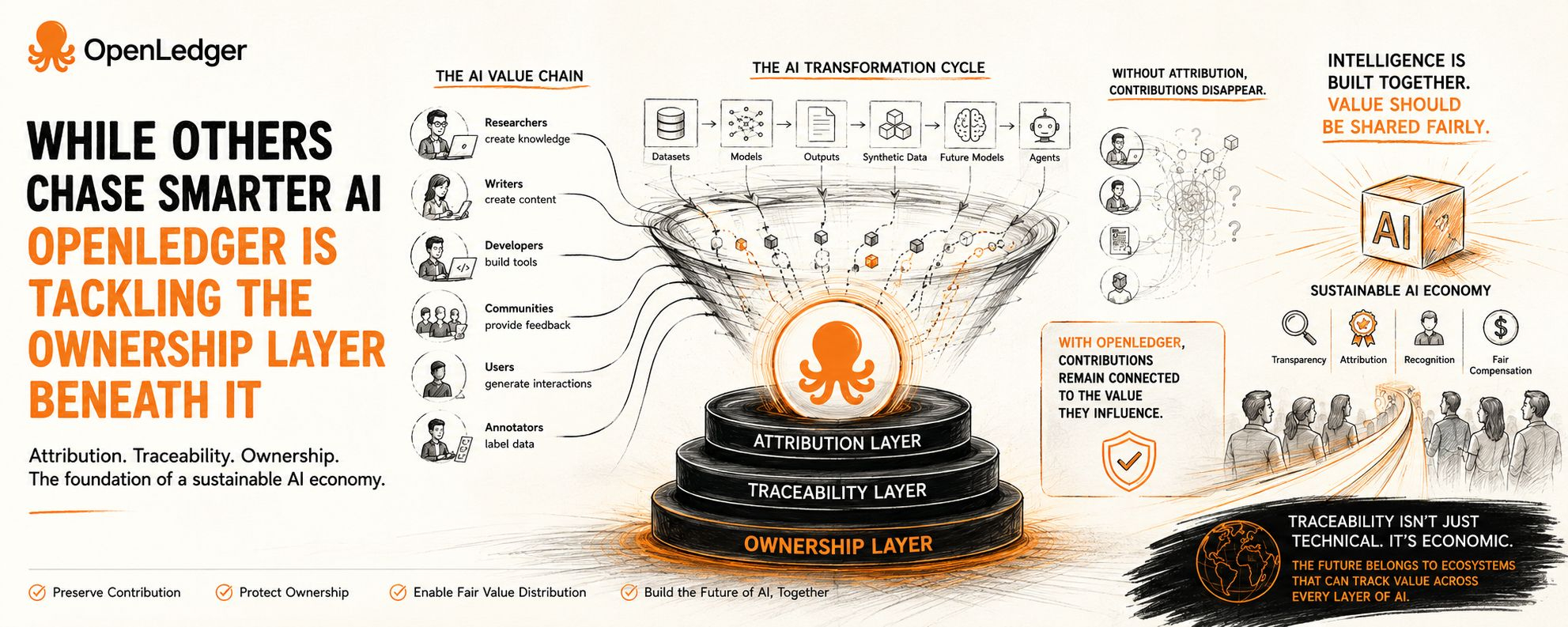
Modern AI systems no longer operate as isolated models. They exist inside layers of continuous interaction. Datasets train models. Models generate outputs. Outputs become synthetic datasets. Those datasets influence future models. Future models power agents. Those agents generate new information that enters the ecosystem again. The cycle continues indefinitely. What begins as a single contribution can travel through dozens of transformations before anyone sees the final result. The output remains visible, but the path that created it slowly disappears.
That is where attribution begins to break down. Consider how much human effort already exists inside modern AI systems. Researchers publish knowledge. Writers create content. Developers build tools. Communities provide feedback. Users generate interactions. Annotators label information. Millions of people contribute small pieces of value every day. Yet once those contributions enter large-scale AI systems, they often become impossible to identify. The intelligence remains, but the contributors fade into the background.
At first this may not seem important. After all, AI systems are designed to generate results, not preserve history. But the economics become harder to ignore as AI grows more valuable. If AI becomes a major source of economic output, obvious questions emerge. Who created the underlying value? Who contributed the data? Who improved the system? Who deserves recognition? Who deserves compensation? These questions become increasingly difficult to answer when attribution disappears after every transformation.
The challenge becomes even more complex as synthetic data expands. AI-generated outputs are increasingly becoming training material for future systems. Models learn from other models. Information loops back into itself. The line between original creation and derived creation becomes harder to identify. In that environment, reuse often spreads faster than attribution. Influence expands while recognition contracts. Over time, the ecosystem risks losing track of where value originated in the first place.
That is why projects focused on attribution continue to catch my attention. Not because attribution solves every problem. It does not. But preserving contribution may become foundational to building sustainable AI economies. The idea is surprisingly simple. What if contributions remained connected to the value they influenced? What if reuse did not automatically erase origin? What if participation remained visible even after countless layers of transformation?
These questions sound technical on the surface, but they are fundamentally economic questions. Every mature economic system eventually develops mechanisms for ownership, accountability, and value distribution. AI will likely be no different. The future may not belong exclusively to the most intelligent models. It may belong to the ecosystems capable of tracking value creation across increasingly complex networks of contributors, datasets, models, and agents.
That possibility has changed how I think about AI entirely. For a long time, I viewed AI primarily as a race toward greater intelligence. Now I increasingly see it as a coordination challenge. The next breakthrough may not come from another benchmark score. It may come from solving attribution at scale.
Because once intelligence becomes infrastructure, knowing where value came from may become just as important as the intelligence itself. And in a world where AI systems continuously build upon one another, traceability may be the mechanism that prevents contribution from disappearing into the background forever.
@OpenLedger #OpenLedger $OPEN $LAB $ID