
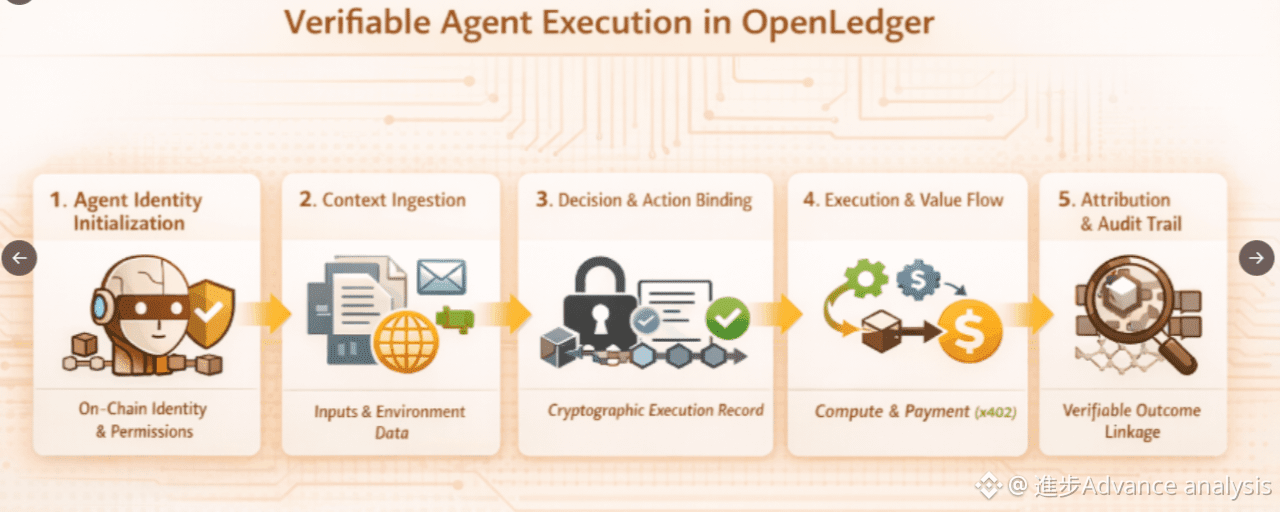

(A) Agent Identity Initialization It all starts with identity.
Before an AI agent can perform any task it acquires an on chain identity with permissions. This creates clear rules about what the Agent can access or perform.
Why this is important : Without identity and permissions autonomous Agents become difficult to control .
(B) Context Ingestion
The agent collects inputs from multiple sources.
This may include:
✔ datasets
✔ external tools
✔user instructions
✔environmental data
✔ APIs and external systems
The goal is to provide the agent with context before making decisions.
(C) Decision & Action Binding
This is where things become more interesting. Instead of actions happening invisibly the image suggests that decisions create cryptographic execution records .
In simple terms : Decision Record Verification This creates evidence that actions actually occurred .
(D) Task Execution and Value Flow
After the decision is approved, the agent performs various tasks.
The figure shows that task execution is directly linked to economic activity:
✅Compute resources
✅Payments
✅Value transfers
✅Automated operations
This creates an environment in which agents can potentially participate in the economic system.
(E) Attribution and Audit Trail
The final stage focuses on traceability.
The system attempts to establish links between:
Who performed the tasks
What inputs influenced the outcomes
What value was created
How decisions were made
What results are called verifiable outcome linkages in the diagram.
👍👍Why this matters
Most AI systems today operate like black boxes.
This workflow represents a different model:
Introduction - Context - Decision - Action - Imposition
The big idea is simple:
As AI agents become more autonomous, transparency becomes more important.
The challenge is no longer just to create intelligent agents.
But to create agents whose actions can be verified, audited and trusted.
@OpenLedger #OpenLedger #open $OPEN
