
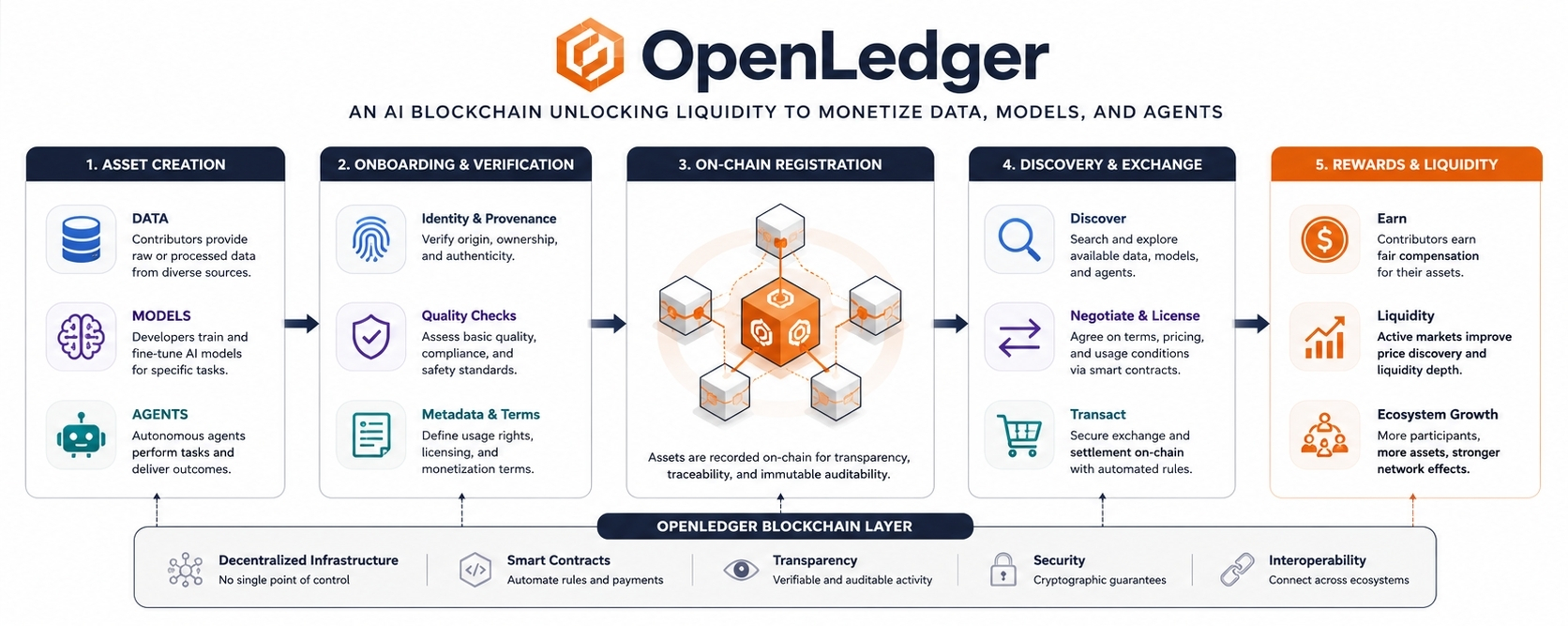
OpenLedger is built around an idea that sounds obvious once you hear it: if data, AI models, and autonomous agents create value, the people who contribute them should have a way to earn from that value. The challenge is that turning this idea into a working system is much harder than it first appears.
Most discussions about AI focus on what the technology can do. Far less attention is given to how the people and systems behind that technology coordinate with one another. Data comes from somewhere. Models are trained by someone. Agents rely on infrastructure, resources, and ongoing maintenance. Value is created by many participants at once, which makes it difficult to determine who should be rewarded and by how much.
This is where OpenLedger enters the picture. As an AI-focused blockchain, it aims to create a framework where data, models, and agents can be tracked, exchanged, and monetized through decentralized infrastructure. The goal is not simply to store information on a blockchain. The larger objective is to make AI assets behave more like assets in a functioning economy, where ownership, contribution, and value can be recognized more transparently.
That sounds straightforward in theory. In reality, economies are rarely straightforward.
I often think about systems like this the same way I think about a city's road network. On a quiet afternoon, everything appears efficient. Cars move smoothly, intersections stay clear, and travel times seem predictable. But the true quality of the system only becomes visible when something goes wrong. A storm arrives, an accident blocks a major route, or thousands of people suddenly need to travel at the same time. The pressure reveals weaknesses that were hidden during normal conditions.
OpenLedger faces a similar challenge.
When participation is relatively low and incentives are aligned, coordination feels easy. Data providers contribute information. Developers build models. Agents perform tasks. Rewards are distributed. The system appears balanced.
The real test begins when growth introduces complexity.
More participants mean more competing interests. More activity means more demand on infrastructure. More value flowing through the network means stronger incentives to exploit loopholes or maximize personal gain. None of this requires bad actors. It is simply how economic systems behave when people respond to incentives.
One of the most difficult problems is that AI assets are not naturally uniform.
A share of stock is relatively easy to value because everyone is trading the same thing. Data is different. One dataset may dramatically improve an AI model while another adds very little value. Two models might perform similarly in testing but behave very differently in real-world environments. Agents may complete the same task in completely different ways, with varying levels of efficiency and reliability.
Because of this, measuring contribution becomes far more complicated than recording activity.
A blockchain can show that someone submitted data. It can show that a model was used. It can show that an agent completed a transaction. What it cannot automatically determine is whether those actions created meaningful value.
That distinction matters more than it may seem.
A system that rewards participation without accurately measuring usefulness can gradually encourage the wrong behavior. People naturally optimize for whatever the system rewards. If rewards are based primarily on volume, participants may focus on producing more rather than producing better. If evaluation becomes too strict, however, contributors may lose motivation to participate at all.
There is no perfect balance.
Every design decision creates trade-offs. Simplicity improves accessibility but may reduce accuracy. Precision improves measurement but often increases complexity. OpenLedger, like any large-scale coordination system, must constantly navigate this tension.
The challenge becomes even more visible during periods of stress.
When demand increases, networks become busier. Transactions take longer. Verification processes face greater pressure. Small inefficiencies that once seemed insignificant can suddenly affect the user experience in noticeable ways.
I've seen this happen repeatedly across digital systems. Rarely does a platform struggle because of one dramatic failure. More often, problems emerge through accumulation. A slight delay becomes a workflow disruption. A workflow disruption creates frustration. Frustration reduces participation. Reduced participation affects liquidity and confidence.
The process is gradual, but its effects can be significant.
Trust plays a central role here.
Many people think of blockchain systems primarily as technological structures, but in practice they are also trust systems. Participants need confidence that contributions will be recognized fairly. Developers need confidence that the rules will remain predictable. Users need confidence that the assets they interact with are authentic and valuable.
Technology can support that trust, but it cannot fully create it.
A ledger can provide transparency. Smart contracts can automate processes. Decentralized infrastructure can reduce dependence on centralized intermediaries. Yet none of these mechanisms can completely remove uncertainty. Data quality can still vary. Models can still produce unexpected results. Agents can still behave in ways that create friction or unintended consequences.
This is not a flaw unique to OpenLedger. It is a reality faced by every attempt to organize complex human and technological activity at scale.
What makes OpenLedger interesting is that it acknowledges a problem many industries are only beginning to confront. AI is becoming increasingly valuable, but the systems used to distribute that value remain fragmented. Data exists in one place, models in another, and economic incentives somewhere else entirely. Connecting these pieces into a coherent framework is a difficult coordination challenge.
The success of such a framework depends less on whether everything works perfectly and more on how the system responds when things stop working perfectly.
Can it handle disagreement over value attribution? Can it maintain efficiency as activity grows? Can it adapt when incentives evolve in unexpected directions? Can it continue functioning when participants behave according to their own interests rather than idealized assumptions?
Those questions matter because real-world systems are rarely tested under ideal conditions.
Markets become emotional. Users become impatient. Infrastructure experiences strain. Priorities shift. What appears elegant on paper often looks very different when exposed to scale and uncertainty.
In many ways, OpenLedger's long-term challenge is not technological alone. It is organizational. The network must coordinate contributors, developers, data providers, model creators, and autonomous agents that may all have different goals. That is a remarkably complex task.
Yet that complexity is also what makes the project worth paying attention to.
The future of AI will likely involve far more than models alone. It will involve ecosystems of data, intelligence, and autonomous systems interacting continuously. If those ecosystems are going to function efficiently, they need mechanisms for ownership, compensation, and coordination.
OpenLedger represents one attempt to build those mechanisms.
Whether any single design ultimately succeeds remains uncertain. What is clear, however, is that creating liquidity around AI assets is not simply a technical problem. It is a human problem, an economic problem, and a coordination problem all at once.
And as with most complex systems, the real story is not how it behaves when conditions are perfect. The real story is how it holds together when they are not.