

I’ve spent some time watching how wallets are changing in Web3, and honestly, this partnership between Trust Wallet and @OpenLedger feels like more than just another tech integration.
Trust Wallet’s already massive over 200 million people use it to stash, manage, and send their crypto. From total beginners poking around their first dApp to hardcore DeFi folks juggling portfolios across nine chains, people trust Trust Wallet for its simple design, solid security, and surprising accessibility.
Now, they’re teaming up with OpenLedger’s verifiable AI stack in a move that could turn Trust Wallet into the first real AI-native self-custody wallet. Imagine controlling your wallet with plain language just telling it what you want to do and having personalized, onchain automation running transparently, without ever giving up your keys.
That’s a bigger deal than most realize.
As Web3 matures, it’s clear that intelligence actual smarts is becoming the new interface. But crypto isn’t just about cool features. If AI turns into an opaque, black box, it runs straight into what Web3 stands for: transparency and user control.
Let’s be honest, using Web3 is still clunky. Switching networks, comparing bridges, fumbling with contract addresses, re-reading approvals before you sign these hassles never seem to go away. Even seasoned users regularly worry: Am I approving the right token? Is this just a permit, or am I giving access to everything? Is this the best route, or am I missing a cheaper one?
That friction? It keeps regular people out.
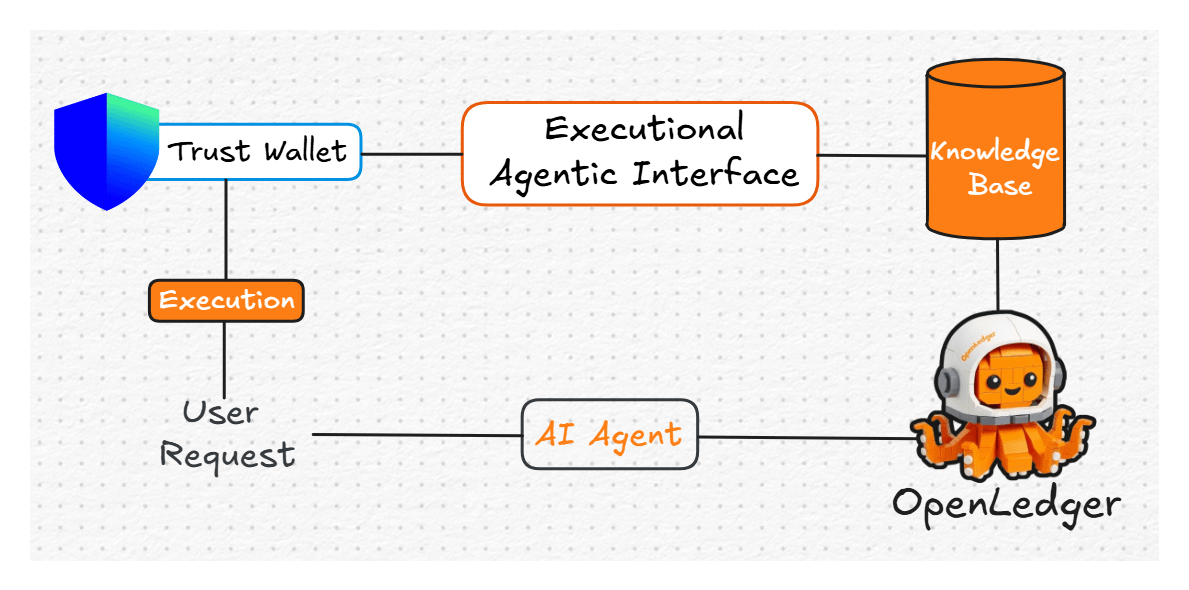
What’s cool about this partnership is that OpenLedger isn’t just layering on convenience. Their AI is actually verifiable and explainable. Every AI-driven suggestion whether it’s swapping tokens, optimizing gas, or picking a dApp route stays transparent and attributable, right onchain. Nothing’s hidden or automatic behind closed doors.
That flips the usual AI role on its head.
Instead of pushing people aside, the AI here sharpens your decisions but keeps you in the driver’s seat. Automation lends a hand, but you call the shots.
As Trust Wallet’s CEO, Eowyn Chen, put it: “We’re excited to explore how AI can simplify and personalize the wallet experience, while staying true to our mission of self-custody and user ownership.”
That’s perfectly in line with OpenLedger’s whole idea: build AI systems that aren’t just clever they’re provable, fair, and accountable.
So what could this actually mean for Trust Wallet? Let’s break it down:
First, conversational UX. Instead of wading through endless menu trees, you just type something normal like, “Swap my ARB for USDC on the cheapest route” and the wallet takes care of the rest, no sweat.
Next, context-aware smarts. The AI learns your habits and gives tips tailored to you like pinging you when rewards are ready to claim, flagging high gas, or surfacing DeFi moves that fit your style.
Third, smooth onchain execution. Complicated tasks, like bridging, staking, or stringing together multi-hop swaps? AI agents handle them, out in the open and easy to trace.
And finally, true transparency. Every step is explainable and auditable. You always know why a recommendation came up, and what logic the AI followed.
For me, this is the turning point wallets stop acting like glorified vaults and start becoming smart execution layers for your Web3 life.
But the biggest change? OpenLedger’s architecture actually keeps the whole thing open and verifiable.
Most projects bake in convenience first and worry about transparency later. Not here. OpenLedger designed its AI to be “trustless” from the start. You can cryptographically prove every suggestion, every action, right back to specific models and datasets, thanks to their Proof of Attribution system.
Basically, you’re not getting a generic assistant making mysterious choices. You’re getting an AI co-pilot on your side, not taking over.
Little by little, plain language replaces scary technical steps.
AI helps with the heavy lifting, but you stay in charge.
And everything remains clear and traceable.
Honestly, that’s about as Web3 as it gets.
Zooming out, the long-term vision is even wilder. This isn’t just about slapping a chatbot onto a wallet. Imagine actual AI agents, running inside your wallet, that know your onchain habits, spot DeFi moves as they fit your style, warn you before bad approvals, and handle repetitive stuff while every action stays user-controlled and transparent.
Stack that with Trust Wallet’s existing user base and security features, and you’re talking about a new kind of crypto experience: faster, sharper, tailored to you, and truly self-custodial.
We’re moving from wallets that just hold assets to wallets that help you interact intelligently with everything in Web3.
And if #OpenLedger really manages to bring explainable and verifiable AI to mainstream wallets like Trust Wallet, we might look back at this as a quiet but major shift in crypto infrastructure.
