
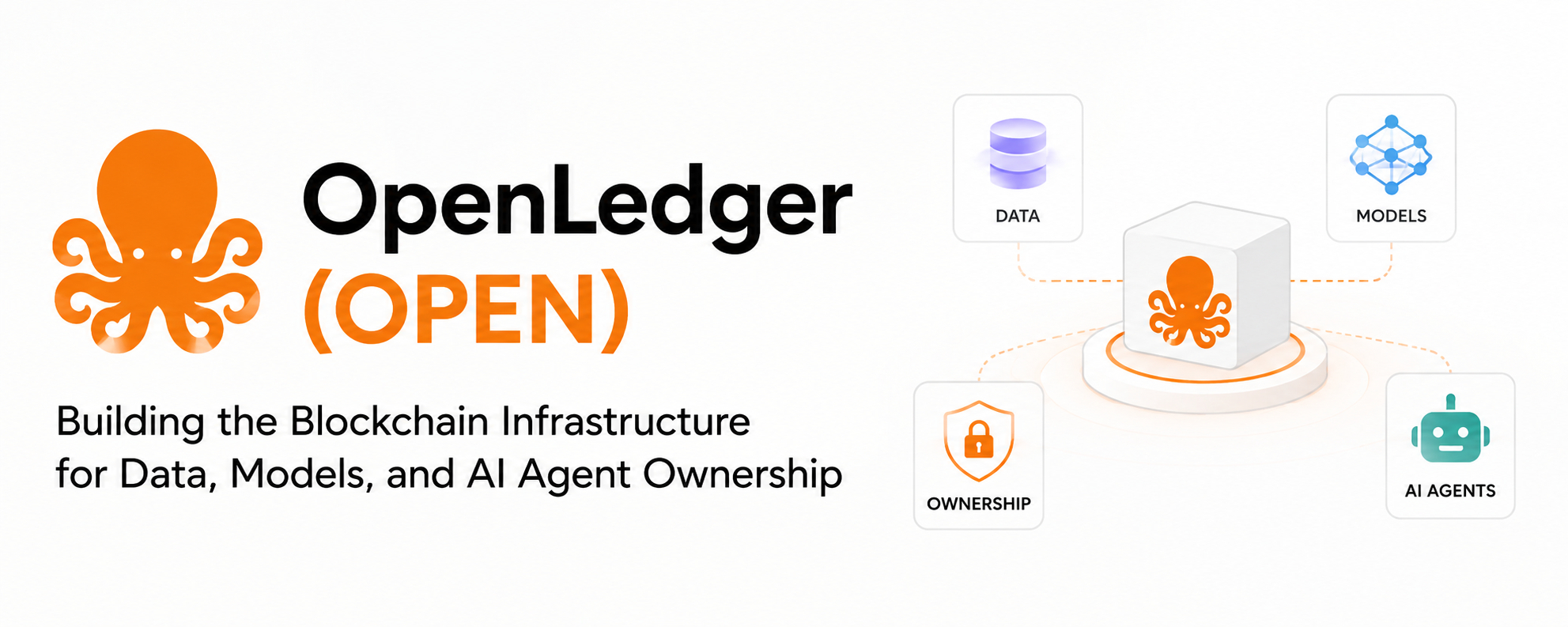
When I look at the current AI landscape, one problem becomes obvious very quickly. Data creates models, models create intelligence, and intelligent agents create outcomes, yet the economic value generated across this stack is often fragmented. The people producing data, building models, and operating AI systems do not always have clear mechanisms to capture value from their contributions. As AI becomes more integrated into digital infrastructure, this disconnect becomes increasingly important. From my perspective, the idea behind OpenLedger is an attempt to address this economic gap by treating data, models, and agents as assets that can participate in a shared liquidity layer.
What interests me is not simply the combination of AI and blockchain. Many projects use those two terms together. The more important question is why a blockchain is needed in the first place. In the context of OpenLedger, the blockchain appears to function as an economic coordination layer. Rather than focusing only on transactions, the network is positioned around the movement of value between contributors and consumers of AI resources. That changes the role of the blockchain from a settlement network into a marketplace infrastructure for intelligence-related assets.
At a conceptual level, OpenLedger is built around three components: data, models, and agents. These are not independent pieces. They form a production chain. Data serves as the input, models transform that input into intelligence, and agents use that intelligence to perform actions. Most AI systems already follow this structure. The difference here is that OpenLedger attempts to make each layer economically visible and potentially monetizable.
The focus on liquidity is particularly important. In traditional financial markets, liquidity allows assets to be exchanged efficiently without requiring direct negotiation between every participant. OpenLedger appears to apply a similar idea to AI resources.
Instead of treating datasets, models, or agents as isolated products, the network seeks to create conditions where these resources can move through a broader economic system. The objective is not simply ownership. The objective is enabling value transfer around AI activity.
From a builder's perspective, this design addresses a practical challenge. Developing useful AI systems requires continuous access to resources. Data providers want compensation. Model creators want sustainable revenue. Agent operators need incentives to maintain performance. Without economic alignment, ecosystems often struggle to retain contributors over long periods.
By introducing liquidity mechanisms around these assets, OpenLedger is attempting to create stronger connections between contribution and reward.
Another aspect worth considering is how this changes developer behavior. Developers often build where economic incentives are predictable. If a system allows contributors to capture value directly from the resources they create, participation becomes easier to justify. In theory, this can encourage more specialized data creation, more focused model development, and more experimentation with autonomous agents.
The blockchain itself becomes less important than the economic framework it enables.
A useful way to think about this is through a real-world example. Imagine a developer creates a specialized AI model designed for a particular industry workflow. That model requires unique datasets collected by another group and is eventually deployed through an agent operated by a third participant. In many environments, coordinating value distribution across these contributors can become complicated.
The architecture suggested by OpenLedger is attempting to place these relationships inside a shared economic system where each component can be recognized and monetized according to its role.
This approach also reflects a broader shift occurring within AI infrastructure. The market is gradually moving beyond simple model development. Attention is increasingly focused on the entire lifecycle of intelligence production. Data quality, model performance, and agent execution all contribute to final outcomes. Networks that acknowledge this full chain may be better positioned than systems that focus on only one layer.
OpenLedger appears to recognize that intelligence is not created by models alone.
At the same time, there are structural risks that should not be ignored. Liquidity is valuable only when there is meaningful demand. Creating mechanisms for monetization is easier than creating sustainable usage.
If participants do not see clear benefits from acquiring data, models, or agent services through the network, liquidity can remain limited despite strong technical design. Economic systems ultimately depend on active participants rather than architecture alone.
There is also the challenge of quality. Not all data is useful. Not all models are effective. Not all agents produce reliable outcomes. Any system built around monetization must eventually solve the problem of distinguishing valuable contributions from low-quality ones.
Without credible methods for evaluating resources, economic incentives can become misaligned and reduce overall network efficiency.
From my perspective, the most important aspect of OpenLedger is that it frames AI infrastructure as an economic problem rather than purely a technical one. The project is not only concerned with how intelligence is created. It is concerned with how value moves between the people and systems involved in creating it.
That distinction matters because many of the challenges facing AI today are increasingly connected to ownership, incentives, and resource allocation.
Whether this infrastructure succeeds over time will depend less on the existence of a blockchain and more on the strength of the economic relationships built around it. If data providers, model builders, and agent operators all find measurable value in participating, the network could develop durable utility.
If those relationships fail to create meaningful activity, the liquidity layer becomes far less relevant. In the end, the long-term test for OpenLedger is not whether it can tokenize AI resources, but whether it can create a functioning economy around them.
