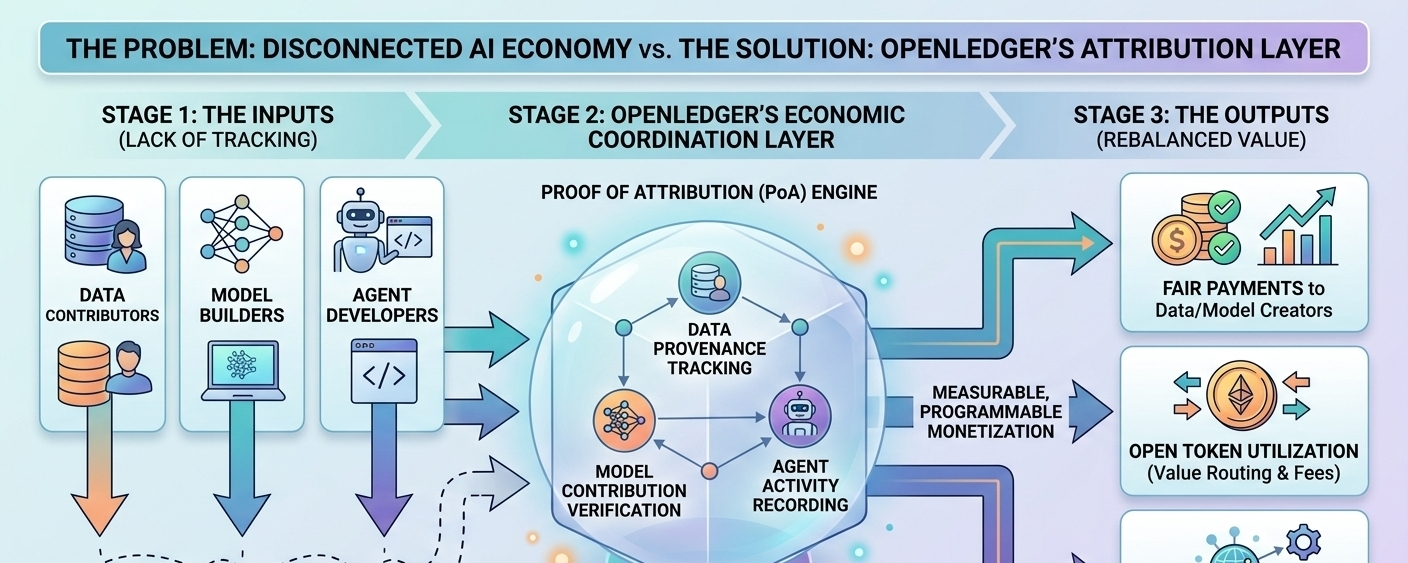
@OpenLedger #OpenLedger $OPEN I keep coming back to OpenLedger because it feels like it’s focused on a part of the AI economy most people still mention only in passing, but rarely stop to examine directly.
Liquidity.
Not token liquidity in the usual crypto sense. Something deeper than that.
The movement of value between the people producing data, the systems training on it, the models generating outputs from it, and the agents eventually monetizing those outputs in the market.
That layer matters more than people think.
Most conversations around AI still orbit around model quality. Better reasoning. Faster inference. Bigger context windows. More capable agents. Every week there’s another benchmark, another demo, another announcement trying to prove who is ahead.
But underneath all of that sits an economic problem that still feels unresolved.
Who gets paid?
And maybe even more important—who should get paid?
That’s the part OpenLedger seems interested in rebuilding.
OpenLedger doesn’t feel like another AI blockchain project trying to attach a token to machine learning and call it infrastructure. It feels more like an attempt to create accounting rails around intelligence itself.
That distinction sounds subtle until you really sit with it.
Because once AI becomes economic output instead of just software output, ownership gets messy very fast.
Data creates the training environment.
Models transform that data into intelligence.
Agents operationalize that intelligence into action.
Users generate feedback loops.
Applications extract revenue.
And suddenly value is moving across five or six layers at once with almost no clean way to attribute contribution.
Everyone is creating value. Everyone wants a share of it. Very few systems can track it cleanly.
That tension has been building quietly for years.
OpenLedger’s core design seems built around the idea that attribution is infrastructure.
That’s where Proof of Attribution starts getting interesting.
Not because it sounds technically impressive. Crypto has never lacked impressive language.
But because attribution changes incentives.
If attribution becomes measurable, monetization becomes programmable.
If monetization becomes programmable, behavior changes.
And once behavior changes, markets form around it.
That’s when infrastructure stops being theoretical.
People often underestimate how much crypto adoption is really incentive design disguised as technology.
Users follow yield.
Builders follow opportunity.
Capital follows monetizable activity.
And networks that align those flows tend to survive longer than networks that only optimize architecture.
That’s why OpenLedger feels worth paying attention to.
The project sits inside decentralized AI, but it’s really operating closer to an economic coordination layer than a pure AI protocol.
That matters.
Because decentralized AI has a monetization problem that still feels largely unsolved.
There’s no shortage of builders. No shortage of datasets. No shortage of open-source models. No shortage of agent frameworks either.
But sustainable value capture across those layers remains messy.
Most contributors still create value before they know how they’ll be compensated.
That creates pressure.
And pressure always leaks somewhere.
Usually through extraction.
Platforms capture too much.
Data suppliers capture too little.
Users contribute behavioral intelligence without owning any of the upside.
Models become profitable while the layers feeding them remain economically invisible.
That imbalance doesn’t disappear just because the system is onchain.
OpenLedger appears to recognize that.
Its architecture feels less obsessed with proving AI can exist onchain and more focused on proving that AI value can settle fairly across participants.
That’s a harder problem.
And honestly less glamorous.
Which is partly why it interests me.
Markets usually overprice what looks exciting and underprice what quietly removes friction.
The infrastructure people notice last is often the infrastructure everyone eventually depends on.
Still, none of this means execution becomes easy.
Building an AI infrastructure blockchain introduces another set of constraints immediately.
Attribution itself is difficult.
Data provenance is difficult.
Verifying model contribution is difficult.
Preventing spam contribution is difficult.
Designing rewards without encouraging low-quality farming behavior is difficult.
Crypto incentives are incredibly good at attracting participation.
They’re equally good at attracting manipulation.
Sometimes the same mechanism attracts both at once.
That’s where OpenLedger will be tested.
Not in concept.
In behavior.
Can Proof of Attribution remain meaningful when capital starts optimizing around it?
Can rewards remain tied to real contribution instead of synthetic activity?
Can AI data monetization scale without turning contribution into another emissions game?
That’s where the real market question sits for me.
And then there’s the token itself.
The OPEN token becomes interesting only when mapped against usage.
Not price.
Usage.
If data suppliers, model builders, agents, and applications all interact through OpenLedger’s economic layer, then the token isn’t just governance or speculation—it becomes part of value routing.
That creates stronger structural demand if activity compounds.
But token design is fragile.
If fees become extractive, usage leaves.
If incentives become too loose, emissions dilute attention.
If utility remains abstract, speculation dominates the narrative and the infrastructure disappears behind it.
Crypto has seen this pattern many times before.
Strong protocol.
Weak usage.
Great story.
Temporary volume.
Then silence.
OpenLedger probably knows that the challenge isn’t launching an AI blockchain.
It’s staying economically relevant after launch.
That’s harder.
Because AI moves faster than crypto infrastructure.
By the time one layer stabilizes, another layer shifts.
Model economics evolve.
Inference costs drop.
New agent behavior emerges.
User expectations change.
Revenue pools move.
Infrastructure has to remain flexible enough to survive all of that while still maintaining coherent incentives.
Very few networks manage that.
What I find most compelling isn’t whether OpenLedger becomes dominant.
Too early for that.
It’s that the project feels pointed at the right problem.
And in this cycle, that matters more to me than polished messaging or short-term narrative strength.
A lot of crypto still competes to own attention.
OpenLedger feels like it’s trying to own attribution.
That’s a different bet entirely.
And maybe a more durable one.
Because if AI becomes the next major production layer of the internet, then the real battle probably won’t be over who builds the smartest model.
It’ll be over who captures, routes, verifies, and distributes the value created around that intelligence once millions of humans, agents, and systems begin interacting with it simultaneously.
That’s less visible than model output.
Less exciting than demos.
Less memeable than tokens pumping on a chart.
But structurally?
Probably far more important.
And markets have a habit of ignoring structural importance right up until the moment they can’t anymore