
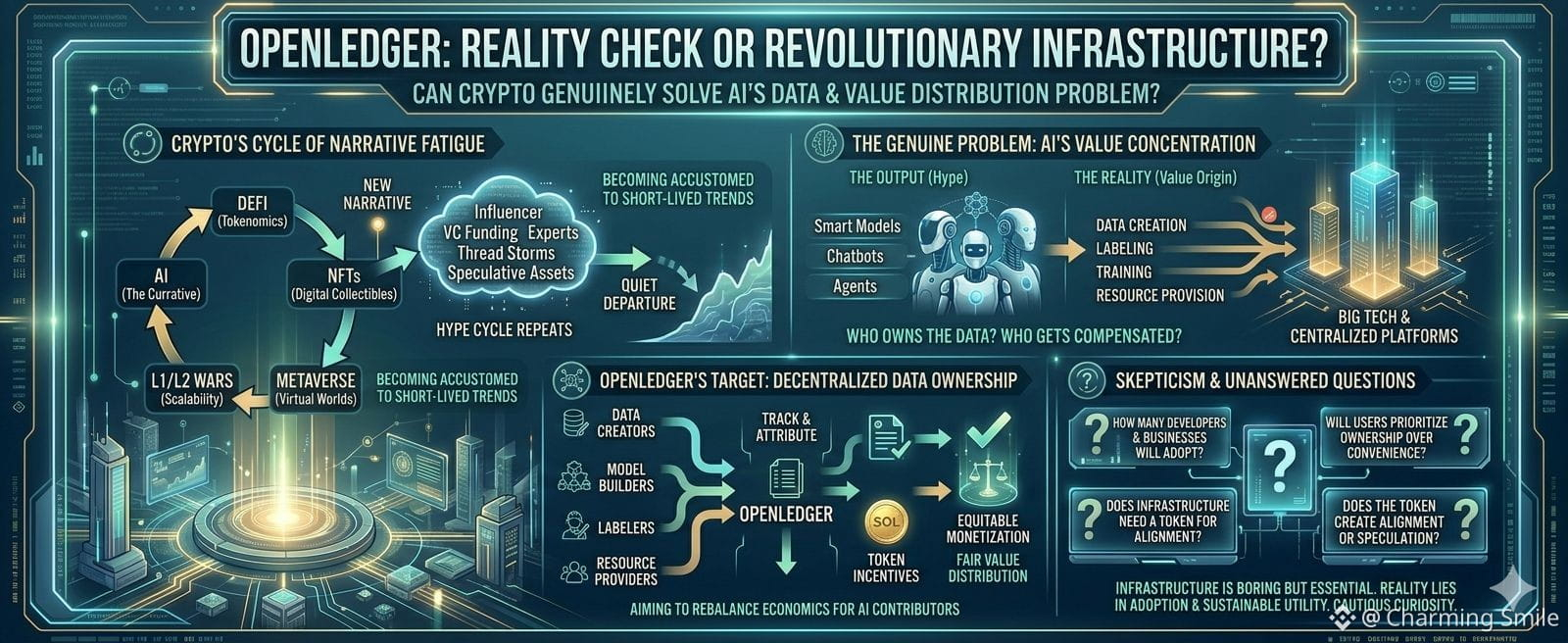
I don't know if it's just me getting older in this market, but every cycle feels a little more familiar than the last one.
A new narrative appears. Influencers suddenly become experts in it overnight. Timelines fill with threads. Venture capital starts flowing. Everyone starts repeating the same talking points. Then six months later people quietly move on to the next thing while pretending they never believed the previous story in the first place.
I've watched it happen with DeFi. I've watched it happen with NFTs. I've watched it happen with metaverse projects, GameFi projects, interoperability projects, Layer 1 wars, Layer 2 wars, and whatever else the industry decided was going to change everything.
Now it's AI.
And honestly, the AI narrative in crypto has reached the point where I automatically become suspicious whenever I see those two letters.
Not because AI isn't important.
Not because AI isn't growing.
But because crypto has a habit of attaching itself to legitimate technological trends and then creating fifty versions of the same tokenized pitch around them.
That's why OpenLedger caught my attention in a strange way.
Not because I immediately believed in it.
Not because I think it has all the answers.
Actually, the reason it stood out is because the problem it talks about is one of the few AI-related problems that feels genuinely real.
Most AI discussions today focus on the output.
People talk about chatbots.
People talk about agents.
People talk about models becoming smarter.
But very few people talk about where the value is actually coming from.
Someone created the data.
Someone spent time labeling information.
Someone trained systems.
Someone contributed resources.
Someone provided the foundation that makes AI useful.
Yet most of the economic value seems to concentrate in a handful of companies.
That's not exactly a new observation, but it is an important one.
And that's where OpenLedger enters the conversation.
The basic idea is that data, models, and AI-related contributions should be easier to track, attribute, and monetize.
On paper, that sounds reasonable.
Actually, it sounds more reasonable than a lot of crypto narratives I've heard over the years.
The funny thing is that crypto has always loved talking about ownership.
Ownership of money.
Ownership of assets.
Ownership of digital goods.
Now we're seeing ownership discussions move toward AI itself.
Who owns the data?
Who gets compensated?
Who gets credit?
Who captures the value?
Those questions are becoming harder to ignore as AI grows.
So I understand why projects like OpenLedger exist.
The problem is that understanding the motivation behind a project and believing the project will succeed are two completely different things.
Crypto investors often confuse those two things.
I've done it myself.
Many times.
A good idea is not the same thing as a successful network.
A real problem is not the same thing as product-market fit.
And a token is definitely not proof that demand exists.
That's where my skepticism starts showing up.
Because once you move beyond the headline idea, things become much more complicated.
Let's say OpenLedger successfully creates systems that allow contributors to be rewarded for AI-related value creation.
Okay.
Who are the users?
How many developers actually care?
Will businesses adopt it?
Will people pay attention to attribution if convenience exists somewhere else?
Those questions sound boring.
Unfortunately, boring questions are usually the most important ones.
Crypto tends to focus on vision.
Markets focus on behavior.
And behavior is messy.
Most users don't care about elegant economic theories.
Most users care about speed.
Convenience.
Cost.
Results.
If a centralized solution is easier, many people will choose it.
History has shown that repeatedly.
That's the uncomfortable reality every decentralized project eventually faces.
Then there's the token itself.
And honestly, whenever I see a token attached to infrastructure, I automatically ask the same question.
Does this thing actually need a token?
I'm not saying it doesn't.
I'm saying that's the question that should always come first.
Because crypto has a long history of creating tokens first and utility later.
We've all seen it.
Projects spend years trying to justify a token that was launched before the ecosystem existed.
Sometimes it works.
Often it doesn't.
OpenLedger is not alone in facing that challenge.
Every infrastructure project faces it.
Every AI-crypto project faces it.
Every network that depends on incentives faces it.
The difficult part is proving that the token creates meaningful alignment instead of simply creating another speculative asset.
And let's be honest.
Speculation always arrives faster than utility.
Always.
Crypto has never had a shortage of traders.
It has always had a shortage of sustainable users.
That's why I find myself looking at OpenLedger with cautious curiosity rather than excitement.
Excitement is easy.
Crypto is full of excitement.
Every project is revolutionary during a bull market.
Every founder is changing the future.
Every roadmap sounds incredible.
Then reality shows up.
Reality usually arrives carrying adoption numbers.
And reality can be very rude.
What keeps me interested is that OpenLedger appears to be targeting infrastructure rather than hype-driven consumer applications.
Infrastructure is boring.
Infrastructure is rarely glamorous.
Infrastructure doesn't generate viral moments.
But infrastructure is often where the actual value gets built.
Nobody celebrates roads until they need them.
Nobody talks about plumbing until it stops working.
Infrastructure projects often feel similar.
If they succeed, people eventually take them for granted.
If they fail, nobody remembers them.
That's the strange position OpenLedger occupies.
It's trying to solve a problem that genuinely exists.
It's doing so in an industry famous for overpromising.
It's operating in the AI sector, which is currently drowning in hype.
And it's using blockchain technology, which many people still struggle to trust.
That's a difficult combination.
Maybe it works.
Maybe it doesn't.
Maybe AI eventually needs systems like this.
Maybe centralized platforms solve the same problems faster.
I genuinely don't know.
And after enough years in crypto, I've become comfortable saying those three words.
I don't know.
The market has a way of humbling certainty.
What I do know is that OpenLedger feels more interesting when you ignore the hype and focus on the underlying question.
How should value be distributed in an AI-driven world?
That's not a fake problem.
That's not a manufactured narrative.
That's a question people will continue asking long after today's trends disappear.
Whether OpenLedger becomes part of the answer remains to be seen.
For now, it sits in that category of projects I watch without becoming emotionally attached to.
The idea makes sense.
The execution still needs to prove itself.
The risks are real.
The opportunity might be real too.
And in a market overflowing with certainty, that's probably the most honest conclusion I can reach.
