
Everyone is racing to build smarter AI.
Bigger models. Better reasoning. Faster inference. Stronger benchmarks.
But the more time I spend researching AI infrastructure, the more I find myself wondering about a different challenge entirely.
What happens when the people who help build AI no longer have a reason to participate?
Because AI doesn't grow because of machines alone.
It grows because of people.
A thought kept circling in my head today while I was reading about AI infrastructure.
Everyone seems obsessed with the same thing when discussing artificial intelligence: bigger models, better reasoning, faster inference, stronger benchmarks.
And honestly, I get it.
The technology is impressive.
But the more time I spend researching projects in this space, the more I find myself asking a completely different question:
Why would people keep contributing to these systems year after year?
Because when you strip away all the technical language, AI doesn't really grow because of machines.
It grows because of people.
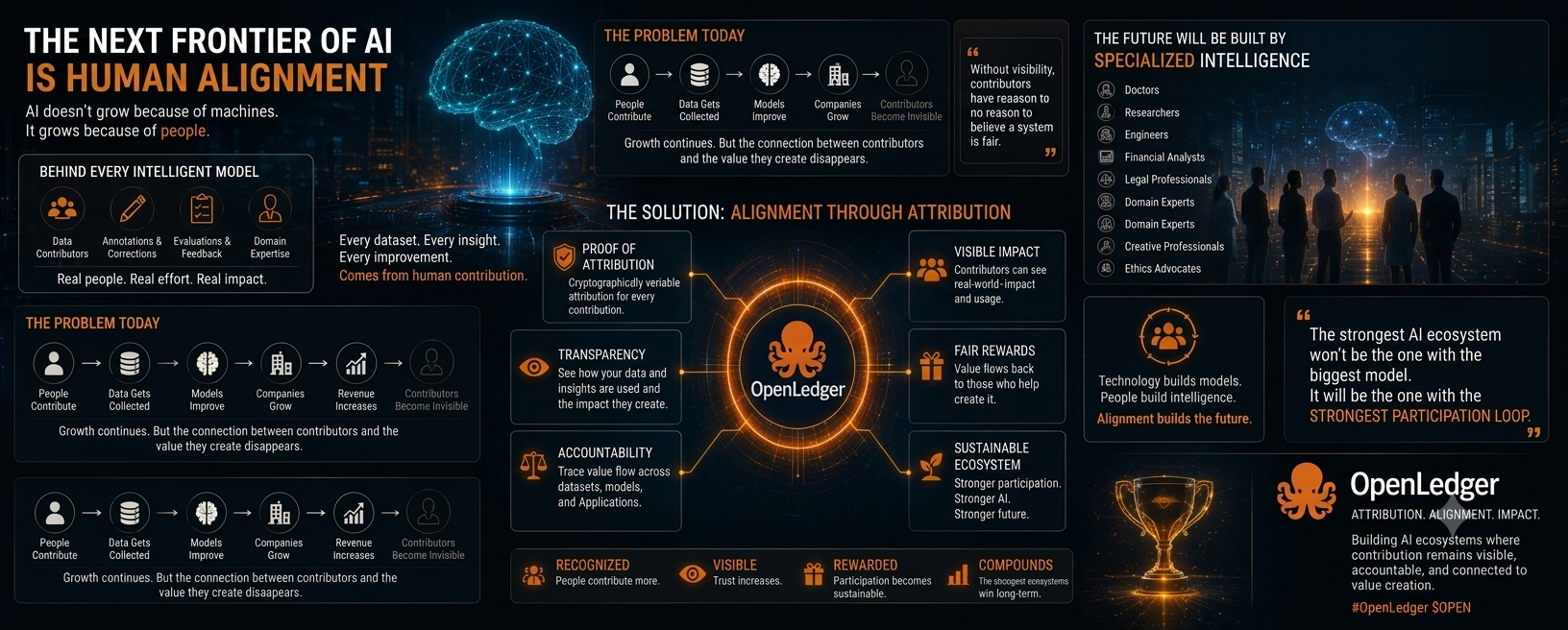
Every dataset came from someone. Every annotation, correction, evaluation, and domain-specific insight exists because a human decided to spend time contributing knowledge. Behind every "intelligent" model is an enormous amount of human effort that most people never see.
That's why I think one of the biggest AI conversations isn't about intelligence at all.
It's about alignment.
Think about how most systems work today.
People contribute value. Data gets collected. Models improve. Companies grow. Products generate revenue.
But the connection between contributors and the value they helped create often disappears almost immediately.
The system keeps moving.
The contributors become invisible.
At first, that doesn't seem like a major issue. Growth continues. Innovation continues. Everything looks fine from the outside.
But over time, incentives start to matter.
The best contributors become harder to attract.
Specialized experts become harder to retain.
Trust slowly weakens.
And participation starts relying more on goodwill than actual alignment.
That's why I've started paying much closer attention to incentive structures.
Most people think incentives are just about money.
I don't.
I think incentives are behavioral infrastructure.
They influence who participates, how long they stay, and whether they feel their contributions actually matter.
When people feel recognized, they contribute more.
When contribution is visible, trust increases.
When rewards reflect impact, participation becomes sustainable.
None of this happens overnight, but the effects compound over time.
And compounding participation might become one of the biggest competitive advantages in the entire AI industry.
Consider a simple example.
Imagine a medical researcher contributes highly specialized healthcare data that helps train an AI model later used by hospitals around the world. The model generates enormous value, improves outcomes, and becomes commercially successful. Yet the original contributor may never know how their data was used, what impact it had, or whether it helped create value downstream.
That disconnect is becoming one of the most important questions in AI.
How do we create systems where contributors can see the role they played in building intelligence?
This is one reason OpenLedger keeps catching my attention.
What interests me isn't simply the technology. It's the attempt to create a stronger relationship between contributors, datasets, models, and the value generated downstream through mechanisms like Proof of Attribution.
Whether OpenLedger ultimately succeeds or not, I think it's asking one of the right questions:
How do we build AI ecosystems where contribution remains visible, accountable, and connected to value creation?
For me, the interesting part isn't even the reward distribution.
It's accountability.
It's transparency.
It's giving contributors a way to actually see how their work fits into a larger ecosystem.
Because attribution does something important.
It creates trust.
Without visibility, contributors have no reason to believe a system is fair.
Without trust, participation weakens.
And without participation, even the most advanced AI infrastructure eventually hits limits.
I think this becomes even more important when we look at where AI is heading next.
The future won't be built entirely by giant general-purpose models.
A huge amount of progress will come from specialized intelligence.
Doctors.
Researchers.
Engineers.
Financial analysts.
Legal professionals.
People with expertise that cannot simply be replaced by scale.
And if these contributors are expected to keep sharing valuable knowledge, there has to be a reason for them to stay involved.
Technology alone isn't enough.
Alignment matters.
In fact, I have a feeling the strongest AI ecosystem of the next decade may not be the one with the largest model or the biggest GPU cluster.
It may be the one that builds the strongest participation loop.
A system where contributors can see their impact.
A system where attribution remains transparent.
A system where value flows back toward the people helping create it.
The more I think about it, the more this feels like the real challenge.
Making AI smarter is important.
Making AI ecosystems sustainable may be even more important.
Because intelligence can attract attention.
Innovation can generate excitement.
But alignment is what keeps people showing up.
And in the long run, the AI networks that successfully connect participation, ownership, attribution, and value creation may be the ones that survive long after today's models become tomorrow's history.