
Market's been a bit directionless the last few days. Nothing dramatic, just that slow grind where nothing feels worth acting on. I ended up doing what I usually do in those stretches — going sideways into project docs instead of staring at charts.
I'd written some short notes on OpenLedger before. Had a rough sense of what it was doing. AI blockchain, data attribution, the whole Proof of Attribution framing. Checked back in today because something from a previous task had been sitting in the back of my mind and I couldn't shake it.
So I started reading through how the cross-chain layer actually fits into the coordination model. And about forty minutes in, something clicked that I don't think gets talked about the right way.
Most people are framing $OPEN and OpenLedger as a cross-chain story. Like — 130+ blockchains accessible via LayerZero, models and data moving across ecosystems, agents able to pull resources from wherever they live. That's the pitch. That's what gets highlighted. And I bought that framing for a while too.
But here's what I think people are actually missing.
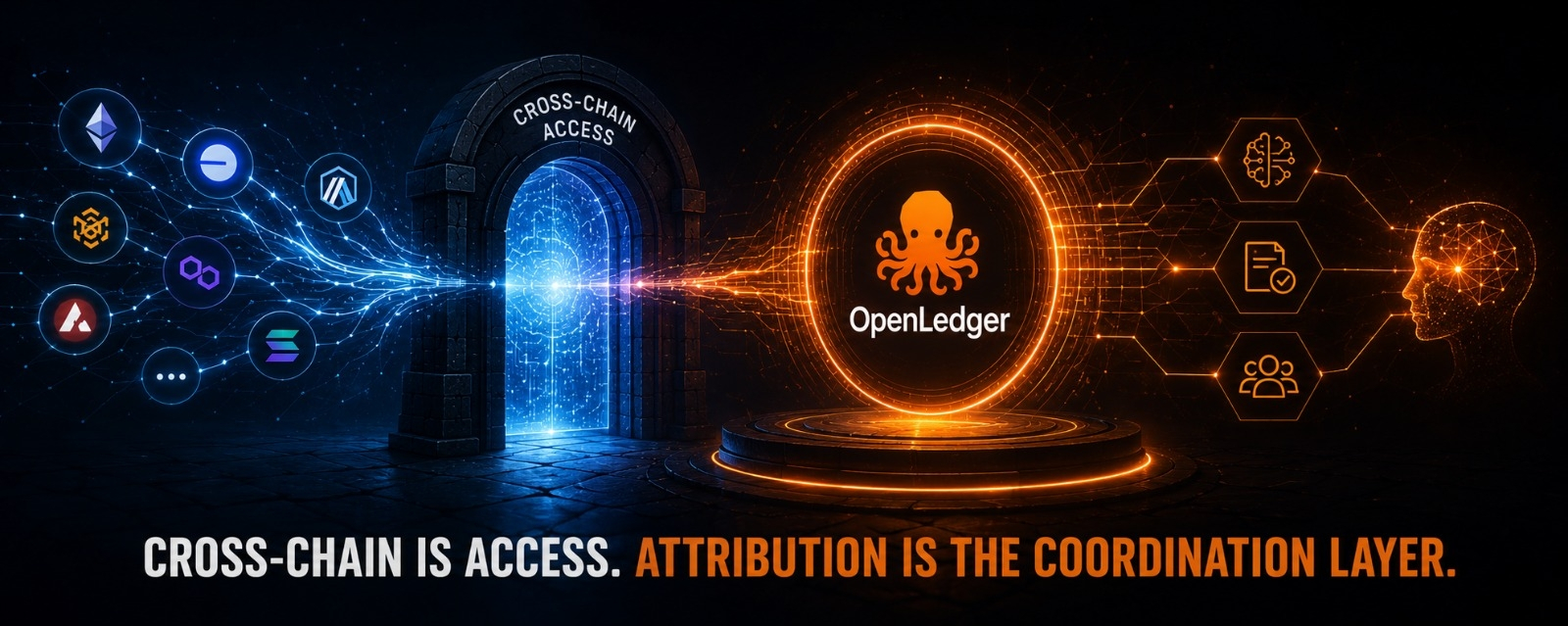
The cross-chain layer isn't the mechanism. It's the front door.
Everything that makes OpenLedger distinct — the attribution engine, the inference-linked payments, the way contributors get rewarded based on actual model influence rather than just depositing data — none of that lives on the cross-chain layer. It lives on OpenLedger's own chain. The cross-chain infrastructure is how agents and developers arrive. What happens after they arrive is a completely separate system.
I thought about it like this. Imagine you're an AI agent running somewhere on Base or Arbitrum. You need training data or a model call. You come in through the bridge. But once you're inside OpenLedger's environment, you're in a settlement layer where every inference gets traced back to a contribution, and every contribution has an on-chain attribution record. The bridge just got you there. The attribution engine is what decides whether anyone gets paid.
That's the actual coordination layer. Not the routing. The attribution.
And that distinction matters because when people evaluate the cross-chain story, they're essentially evaluating the entry mechanism. But the defensible value — if it ever materializes — isn't about how many chains you can reach. It's about whether the attribution logic is accurate enough and trusted enough that AI developers actually want to build compensation structures on top of it.
Those are two very different bets.
Here's the part that bothers me though.
The cross-chain infrastructure is built on LayerZero. Which, as of six weeks ago, is navigating some real reputational fallout after the KelpDAO bridge exploit — $292 million drained on April 18 through a 1/1 DVN configuration that turned out to be LayerZero's own default setup. The post-mortem dropped May 20. LayerZero has since banned single-verifier configurations and is forcing migration across active integrations.
OpenLedger integrated LayerZero in October 2025. Whether their bridge config was in the 40% that were running the vulnerable setup at time of exploit — I couldn't confirm from public docs. And that's a weird gap to sit with when you're trying to evaluate how "verified" the data movement actually is.
Because here's the thing. The exploit worked because on-chain everything looked clean. Messages were relayed. Signatures verified. The fraud was invisible at the contract level. If the pipe carrying OpenLedger's attribution proofs has that kind of vulnerability surface, then the "verifiable" part of the story has a footnote nobody's reading.
I'm not saying the attribution engine is broken. I'm saying the trust model for cross-chain data movement just took a credibility hit from the infra layer OpenLedger relies on. And the coordination thesis depends on trust more than most projects in this space.
The September unlock is still out there too. Circulating supply sitting at 220 million against a billion total. That's a lot of token that hasn't entered the market yet, and the runway to meaningful AI agent adoption before that pressure arrives feels tight.
I think the people who get $OPEN right are going to be the ones who stop asking "how many chains does this reach" and start asking "how accurate is the attribution, and who actually cares enough about that accuracy to pay for it." That's the real signal. The cross-chain layer is almost a distraction.
Anyway. Charts still look unconvincing. I'll probably just keep watching how the LayerZero migration plays out before forming a stronger view here.