I didn't take it seriously at first. AI blockchain. Liquidity for data models agents. It felt like the inevitable mash‑up of whatever two narratives were dominating the timeline. I've been through enough cycles to recognize that pattern. We get excited about a new capability then we try to financialize it before we’ve really understood its failure modes.
So yes I skimmed it.
But OpenLedger kept lingering in the back of my mind and not because of the AI angle. It was the quieter claim underneath that the input layer of intelligence the data the model contributions, the agents acting on behalf of users shouldn’t remain this vague, unpriced, semi‑owned substrate.
That's not a glamorous problem. It’s administrative. It's about record‑keeping attribution, identity persistence. The boring layers.
And boring layers are where systems either hold or rot.
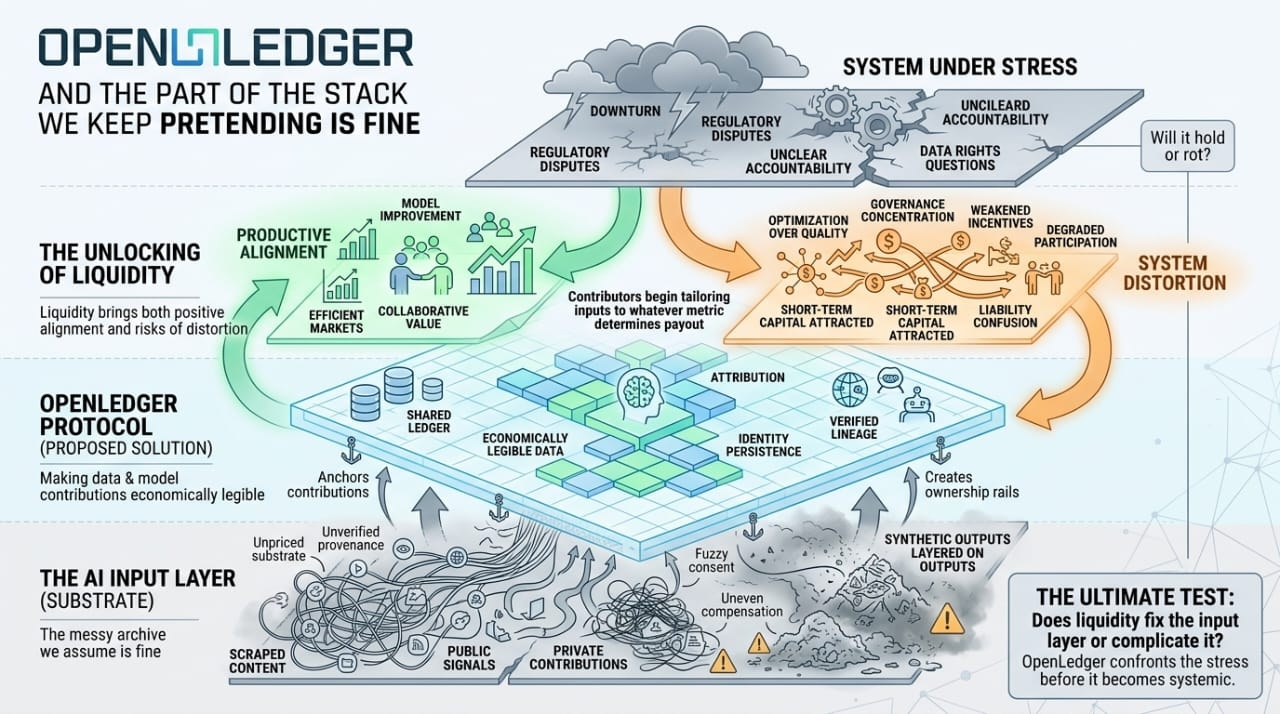
I keep coming back to how casually we talk about training data. As if it’s just a resource pool. In reality it's a messy archive of scraped content public signals private contributions synthetic outputs layered on synthetic outputs. Provenance is often assumed not verified. Consent is fuzzy. Compensation is uneven.
Maybe that's too harsh. But it feels accurate.
So when something like OpenLedger suggests anchoring contributions and lineage onto a shared ledger making data and models economically legible I can't just dismiss it as narrative stacking. There's a real gap there.
Still liquidity makes me uneasy.
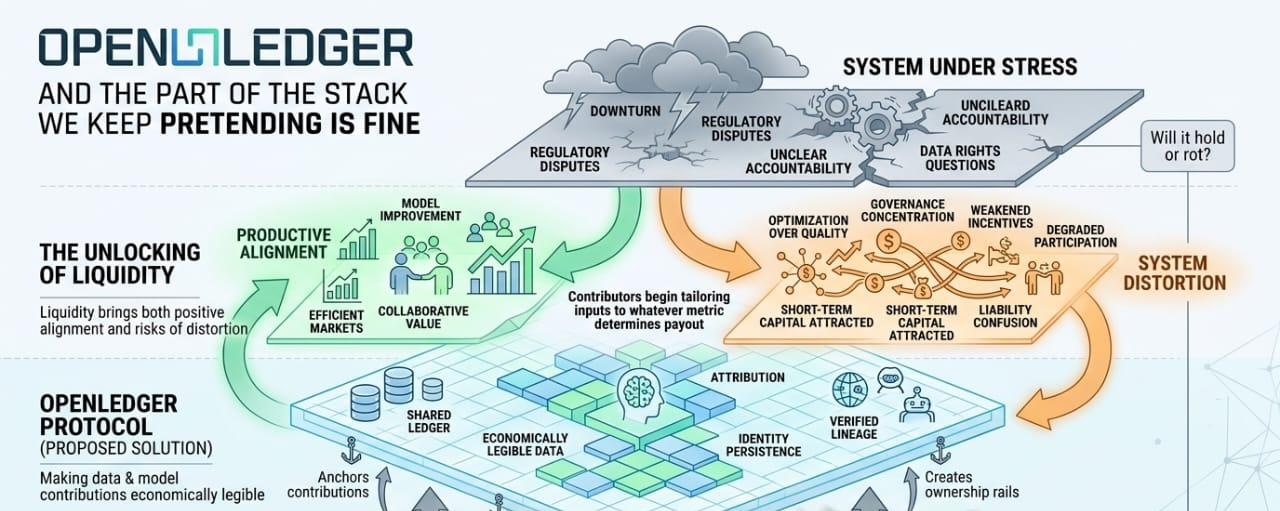
Once you unlock liquidity you unlock optimization. Contributors begin tailoring inputs to whatever metric determines payout. Model builders tweak behavior to capture value. Agents act in ways that maximize reward. Some of that alignment is productive. Some of it quietly degrades quality.
That's where things start to feel uncomfortable.
Crypto history is full of systems that worked beautifully in ideal conditions and slowly distorted under financial pressure. Governance tokens concentrated. Yield farming attracted short‑term capital. Participation declined once incentives weakened. The protocol didn’t die it just became something narrower than intended.
Would OpenLedger avoid that gravity? I'm not sure any network does.
There's also the identity problem. If agents are earning and transacting who is accountable? If a model trained on monetized data produces harmful output does the ledger clarify responsibility or just create a visible audit trail of confusion? Recording contribution isn't the same as resolving liability.
I didn't take it seriously at first because I thought we were monetizing something still too fluid to pin down. Intelligence evolves. Data ages. Context shifts. Locking these into economic primitives feels premature.
But the alternative is worse. Centralized AI providers already control the majority of the stack. If ownership rails aren't built openly they'll calcify privately. At least a public ledger forces transparency, even if it doesn’t solve everything.
I keep circling back to pressure. How does this behave in a downturn? When token incentives shrink? When disputes arise over attribution? When regulators ask uncomfortable questions about data rights? Infrastructure reveals itself under stress, not enthusiasm.
Maybe OpenLedger is an early attempt to confront that stress before it becomes systemic. Or maybe it's another experiment that will expose just how hard it is to stabilize the input layer of intelligence.
I don't have a clean answer. I just know the part of the stack we've been pretending is fine probably isn't. And whether liquidity fixes that or complicates it still feels like an open question.