
Artificial intelligence has become one of the biggest technological stories of our time. New models appear almost every week, companies invest billions into AI development, and users interact with AI tools more than ever before. Yet behind all the excitement, there is a question that still feels largely unanswered:
Who actually owns the value that AI creates?
Most conversations about AI focus on model performance, computing power, or the race between major technology companies. Those topics matter, but they often ignore something much more fundamental. Every AI system depends on data. Without data, there are no models to train, no insights to generate, and no products to sell.
The strange part is that the people contributing data rarely participate in the value generated from it.
For years, the dominant model has been simple. Data is collected, models are trained, companies build products, and revenue flows toward the platform. The contributors behind the data often remain invisible. As AI continues to expand into every industry, this imbalance is becoming harder to ignore.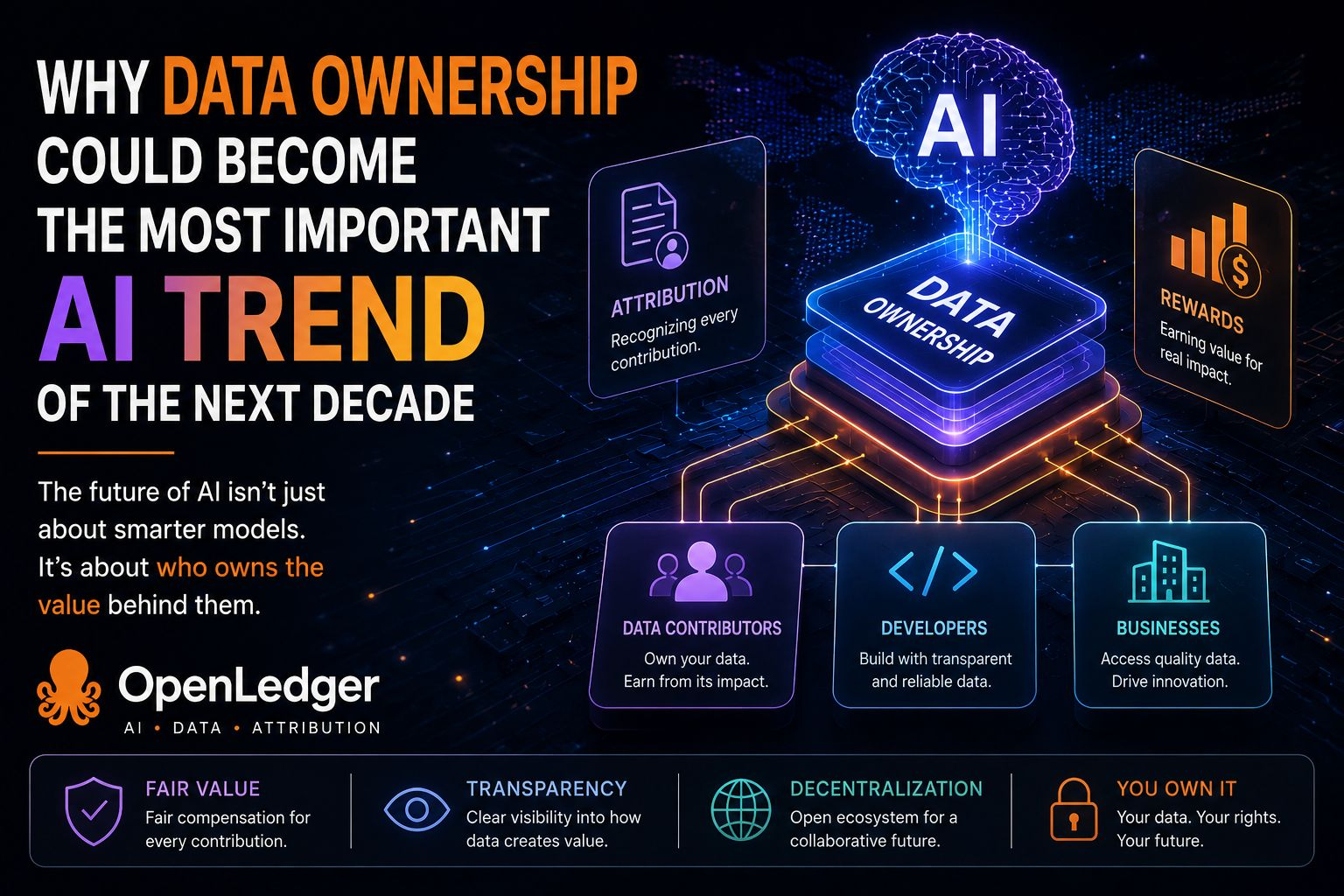
This is one reason I started paying closer attention to OpenLedger.
What caught my attention was not another promise of faster AI or bigger models. Instead, the project focuses on a question that many AI platforms seem willing to avoid: how can contributors be recognized and rewarded when their data helps create value?
At the center of OpenLedger's vision is the concept of attribution. The idea sounds straightforward on paper. If data contributes to the performance of an AI model, there should be a way to identify that contribution and connect it to economic rewards. In practice, however, this is an extremely difficult challenge.
Modern AI systems operate on massive amounts of information. Understanding which data influenced which output is far from simple. Yet if this challenge can be solved effectively, the implications could be significant.
Imagine a future where specialized datasets become productive digital assets rather than static collections of information. Instead of simply uploading data and losing visibility forever, contributors could potentially participate in the value generated when their data is used. Developers could build models with clearer economic relationships between creators, users, and infrastructure providers.
This is where OpenLedger becomes interesting.
The project is attempting to build an ecosystem where datasets, models, and applications are connected through an attribution framework. Rather than treating data as a resource that disappears into a black box, the goal is to make contributions more transparent and measurable.
Whether this vision succeeds remains an open question. Technical execution matters. Adoption matters. Real-world demand matters. The history of both AI and crypto is filled with ambitious ideas that struggled to gain traction outside of early communities.
Still, I think the broader discussion is becoming increasingly important.
As AI systems become more powerful, the economic structure around them will matter just as much as the technology itself. The future is not only about creating better models. It is also about determining how value flows between participants.
Many people assume AI will naturally become more decentralized over time. I am not convinced that outcome is guaranteed. Centralization remains powerful because it is often simpler and more efficient. If alternative systems want to compete, they must provide clear advantages that users, developers, and businesses actually care about.
Data ownership and attribution could become one of those advantages.
Regulators are asking more questions about training data. Creators are becoming more aware of how their content is used. Businesses increasingly want transparency around AI systems that influence decisions and operations. These pressures are not disappearing anytime soon.
That is why projects focused on attribution deserve attention, even if they remain early-stage experiments.
For me, the most interesting aspect of OpenLedger is not the token, the market narrative, or short-term price action. It is the attempt to rethink the economic foundations of AI. The project is exploring whether contributors can move from being invisible inputs to recognized participants within an AI economy.
There are still many challenges ahead. Attribution must work reliably. Incentives must remain sustainable. The ecosystem must attract real users rather than temporary speculation. None of these obstacles are small.
But sometimes the most valuable projects are the ones asking difficult questions before everyone else realizes those questions matter.
The AI industry has spent years focused on building intelligence. The next decade may force us to focus equally on ownership, attribution, and economic fairness.
If that shift happens, the projects working on those problems today could become far more important than they appear right now.
That is why OpenLedger remains one of the more interesting AI-related ecosystems I am watching. Not because success is guaranteed, but because the problem it is trying to solve feels increasingly relevant as AI continues to grow.#OpenLedger $SIREN $OPEN