
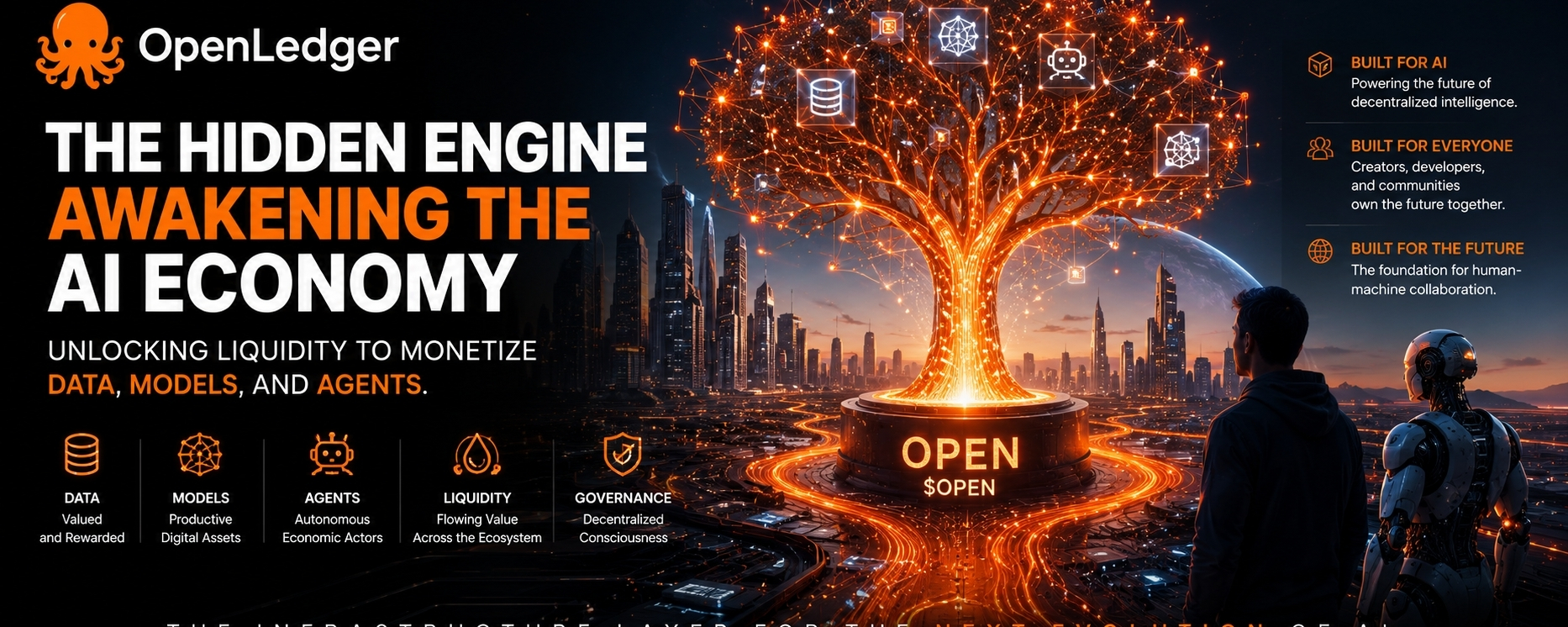
Most people look at artificial intelligence and see intelligence. I see something else. I see a growing city with no clear way to reward the people who built it. Data creators feed the machines. Model developers refine them. Builders create agents that perform tasks. Yet the value often gathers in a few places while the contributors remain invisible. Beneath the excitement of AI, a silent imbalance has been forming for years.
Then a new signal begins to appear.
OpenLedger enters the scene not as another blockchain chasing attention, but as an attempt to solve a deeper problem. It asks a simple question. What happens when data, models, and AI agents become assets that can move, earn, and grow inside an open economy? The answer starts to reshape everything. Suddenly the raw ingredients of intelligence are no longer trapped inside isolated systems. They become liquid. They become alive.
The more I explored OpenLedger, the more it felt less like a network and more like a living organism. Every piece has a role. Smart contracts act like veins carrying value across the ecosystem. Liquidity moves through the network like blood, feeding activity wherever demand appears. Governance behaves like a form of consciousness, constantly adapting and responding to the needs of the system. Nothing sits still. Every interaction creates new pathways for growth.
This is where the mystery becomes interesting.
In traditional AI platforms, data is often consumed and forgotten. Its contribution becomes difficult to measure. OpenLedger approaches the problem differently. It creates a framework where valuable data can be recognized, tracked, and rewarded. Models are not simply tools. They become productive digital assets. AI agents are no longer passive software waiting for instructions. They become economic participants capable of generating activity, creating value, and interacting with other systems.
For builders, the experience feels transformative. An idea that once depended on large centralized platforms can now find its own economic engine. A developer can contribute a model and receive value based on real usage. A data provider can see direct recognition for contributions that improve intelligence. The connection between effort and reward becomes clearer. The invisible suddenly becomes visible.
Traders experience a different shift. Instead of speculating only on narratives, they gain exposure to the infrastructure powering the AI economy itself. Liquidity begins to reflect real network activity. The market becomes more than a place of price discovery. It becomes a map of intelligence flowing through a digital ecosystem.
What fascinates me most is the psychological change this creates. People stop thinking about AI as a distant technology controlled by powerful institutions. They begin to see it as something they can participate in, contribute to, and benefit from. Ownership changes behavior. Incentives change creativity. New forms of collaboration start emerging where humans and machines generate value together.
As the horizon expands, OpenLedger starts looking less like a blockchain and more like an early blueprint for the next stage of digital civilization. Data becomes a living resource. Models become productive capital. Agents become economic actors. The boundaries separating human creativity and machine intelligence begin to soften.
And when viewed from a distance, that may be the real story. OpenLedger is not simply building infrastructure for AI. It is building the marketplace where intelligence itself can move, grow, and find value. In the years ahead, as humans and machines work together in ways that seem impossible today, networks like OpenLedger may quietly become the foundation beneath it all.
