Last Saturday around 10 pm reading OpenLedger docs, something clicked.
I had one of those moments where a project suddenly looked very different from how I first understood it.
For a long time, I thought OpenLedger was mainly about solving data ownership. That seemed simple enough. AI companies need data. People provide data. A system is built to track contributions and make sure contributors get recognized.
Nothing wrong with that idea.
But the more time I spent reading and thinking about it, the more I felt that was only a small part of the story.
What kept pulling my attention was something most people rarely talk about.
Dependencies.
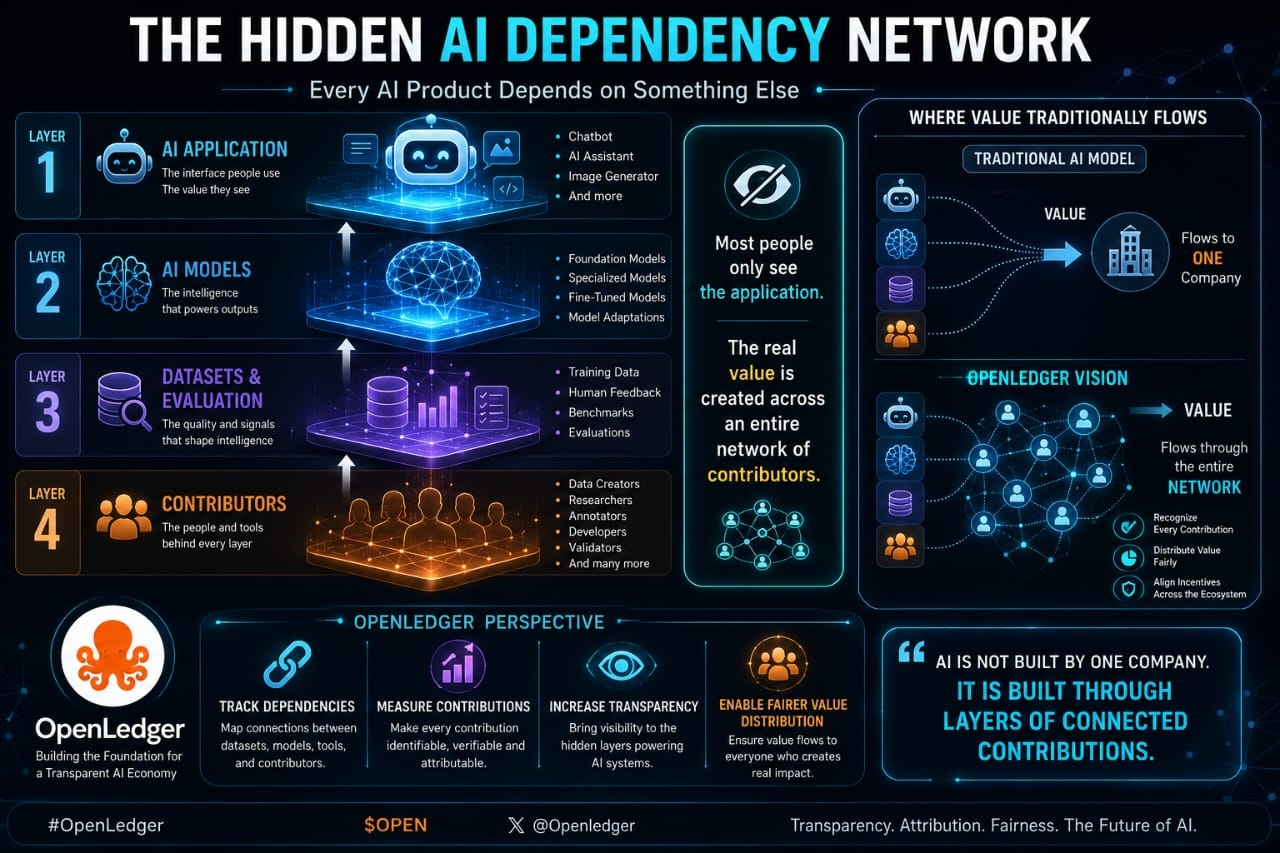
Every AI product we use today depends on something else.
A model depends on training data.
The training data depends on thousands of people who created, labeled, organized, or verified it.
Applications depend on models.
New models often depend on older models.
Everything is connected to something that came before it.
Yet when people talk about AI, they usually focus only on the final product.
We see a chatbot give an answer.
We see an image generator create a picture.
We see an AI assistant complete a task.
What we do not see is the long chain of work that made that result possible.
And honestly, I think that hidden chain may become one of the biggest conversations in AI over the next few years.
Think about it this way.
Imagine a company launches an AI application that becomes very successful.
Millions of people use it.
Revenue grows.
Investors get excited.
The company gets most of the attention.
But behind that success there may be thousands of contributors who helped make it possible.
Some created datasets.
Some improved data quality.
Some built tools.
Some provided evaluations.
Some contributed research.
Some helped train specialized models.
Without those pieces, the final product might never have existed.
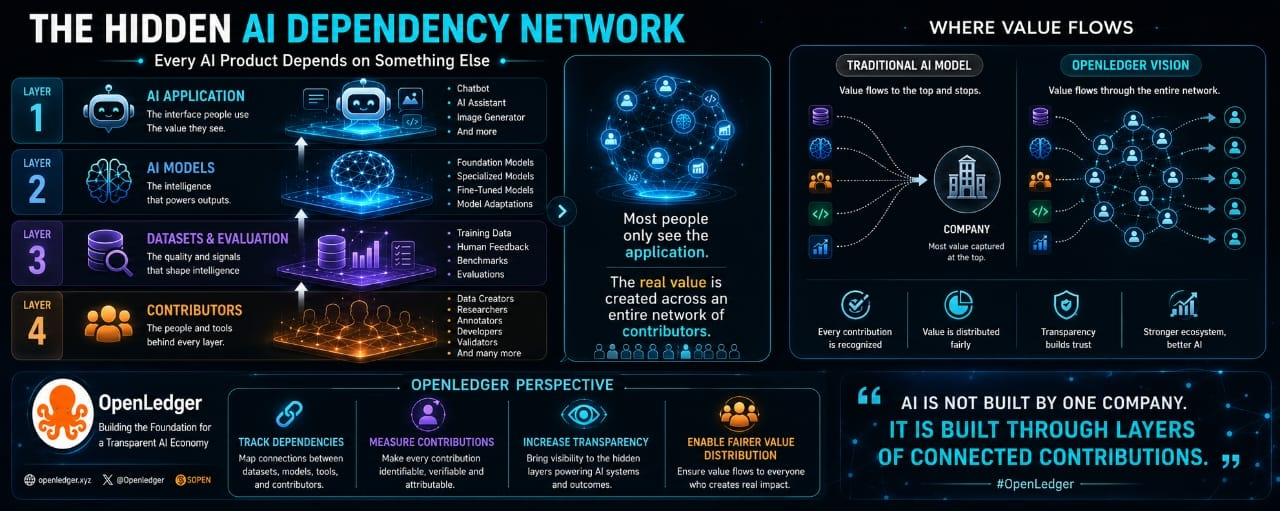
Yet most of the value usually flows toward the company at the top while the deeper network of contributors becomes almost invisible.
The more I thought about this, the more I started looking at OpenLedger from a completely different angle.
Instead of asking how data can be tracked, I started asking a different question.
What happens if AI dependencies can be tracked?
That may sound like a small difference, but I think it changes everything.
If every contribution inside an AI ecosystem can be identified and connected to future outcomes, then suddenly you are not just tracking data anymore.
You are mapping relationships.
You are showing how value is created.
You are showing who contributed to what.
You are creating visibility around work that normally stays hidden.
And once something becomes visible, it becomes much easier to reward fairly.
That idea feels important because AI is becoming more complex every year.
No single person builds everything.
No single company creates every piece.
Modern AI is becoming a network of contributions from many different people and organizations.
The challenge is that our current systems are not very good at recognizing those connections.
Most people only see the final layer.
They see the application.
They see the brand.
They see the company.
They do not see the hundreds or thousands of building blocks underneath.
When I look at OpenLedger, I see a project trying to make those hidden layers visible.
Maybe that ends up becoming one of the most valuable pieces of infrastructure in AI.
Maybe it does not.
But I think the direction is worth paying attention to.
History gives us a few interesting examples.
Most people use the internet every day without thinking about the protocols that allow websites to communicate.
Most people send money digitally without thinking about the systems moving funds behind the scenes.
The infrastructure is there.
It is important.
But it stays largely invisible.
AI may eventually work the same way.
Years from now, people may interact with powerful AI applications without knowing anything about the datasets, contributors, evaluators, researchers, and models that sit underneath them.
The technology will feel simple from the outside.
The reality underneath will be far more connected.
That is why dependency tracking keeps coming back into my mind.
Not because it sounds exciting.
Not because it creates a catchy headline.
But because it addresses a real problem.
If AI continues growing, we need better ways to understand where value comes from.
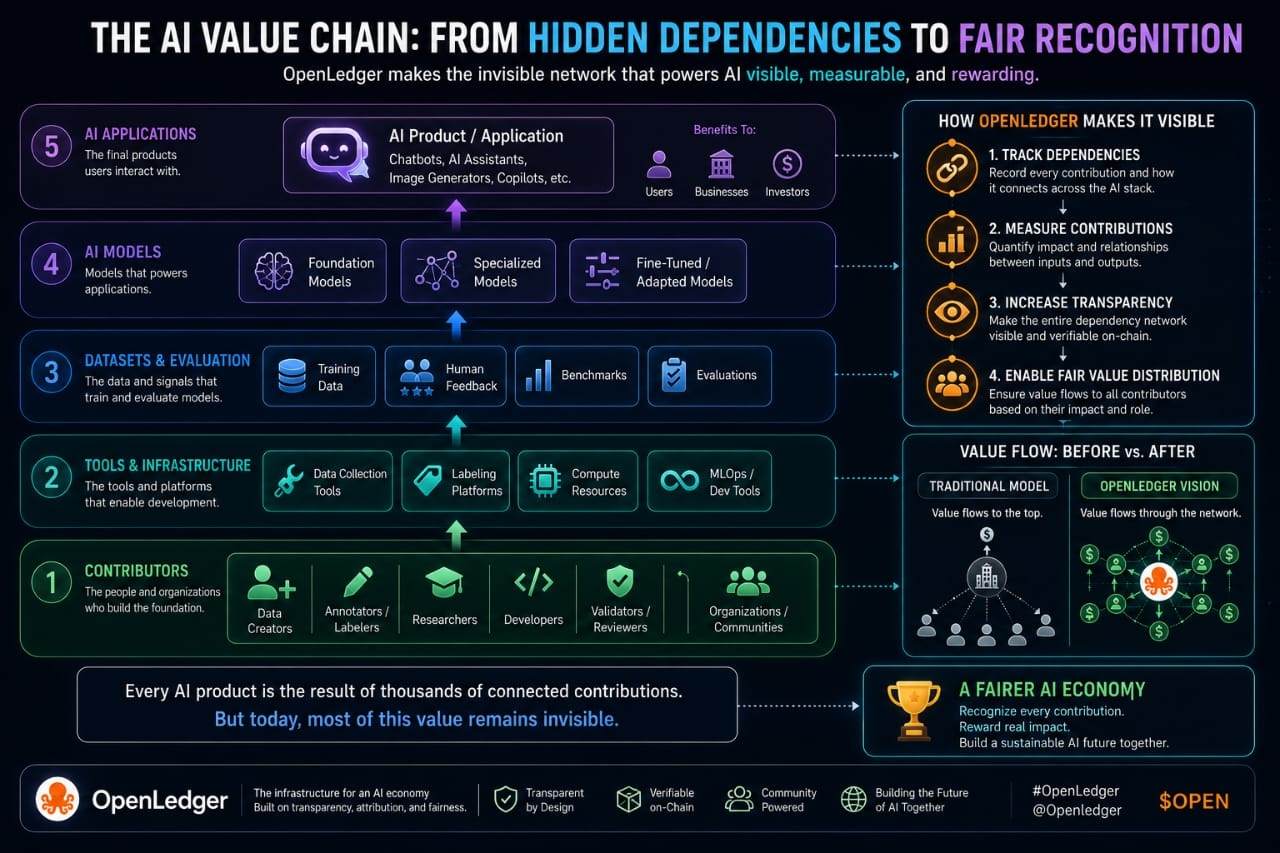
We need better ways to recognize contributions.
We need systems that encourage people to keep building useful resources instead of feeling like their work disappears into a black box.
I think many people are still looking at AI through the lens of models alone.
Which model is bigger.
Which model is faster.
Which model has more users.
Those are important questions.
But sometimes the biggest opportunities are hidden one layer below the conversation everyone is having.
The companies building visible products often get attention first.
The infrastructure supporting those products usually gets noticed later.
That is one reason OpenLedger caught my attention.
It is focused on a part of the AI economy that many people are not discussing yet.
The hidden relationships.
The hidden contributions.
The hidden dependencies.
And if AI becomes as important as many people believe it will, understanding those dependencies may eventually matter just as much as building the models themselves.
I am not saying OpenLedger has already solved this challenge.
Nobody can honestly make that claim today.
What I am saying is that it is working on a problem that feels increasingly real the deeper I look into the AI space.
The more AI systems depend on each other, the more important it becomes to understand those connections.
And if a future exists where contributors can be recognized more fairly, where value can flow through entire networks instead of stopping at the top, and where AI development becomes more transparent, then projects exploring this direction could end up playing a much bigger role than people expect.
That is what clicked for me last Saturday night.
I stopped seeing OpenLedger as just another AI project focused on data.
I started seeing it as an attempt to build the foundation for an AI economy where dependencies are visible, contributions are measurable, and value can move through the network that actually creates it.
Maybe I am early.
Maybe I am wrong.
But it is a perspective I cannot stop thinking about.