
I've been in crypto long enough to recognize the pattern.
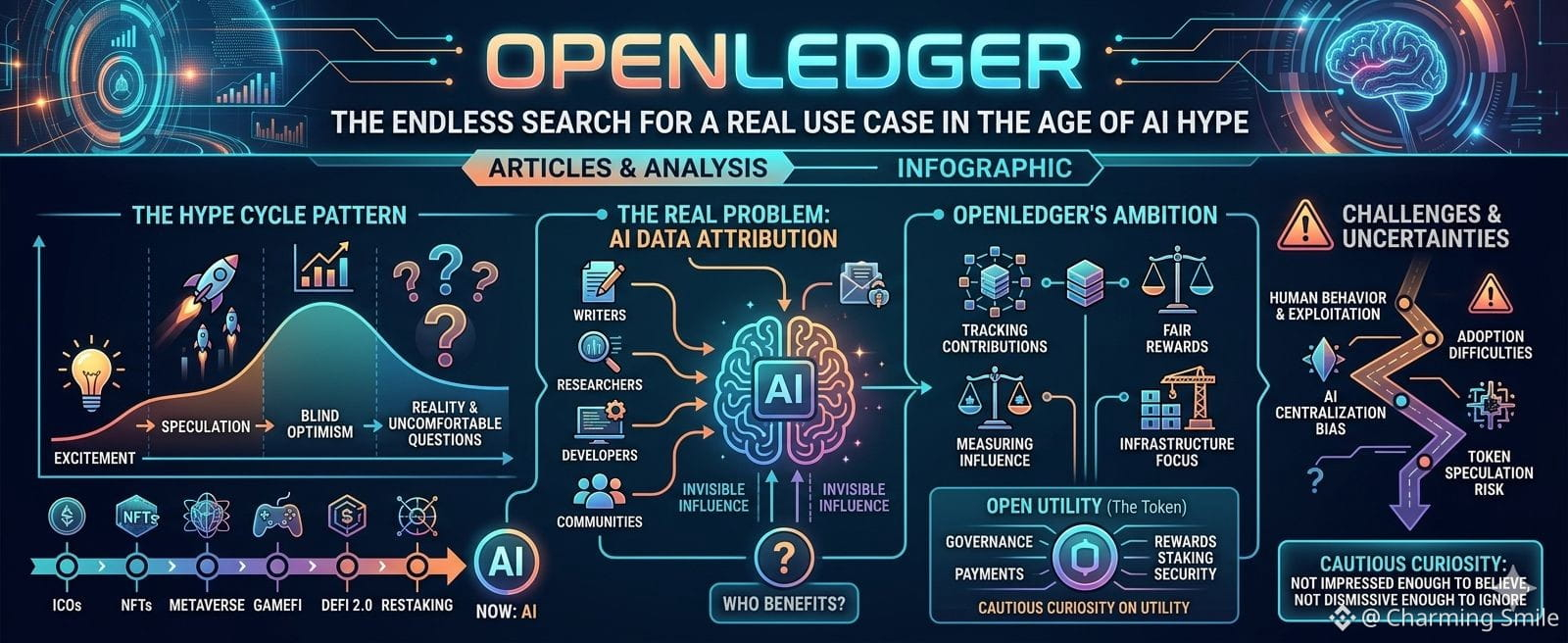
Every cycle arrives with its own vocabulary, its own promises, and its own army of people explaining why this time is different. The names change, the logos change, and the narratives change, but the emotional rhythm stays almost identical. First comes excitement. Then speculation. Then blind optimism. Then reality shows up and asks uncomfortable questions.
A few years ago everyone was talking about ICOs. Then NFTs became the answer to everything. After that it was metaverse worlds that supposedly nobody would ever want to leave. Then came GameFi, DeFi 2.0, Layer 2s, Layer 3s, restaking, and whatever else crypto Twitter needed to stay entertained for another six months.
Now it's AI.
Of course it's AI.
Honestly, if you launched a blockchain project today without mentioning artificial intelligence somewhere in the pitch, people might assume you're not trying hard enough.
That doesn't mean AI isn't important. It obviously is. Unlike some previous crypto narratives, AI is already changing industries in real time. People use it every day. Companies are investing billions into it. The technology itself is real.
The problem is that crypto has a habit of attaching itself to real trends and then creating a mountain of speculation around them.
That's why I approached OpenLedger with a mixture of curiosity and skepticism.
Not because I think it's going to change the world.
Not because I think it's the next big thing.
Mostly because the problem it is trying to address actually exists.
And that's becoming surprisingly rare.
The basic idea behind OpenLedger revolves around something most people don't think about when using AI. Every AI model is built on data. Every answer generated by a model comes from information that originated somewhere. Writers create content. Researchers publish studies. Developers contribute code. Communities generate knowledge. People spend years producing information that eventually becomes part of larger AI systems.
Yet when those systems generate value, the original contributors are often invisible.
That disconnect is real.
Whether you're talking about artists, developers, content creators, or researchers, there is an ongoing debate about who benefits when AI models learn from their work. Most of the rewards currently flow toward the companies building and operating the models.
So when OpenLedger talks about attribution and rewarding contributors, I understand why people find the concept appealing.
The problem itself makes sense.
What I'm less certain about is whether the solution can be implemented at the scale people imagine.
That's where years of crypto experience make me cautious.
Crypto is full of elegant ideas that become messy the moment they encounter actual human behavior.
Everyone loves transparency until incentives get involved.
Everyone loves decentralization until convenience becomes more important.
Everyone loves fair reward systems until people figure out how to exploit them.
That's the part that worries me.
Tracking contributions sounds reasonable in theory. Creating systems that fairly determine who deserves rewards sounds reasonable too. But once millions of users, datasets, models, and transactions enter the equation, things become significantly more complicated.
Who decides what contribution was valuable?
How do you measure influence?
How do you prevent manipulation?
How do you stop people from flooding systems with low-quality information simply because rewards exist?
Maybe OpenLedger has answers to some of these questions.
Maybe it develops better mechanisms over time.
Maybe the industry itself becomes better at attribution.
Or maybe the entire concept turns out to be far more difficult than people currently realize.
I've seen enough projects fail because they underestimated the complexity of human incentives.
The AI aspect creates another layer of uncertainty.
Let's be real for a moment.
A lot of people in crypto talk about decentralized AI as if it's already inevitable. They speak about autonomous agents, decentralized intelligence, and machine economies the same way people once talked about virtual land in metaverse worlds.
But reality tends to be less exciting.
Most of the advanced AI systems people use today remain heavily centralized. Training sophisticated models requires massive resources. Running them requires infrastructure that most organizations simply don't possess. The economics naturally favor large players.
That doesn't mean decentralization has no role to play.
It just means the path isn't as simple as many presentations make it sound.
Whenever I hear claims about decentralized AI ecosystems, I immediately start wondering where decentralization actually begins and where marketing language takes over.
OpenLedger seems aware of this challenge, which is partly why I find it more interesting than some of the louder projects in the space. It appears focused on creating infrastructure rather than trying to convince everyone that it's building some science-fiction version of the future.
Infrastructure is boring.
And honestly, that's usually a good sign.
The most useful things in technology are often the least exciting.
Nobody gets emotionally attached to databases.
Nobody celebrates payment rails.
Nobody creates cult-like communities around backend systems.
Yet those systems quietly support everything else.
If OpenLedger succeeds, it will probably succeed because it becomes useful infrastructure rather than because it becomes a cultural phenomenon.
The token itself creates another set of questions.
That's not unique to OpenLedger.
It's a crypto-wide issue.
After enough years in this industry, I've developed a habit of asking whether a token genuinely improves a network or simply exists because investors expect one.
Sometimes the answer is obvious.
Other times it feels forced.
Every project seems to have a token that handles governance, payments, rewards, incentives, staking, security, and a dozen other responsibilities simultaneously.
At some point the token starts sounding less like a necessity and more like a Swiss Army knife desperately trying to justify its own existence.
That doesn't mean OPEN lacks utility.
It simply means I no longer accept token utility claims at face value.
Experience teaches you to separate the infrastructure from the asset attached to it.
They're not always the same thing.
Another reality that can't be ignored is adoption.
Crypto investors often assume that if a problem exists, people will automatically adopt the solution.
History says otherwise.
The graveyard of this industry is filled with technically impressive projects that nobody cared enough to use.
Adoption is difficult.
Changing behavior is difficult.
Competing with established systems is difficult.
Even if OpenLedger builds effective attribution systems, there is still the challenge of convincing developers, businesses, researchers, and AI companies to participate.
That's a much bigger challenge than launching technology.
Technology is often the easy part.
Getting people to care is the hard part.
What makes OpenLedger interesting to me isn't certainty.
It's uncertainty.
The problem is real enough that it deserves attention.
The solution is ambitious enough to be worth watching.
At the same time, the risks are impossible to ignore.
AI attribution remains largely unproven.
Decentralized AI remains an experiment.
Token-driven ecosystems remain vulnerable to speculation overwhelming actual utility.
And crypto's history remains littered with projects that sounded brilliant before encountering reality.
Honestly, that's where I land.
Not impressed enough to become a believer.
Not dismissive enough to ignore it.
Just curious.
Maybe it works, maybe it doesn't.
Maybe years from now we'll look back and realize attribution was a missing piece of the AI economy.
Or maybe we'll discover that the incentives, complexity, and adoption challenges were bigger than anyone expected.
I've been through enough crypto cycles to know that certainty is usually expensive.
These days, cautious curiosity feels far more valuable.
And when I look at OpenLedger, cautious curiosity is probably the most honest reaction I can offer.
