
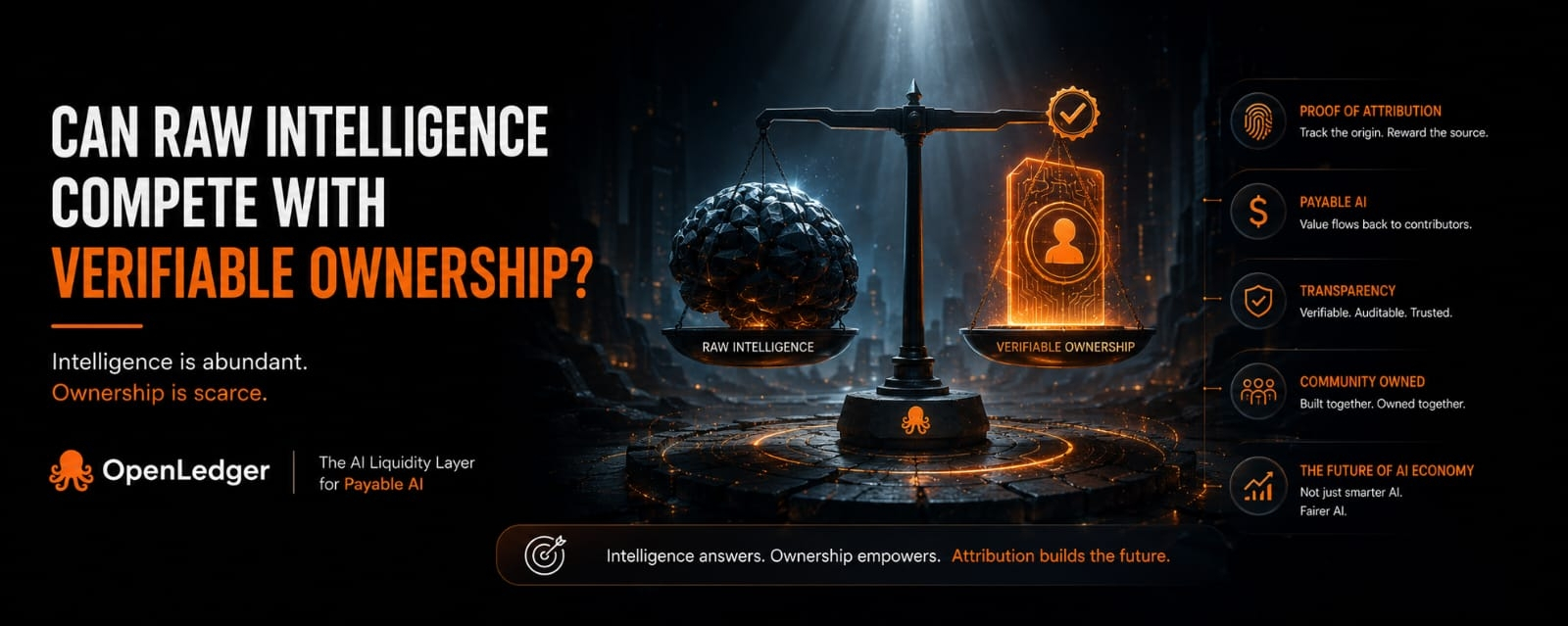

The more I study AI, the more convinced I become that we're approaching a major shift in how value is created and captured.
For the last few years, the industry has been obsessed with intelligence itself. Bigger models. Larger datasets. Faster inference. More powerful outputs. The assumption has been simple: the smartest AI wins.
But what if intelligence isn't the real prize?
What if the real prize is proving where that intelligence came from?
That's the question that keeps bringing me back to OpenLedger.
Every AI model is built on data. Not just a little data, but enormous amounts of human knowledge accumulated over years. Research papers, industry expertise, community insights, financial records, medical information, and countless contributions from people who may never receive recognition for the value they've created. Yet when AI generates an output worth millions—or eventually billions—of dollars, almost nobody can identify who contributed to that value creation process.
The intelligence is visible.
The contributors are invisible.
And I believe that's one of the biggest structural problems in AI today.
OpenLedger approaches this problem from a completely different angle. Instead of asking how AI can become more intelligent, it asks how AI can become more accountable. Instead of focusing solely on generating outputs, it focuses on proving origins. Through its vision of Payable AI and Proof of Attribution, OpenLedger is building infrastructure designed to track where intelligence comes from, who contributed to it, and how value should flow back to those contributors.
That distinction might sound subtle today.
I think it could become one of the most important shifts in the entire AI economy.
The reality is that intelligence is becoming increasingly abundant. Every year, models become cheaper, faster, and more accessible. Open-source AI continues to close the gap with proprietary systems. Capabilities that once seemed revolutionary quickly become commodities. History teaches us that when something becomes abundant, the market starts rewarding what remains scarce.
In the age of AI, scarcity may not be intelligence.
Scarcity may be attribution.
Scarcity may be ownership.
Scarcity may be trust.
Imagine two AI systems producing identical answers. One gives you the output and nothing more. The other shows exactly which data sources influenced the result, which contributors helped create the underlying knowledge, and how economic rewards should be distributed across the network. Both systems are intelligent. Only one creates transparency.
As AI becomes more integrated into finance, healthcare, research, and enterprise decision-making, transparency won't be a luxury. It will be a requirement.
This is why I believe OpenLedger's thesis is so important.
The future AI economy cannot function efficiently if data contributors remain invisible. Every successful economy eventually develops mechanisms for ownership. Real estate has property rights. Capital markets have shareholder rights. Blockchains introduced digital ownership. AI is now reaching a point where it needs its own ownership layer.
OpenLedger's Proof of Attribution is attempting to build exactly that.
By creating a framework where contributions can be identified and rewarded, it transforms data from a passive resource into an active economic asset. Instead of treating contributors as disposable inputs, it treats them as stakeholders. Instead of extracting value from communities, it creates the possibility for communities to participate in value creation.
That's a fundamentally different vision from the AI systems we see today.
What makes this even more compelling is the rise of AI agents. The next generation of AI won't simply answer questions. Agents will execute tasks, make decisions, purchase services, access datasets, and interact with other agents autonomously. In such an environment, attribution becomes even more important. If AI agents are generating economic activity, there must be a way to identify who contributed to the intelligence behind those actions.
Without attribution, value becomes concentrated.
With attribution, value can be distributed.
That's the difference between extraction and participation.
It's also why OpenLedger's concept of Payable AI feels increasingly relevant. The idea that data contributors, validators, developers, and AI participants can all share in the value they help create introduces a new economic model for artificial intelligence. One where intelligence isn't simply consumed but monetized transparently across an ecosystem.
The AI industry often talks about building smarter systems.
OpenLedger is asking a more important question:
How do we build fairer systems?
Because intelligence alone doesn't create sustainable economies.
Ownership does.
Attribution does.
Incentives do.
The next decade of AI may not be defined by which model generates the best response. It may be defined by which network creates the most transparent relationship between intelligence and value. The projects that can prove contribution, verify ownership, and reward participants may ultimately capture more trust than those focused solely on raw capability.
That's why when I look at the future of AI, I don't just see a race for intelligence.
I see a race for attribution.
And in that race, OpenLedger isn't trying to build another AI model.
It's trying to build the ownership layer for the AI economy itself.
The question isn't whether AI will become more intelligent.
It will.
The real question is who will own the value that intelligence creates.
And that may be the most important question OpenLedger is trying to answer.