I didn't take it seriously at first. I've seen too many foundational protocols come and go. AI blockchain. Liquidity for data. Agents with wallets. It sounded like a clean narrative stitched together from whatever the market was already excited about.
And maybe that's unfair. Fatigue does that. After a few cycles your first instinct is to protect yourself from believing too quickly.
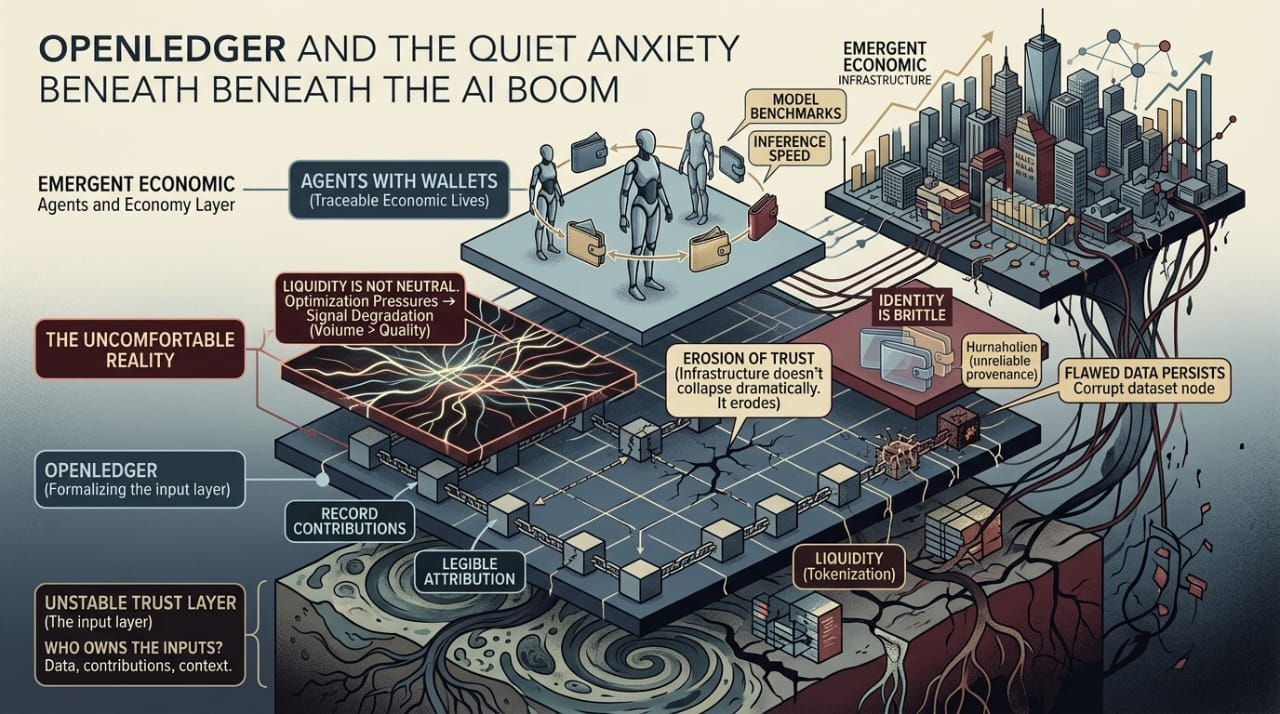
But OpenLedger keeps resurfacing in my thoughts and not because of the AI angle. It's because of the layer it's poking at the one we've mostly ignored while obsessing over model benchmarks and inference speed.
The input layer.
Data. Model contributions. Autonomous agents acting on top of increasingly opaque systems. We've treated these as background materia almost neutral. But they're not neutral. They carry incentives, ownership assumptions, power dynamics.
I keep coming back to that.
If AI is becoming economic infrastructure and it clearly is then the question of who owns the inputs isn't philosophical. It's structural. Who gets paid? Who gets credit? Who carries responsibility when things go wrong?
OpenLedger's answer seems to be: make it legible. Record contributions. Create liquidity around them. Let models and agents have traceable economic lives.
On paper that feels sensible. At least it acknowledges the imbalance between value created and value captured.
But liquidity is not a neutral act.
That's where things start to feel uncomfortable.
Once data contributions become monetizable, the system invites optimization. People will tailor inputs to whatever metrics determine payout. Some of that will improve coordination. Some of it will quietly degrade signal. Volume can overwhelm quality. Edge cases multiply.
We’ve seen this pattern in every tokenized ecosystem. Early participants build thoughtfully. Later entrants optimize ruthlessly. Governance thins out. A smaller group ends up carrying the operational weight.
Infrastructure doesn't collapse dramatically. It erodes.
Maybe that's too harsh. A ledger at least creates transparency. It’s better than opaque corporate stacks where provenance is invisible and compensation is discretionary. Open systems allow contestation. That matters.
Still transparency isn't the same as trust.
If a dataset is flawed recording it on chain doesn't fix the flaw. If a model inherits bias from upstream contributions, economic attribution doesn't resolve harm. If an agent behaves badly its wallet history doesn't automatically clarify accountability.
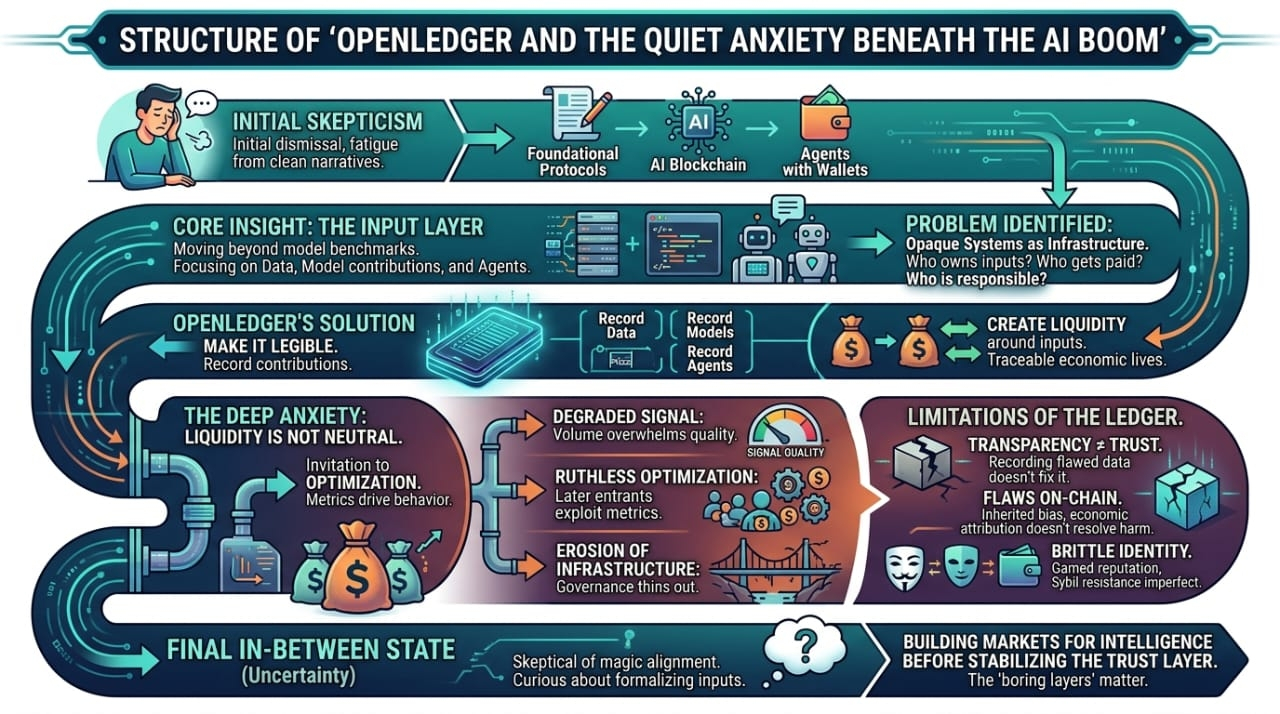
And identity identity is brittle in crypto. Wallets are transferable. Reputation can be gamed. Sybil resistance remains imperfect. Anchoring intelligence to economic identities assumes we've solved persistence better than we have.
I didn't take it seriously at first because it felt like we were pricing something still in flux. Intelligence is emergent. Data shifts meaning across contexts. Agents evolve. Locking these into economic primitives feels premature.
But ignoring the economics doesn't stop them from forming. It just means they form behind closed doors.
So I'm left in this in between space. Skeptical of the idea that liquidity will magically align incentives. Curious about whether formalizing the input layer might prevent deeper consolidation. Unsure how it behaves when incentives shrink or disputes arise.
I keep coming back to the same uneasy thought we're building markets around intelligence before we've stabilized the trust layer beneath it.
Maybe that's inevitable. Or maybe it's the part we'll wish we had slowed down for.
I don't have a conclusion. Just a growing sense that the boring layers matter more than we admit and that we won't know if they're strong enough until something tests them.
@GeniusOfficial $OPEN #OpenLedger