
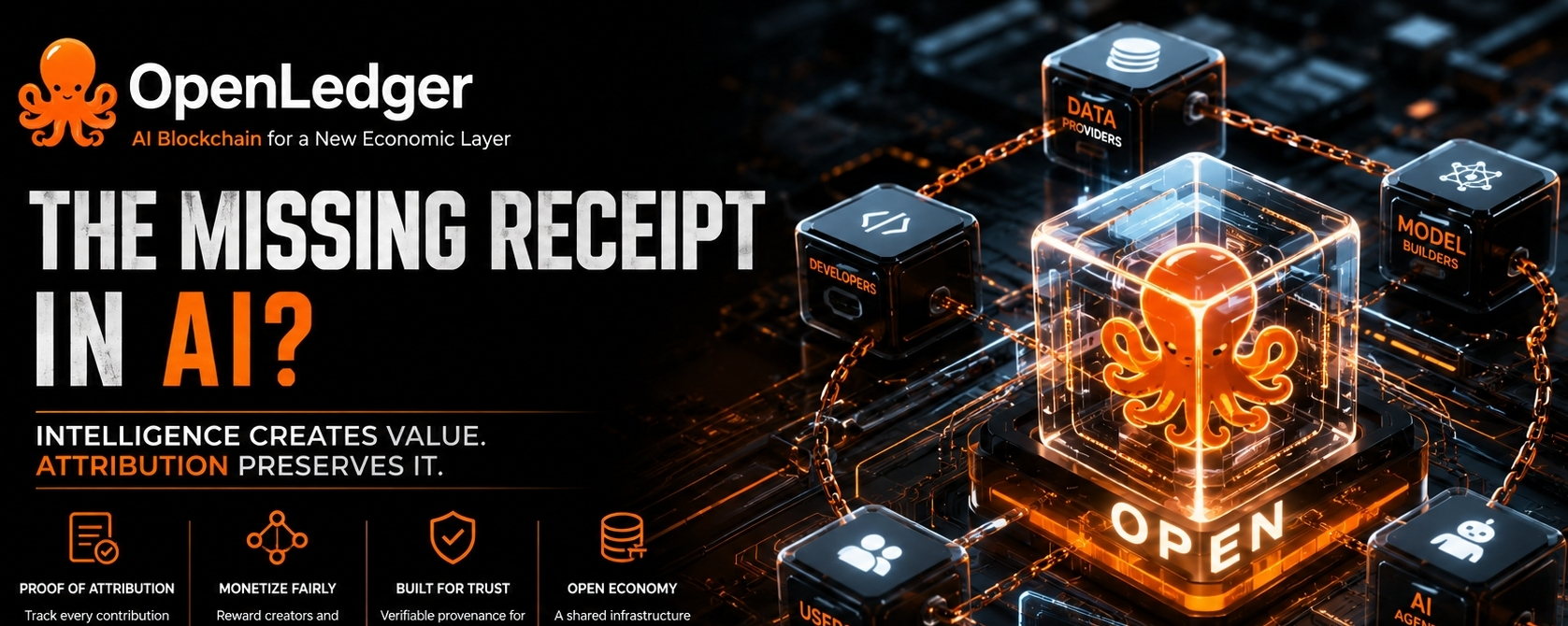
I have spent enough time around both AI and crypto to notice a recurring pattern. Whenever a new AI project appears, the conversation almost immediately shifts toward models. People compare performance, speed, reasoning ability, and output quality. The assumption is that the future will belong to whoever builds the smartest system.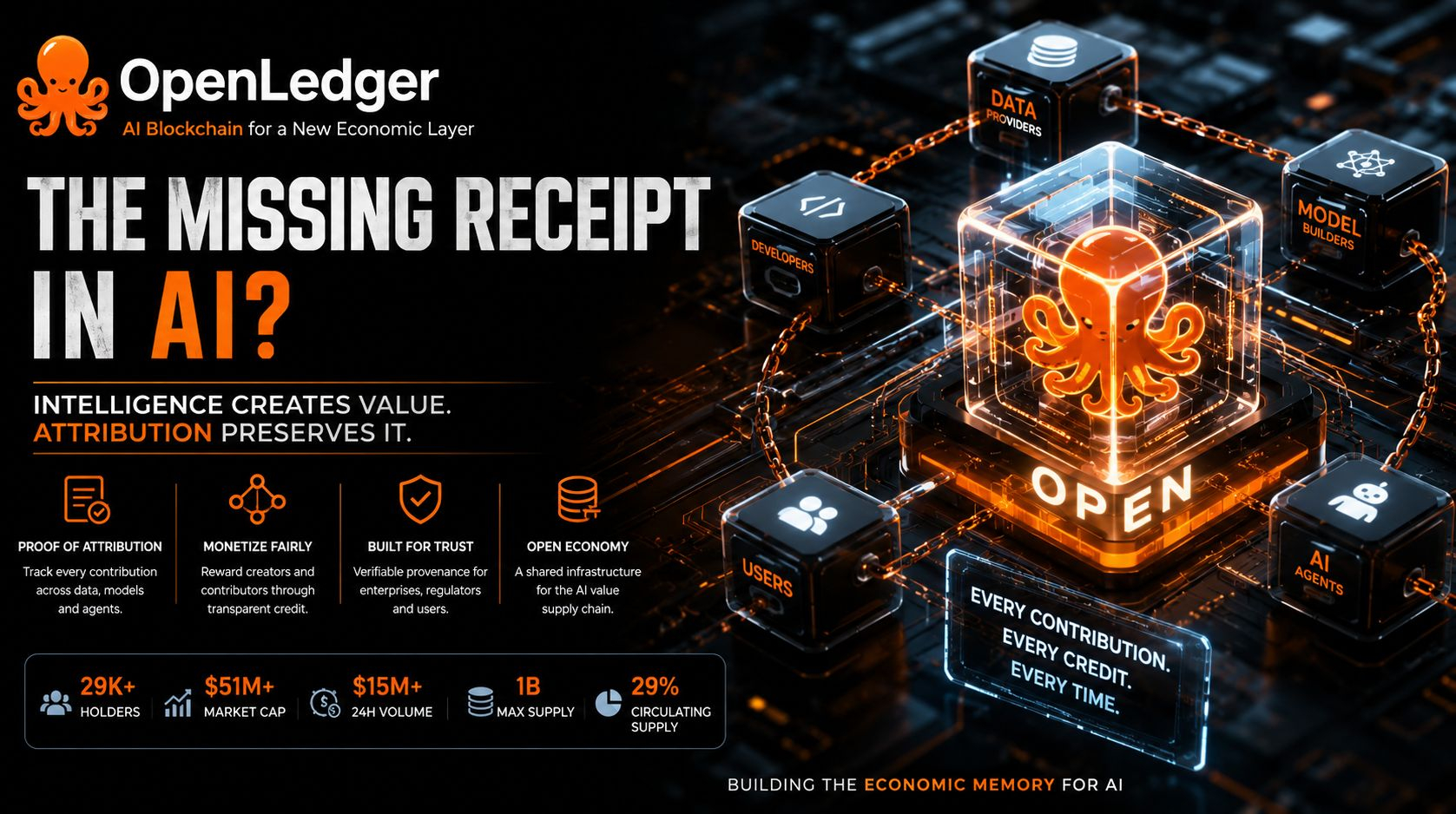
But the longer I observe the industry, the less convinced I become that intelligence is the most important problem left to solve.
What increasingly interests me is something far less glamorous: attribution.
Every AI model is built on layers of human contribution. Data is collected, cleaned, labeled, refined, and organized. Models are trained and improved. Agents are developed and deployed. Yet once value is created, the trail often disappears. The people and resources that helped produce the outcome become difficult to identify, and even harder to reward.
That is the lens through which I started looking at OpenLedger.
What caught my attention was not the promise of another AI blockchain. The market already has plenty of those. Instead, OpenLedger seems to be exploring a much deeper question: what if AI needed a system that could remember where value came from?
The easiest way I can describe it is through an analogy. Imagine walking into a supermarket where every product has been stripped of its label. The food is still there. People can still buy it. But nobody knows who grew it, transported it, processed it, or supplied it. Eventually, the entire economic system becomes difficult to sustain because contributions are no longer visible.
That situation feels surprisingly similar to today's AI landscape.
Models generate enormous amounts of value, but the chain of contribution behind those outputs is often hidden. OpenLedger appears to be attempting to create a record of that journey, allowing data, models, and AI agents to remain economically traceable instead of disappearing into a black box.
The timing is particularly interesting.
Over the past year, AI discussions have shifted away from pure capability and toward accountability. Questions surrounding ownership, licensing, creator rights, and data provenance are becoming harder to ignore. Regulators are asking them. Businesses are asking them. Even users are beginning to ask them.
This is why OpenLedger's recent developments matter more than they might initially appear. The introduction of Proof of Attribution and the network's broader focus on traceability suggest an effort to build infrastructure for a future where AI outputs are not enough. The market may eventually demand evidence of origin as well.
Another development that stood out to me was the integration with Story Protocol. Most people see partnerships and immediately think about ecosystem expansion. I see something slightly different. I see an acknowledgment that AI's economic future may depend on rights management just as much as technical innovation.
In many ways, AI today resembles the early internet. Everyone is focused on creating value, but very few systems are designed to track how that value was created in the first place. OpenLedger seems to be betting that this missing layer will eventually become essential.
The numbers tell an interesting story too.
The project remains relatively small compared to the scale of the problem it is attempting to address. Daily trading activity shows there is clear market interest, while the growing holder base suggests expanding awareness. At the same time, a large portion of total supply has yet to enter circulation, making future token distribution an important variable to watch.
I think this is where many investors make a mistake.
They look at token prices before they look at economic design.
For me, the more important question is whether the network creates genuine demand for participation. OpenLedger's token appears less like a simple payment asset and more like a coordination mechanism connecting different groups inside an AI economy. Data contributors, developers, model builders, and infrastructure providers all potentially interact through the same system.
A second analogy comes to mind here.
Most people think of AI as a factory that produces intelligence. OpenLedger feels more like the accounting department attached to that factory. The machines can still operate without it for a while, but as production scales, someone eventually needs to know who contributed what, who should be compensated, and where value originated.
That function may sound boring compared to cutting-edge AI research.
Historically, however, systems that improve coordination often become more important than systems that improve production.
There is also one contrarian thought I keep returning to.
The market generally assumes compute will remain AI's most valuable resource. I am not sure that will always be true.
Compute tends to become cheaper over time. Hardware improves. Infrastructure expands. Efficiency increases.
Trust, however, often becomes more expensive.
As AI-generated content floods the internet, proving authenticity and origin may become increasingly valuable. In that environment, attribution is no longer just an administrative feature. It becomes economic infrastructure.
Of course, none of this guarantees success.
OpenLedger still faces significant challenges. Adoption remains the biggest one. Building attribution systems is one thing; convincing developers, businesses, and contributors to use them is something entirely different. The project must demonstrate that attribution creates real economic benefits rather than simply generating additional complexity.
Competition will also grow. As the importance of provenance becomes clearer, more projects will enter the space. Large technology companies may even develop their own closed attribution systems.
That is why I am less interested in announcements and more interested in measurable activity.
I want to see whether datasets are being registered. I want to see whether models are generating attributable value. I want to see whether economic activity consistently flows through the network. Those signals will tell us far more than short-term market excitement.
What ultimately makes OpenLedger worth watching, in my view, is that it focuses on a question most of the industry still treats as secondary.
Everyone wants AI to become smarter.
Far fewer people are asking how AI will remember who created value.
Yet that question may become one of the defining economic challenges of the next decade.
If AI becomes a global production system, attribution may become its accounting system. And if that happens, OpenLedger's biggest contribution may not be helping machines think.
It may be helping economies remember.
