
The crazy thing about crypto is that most people only see the token.
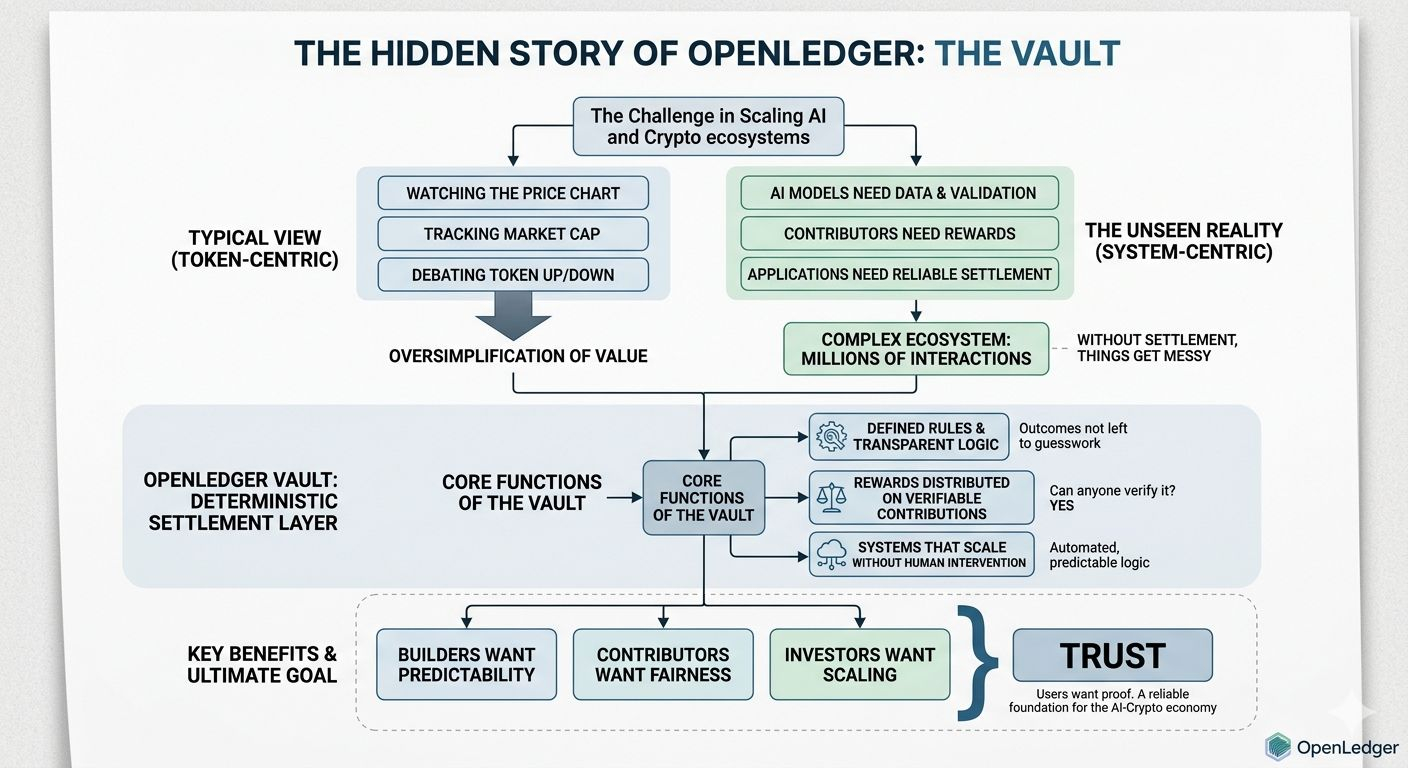
They watch the price chart.
They track the market cap.
They debate whether the token will go up or down.
But sometimes the real story is hiding underneath, quietly doing the work nobody notices.
That's exactly how I started thinking about OpenLedger's Vault.
At first, I looked at the token like everyone else. Supply. Distribution. Utility. The usual stuff.
Then I started digging deeper.
And honestly, the Vault might be one of the most underrated pieces of the whole system.
Think about it for a second.
AI is becoming one of the biggest industries on the planet. Models need data. Data needs validation. Contributors need rewards. Applications need reliable settlement.
Now imagine millions of interactions happening across an AI ecosystem every day.
Who gets paid?
How much should they receive?
Can the outcome be trusted?
Can anyone verify it?
Without a reliable settlement layer, everything starts becoming messy.
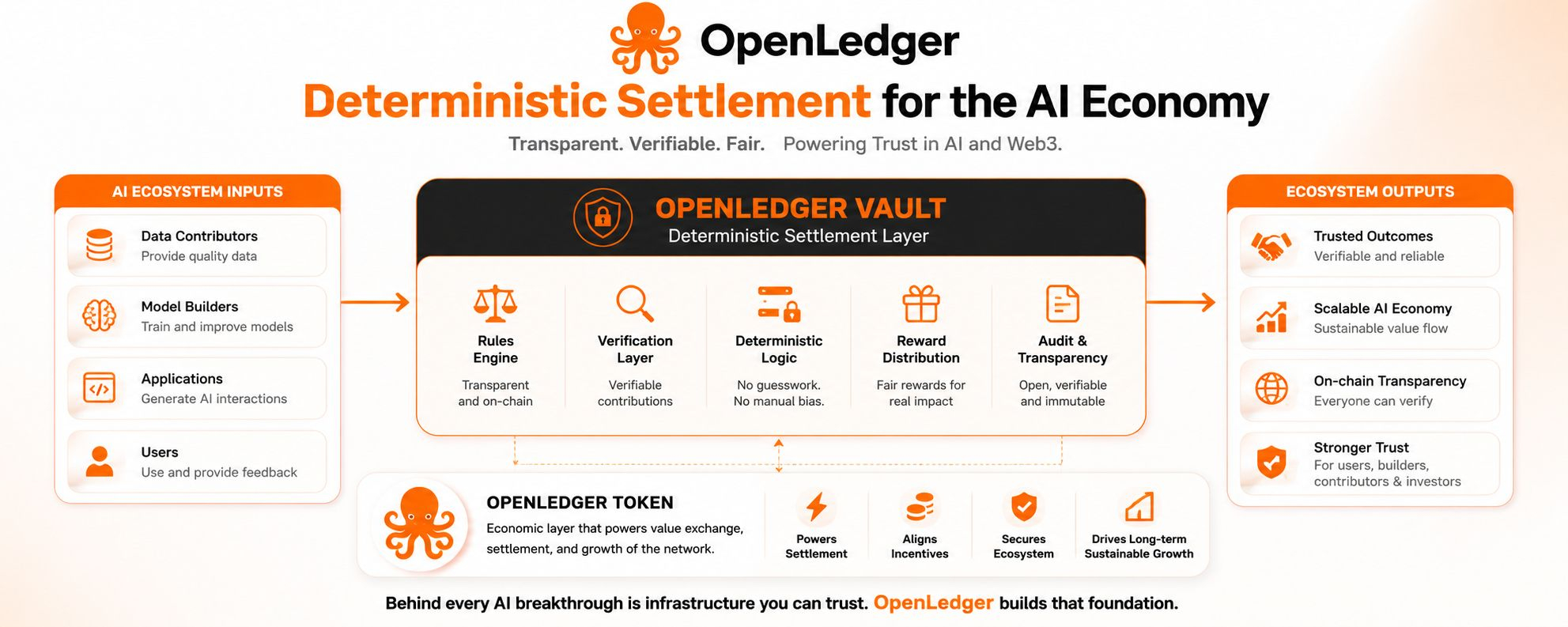
This is where @OpenLedger gets interesting.
The Vault acts like a deterministic settlement layer, meaning outcomes are not left to guesswork or manual decisions. The rules are defined, the logic is transparent, and rewards can be distributed based on verifiable contributions.
That may sound technical.
But when you simplify it, it becomes something much bigger.
Trust.
Because trust is one of the hardest things to build in both AI and crypto.
Users want proof.
Builders want predictability.
Contributors want fairness.
And investors want systems that can scale without constantly relying on human intervention.
The more I think about it, the more the OpenLedger token feels connected to this entire process.
Not just as a speculative asset.
But as part of the economic layer that powers value exchange inside the network.
If AI-generated value is flowing through the ecosystem, then settlement becomes one of the most important functions.
And if settlement becomes important, infrastructure becomes important.
Most people chase the shiny AI application.
Very few people pay attention to the layer making sure everything actually works behind the scenes.
History has a funny habit of rewarding infrastructure.
The roads often become more valuable than the cars driving on them.
Maybe that's why I keep finding myself paying attention to #OpenLedger .
Not because of hype.
Not because of narratives.
But because the project seems focused on solving foundational problems that many people are still ignoring.

Of course, execution is everything.
A great design means nothing if adoption never comes.
But if AI economies continue growing and on-chain contribution systems become more common, deterministic settlement could end up being far more important than most people realize today.
What do you think?
Will AI ecosystems eventually need dedicated settlement infrastructure like this?
Or are most investors still too focused on tokens to notice the systems creating the actual value underneath?