
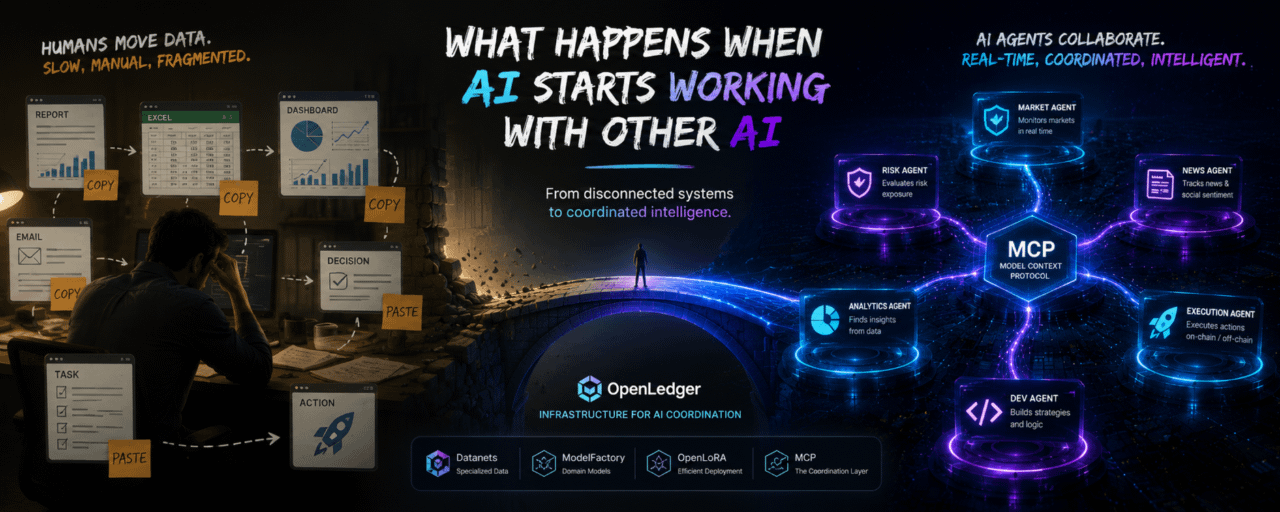
Every day millions of people move information from one system to another.
A report gets copied into a spreadsheet.
A spreadsheet becomes a dashboard.
A dashboard becomes a decision.An email becomes a task.
A task becomes an action.
The more I think about it, the more I realize that a surprising amount of modern work is simply moving information between systems.
Humans spend hours acting as the connection layer.Reading something in one place.
Understanding it.Then passing it somewhere else.
Which made me wonder:What happens when AI starts doing that job instead of humans?
Today, most AI systems still behave like assistants.You ask a question.
The model responds.The interaction ends.
But that may only be a temporary phase .The future could look very different.
Imagine a trading environment where one AI agent monitors markets in real time.A second agent evaluates risk exposure.A third agent tracks news and social sentiment.A fourth agent executes transactions.
No single agent understands everything.Instead, they specialize and collaborate.At first glance, this sounds like an intelligence problem.But the more I think about it, the less convinced I become.
The challenge is not making every agent smarter.
The challenge is making them work together.
Because even highly capable agents can fail if they cannot share context, access the right tools, or communicate effectively with other systems.A market signal is useless if the execution agent never receives it.
A risk warning is useless if it arrives after a transaction has already happened A research insight is useless if it cannot move between systems fast enough.
The more I look at OpenLedger's architecture, the more it feels like the ecosystem is being built around this exact problem.
What makes this particularly interesting is that OpenLedger was never designed around a single model doing everything.
Datanets create specialized knowledge.ModelFactory enables domain-specific models.
OpenLoRA allows those models to be deployed efficiently.Instead of one giant intelligence layer, the ecosystem encourages specialization.
And specialization naturally creates a new requirement:Coordination.This is where MCP becomes important.
OpenLedger describes MCP as a way for AI models to interact with external tools, databases, APIs, blockchains, and real-time information through a standardized interface.At first, that may sound like a technical improvement.But I think the implications are much bigger.
If do not share standards, every AI agent becomes an isolated island.Every new tool requires another custom integration.Every connection becomes another point of failure.
Scale becomes complexity.MCP attempts to solve that problem by creating a common language between models and the systems around them.
In many ways, it reminds me of what happened with the internet itself.The internet did not become valuable because one computer became dramatically smarter than every other computer.It became valuable because millions of different systems could communicate through shared standards.
The more I think about it, the more I wonder if AI is heading toward a similar transition For years, the competition has been about intelligence.
Bigger models.More parameters.Better benchmarks.
But a world filled with specialized agents may create a different bottleneck.
Coordination.The more I look at OpenLedger's architecture, the less it resembles a traditional AI platform.
It starts looking more like an operating environment for specialized agents.One model may understand markets.
Another may understand governance.Another may analyze risk.Another may interact with external tools.
MCP acts as the connective layer that allows these systems to access real-time information, exchange context, and operate within the same environment rather than as isolated intelligence silos.That may become increasingly important as AI moves beyond chat interfaces and into real-world workflows.
Because eventually the question may no longer be:"How smart is the AI?"The question may become:...."How well can thousands of specialized AIs work together?"
OpenLedger's long-term vision seems to recognize that intelligence alone does not create useful systems.Coordination does.And the next major AI breakthrough may not come from building a smarter model.
It may come from making thousands of models capable of working together.
