
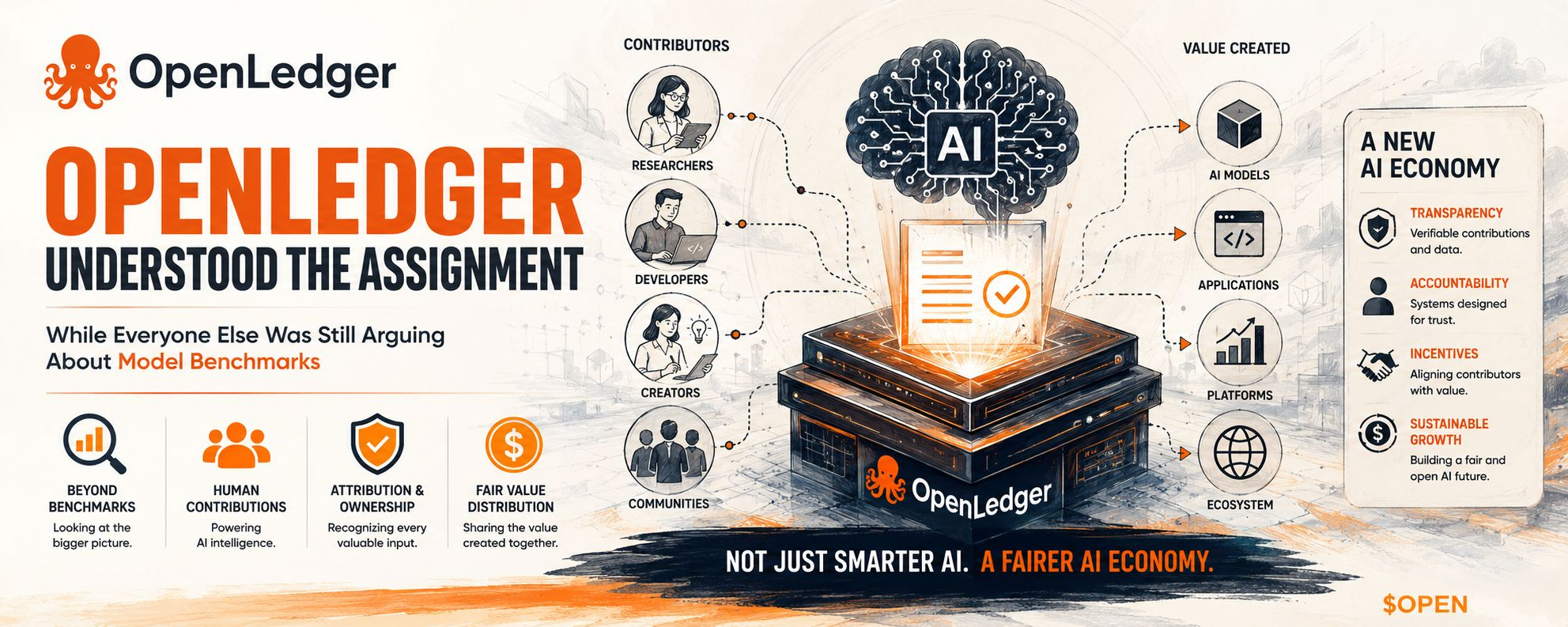
A question has been sitting in the back of my mind lately.If AI becomes a trillion dollar industry where does all that value actually go?
Most investors spend their time comparing models, tracking new releases and debating which company has the strongest technology. That makes sense because intelligence is the most visible part of the market.
But the biggest opportunities are not always found where everyone is looking.
Sometimes the real opportunity sits in the infrastructure layer that quietly enables the entire ecosystem.
When I look at AI today I see an industry generating enormous value from data, expertise and human knowledge. Yet most discussions focus almost entirely on the models themselves.
Very few people are asking how contributors are tracked.
Very few are asking who owns the value generated by AI systems.
And even fewer are asking how that value might eventually be distributed.
That is where OpenLedger caught my attention.
While much of the market was debating benchmark scores and parameter counts OpenLedger appeared to be focused on a different challenge altogether.
The project asks a question that feels increasingly important:
If AI creates value using knowledge contributed by thousands of people who should benefit from that value?
That question becomes harder to ignore every year.
Modern AI systems depend on enormous amounts of information. Researchers, developers, experts, creators and communities all contribute pieces of the intelligence that eventually powers AI applications.
Yet most contributors remain invisible.
The models receive attention.
The platforms capture revenue.
The contributors often receive neither recognition nor economic participation.
That imbalance feels difficult to sustain indefinitely.
OpenLedger's attribution focused approach is interesting because it shifts the discussion away from pure intelligence and toward ownership, transparency and incentives.
Instead of only asking how to make AI smarter it asks how to make the AI economy fairer and more accountable.
That does not automatically guarantee success.
In fact, I think the hardest part is still ahead.
Attribution sounds simple until you try to measure it.
Data quality must be verified.
Contributions must be tracked accurately.
Rewards must be distributed fairly.
The entire system must remain economically efficient.
Those are difficult problems.
But they are real problems.
And unlike benchmark competitions they do not disappear when a newer model arrives.
The reason I continue paying attention to projects like OpenLedger is that they seem focused on infrastructure rather than headlines.
Benchmarks create excitement.
Infrastructure creates ecosystems.
One tends to dominate social media for a few weeks.
The other can shape entire industries for years.
As an investor I find that distinction important.
The market often rewards visible innovation first and foundational innovation later.
If AI continues moving toward a world where attribution, ownership and trust become essential, then the infrastructure supporting those functions could become far more valuable than many people currently expect.
Maybe OpenLedger succeeds.
Maybe it doesn't.
But I think it identified a problem that most of the industry was not paying attention to while everyone else was busy comparing benchmark scores.
And sometimes that is exactly where the most interesting opportunities begin.$OPEN $LAB $H @OpenLedger #OpenLedger