

I used to think the most important breakthrough in technology was the ability to create intelligence. The challenge seemed straightforward: build better models, train them on more data, and intelligence would naturally become more abundant. But the more I looked into the emerging AI economy, the more I felt something was missing from that story.
Intelligence does not appear from nowhere.
Every model, no matter how advanced, is built on layers of human contribution. Researchers, domain experts, communities, and countless individuals create the knowledge that eventually becomes part of the systems we use. Yet once that knowledge enters the pipeline, its origins often become difficult to see.
One thing keeps coming back to me: what if the next challenge in AI is not creating intelligence, but understanding where it comes from and how its value should be shared?
Bitcoin became important because it introduced a new way to think about value, ownership, and verification. It did not invent value itself. Instead, it created infrastructure that allowed value to move through a more transparent system.
I increasingly wonder whether AI is approaching a similar moment.
Today, intelligence is becoming one of the most valuable resources in the digital economy, yet the process behind its creation often remains opaque. Models generate outputs, but the knowledge, expertise, and data that shaped those outputs can be difficult to trace. As AI systems become more economically significant, questions around attribution and ownership may become harder to ignore.
This is where OpenLedger started making sense to me.
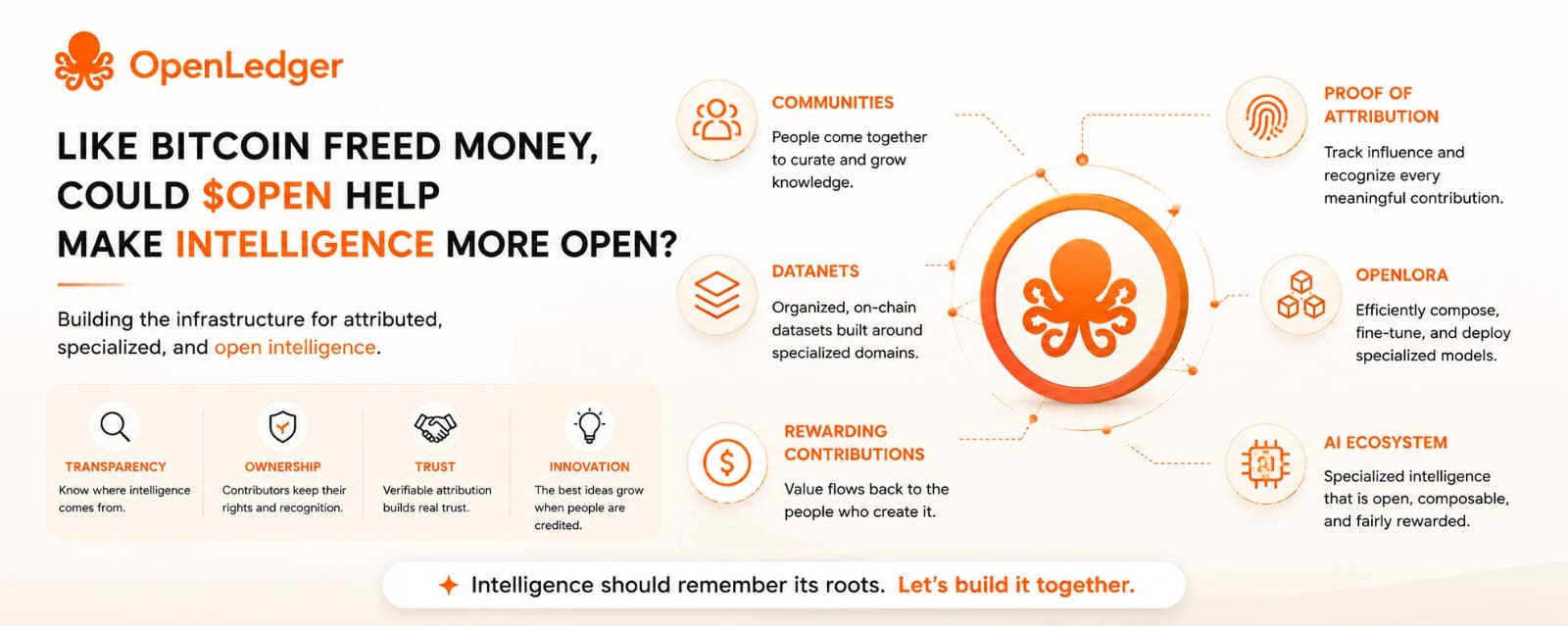
Rather than focusing only on bigger models or more compute, OpenLedger appears to be exploring the infrastructure layer around intelligence itself. The idea that caught my attention is surprisingly simple: if data contributes to value creation, there should be mechanisms that help make those contributions more visible.
Through concepts such as Datanets, communities can collaborate around specialized knowledge domains rather than relying exclusively on broad, generalized datasets. The approach suggests a future where expertise is organized, curated, and potentially linked more closely to the people who contribute it. Alongside this, OpenLedger's vision of Proof of Attribution aims to explore ways of understanding how different contributions participate in the creation of AI-driven value.
This made me pause and reconsider another assumption I had carried for years.
We often talk about general intelligence as if scale alone guarantees progress. But many of the most valuable applications of AI depend on something much more specific: specialized knowledge. Legal expertise, medical insight, scientific research, creative craftsmanship, and industry-specific experience all carry nuances that cannot always be captured through sheer volume alone.
Perhaps the future will not belong exclusively to the largest pools of information. Perhaps it will increasingly reward the highest-quality and most specialized knowledge.
That possibility seems deeply connected to OpenLedger's broader vision. Instead of trying to compete solely on the scale of intelligence, the project appears focused on creating economic and technical frameworks that allow specialized intelligence to be developed, attributed, and potentially rewarded more effectively.
Ownership keeps returning to the center of this conversation.
Not because ownership solves every problem, but because people contribute differently when their contributions are recognized. Without meaningful attribution, there is always a risk that the value generated by collective knowledge becomes disconnected from the individuals and communities who helped create it.
With ideas such as OpenLoRA and attributed model infrastructure, OpenLedger appears to be exploring how specialized AI systems might become easier to deploy and coordinate at scale. More importantly, it raises a larger question about how future AI ecosystems should function.
This feels less like a discussion about one project and more like a discussion about the architecture of future intelligence. As AI becomes increasingly woven into economic life, the systems that govern attribution, ownership, and contribution may become just as important as the models themselves.
In the end, freeing intelligence may not mean building a single all-knowing system. It may mean creating environments where knowledge remains connected to its origins, where contributors remain visible, and where intelligence carries a memory of how it was created.
The question that stays with me is simple: if intelligence can finally remember where it came from, how might that change the way we choose to build it in the future?