I didn’t take it seriously at first
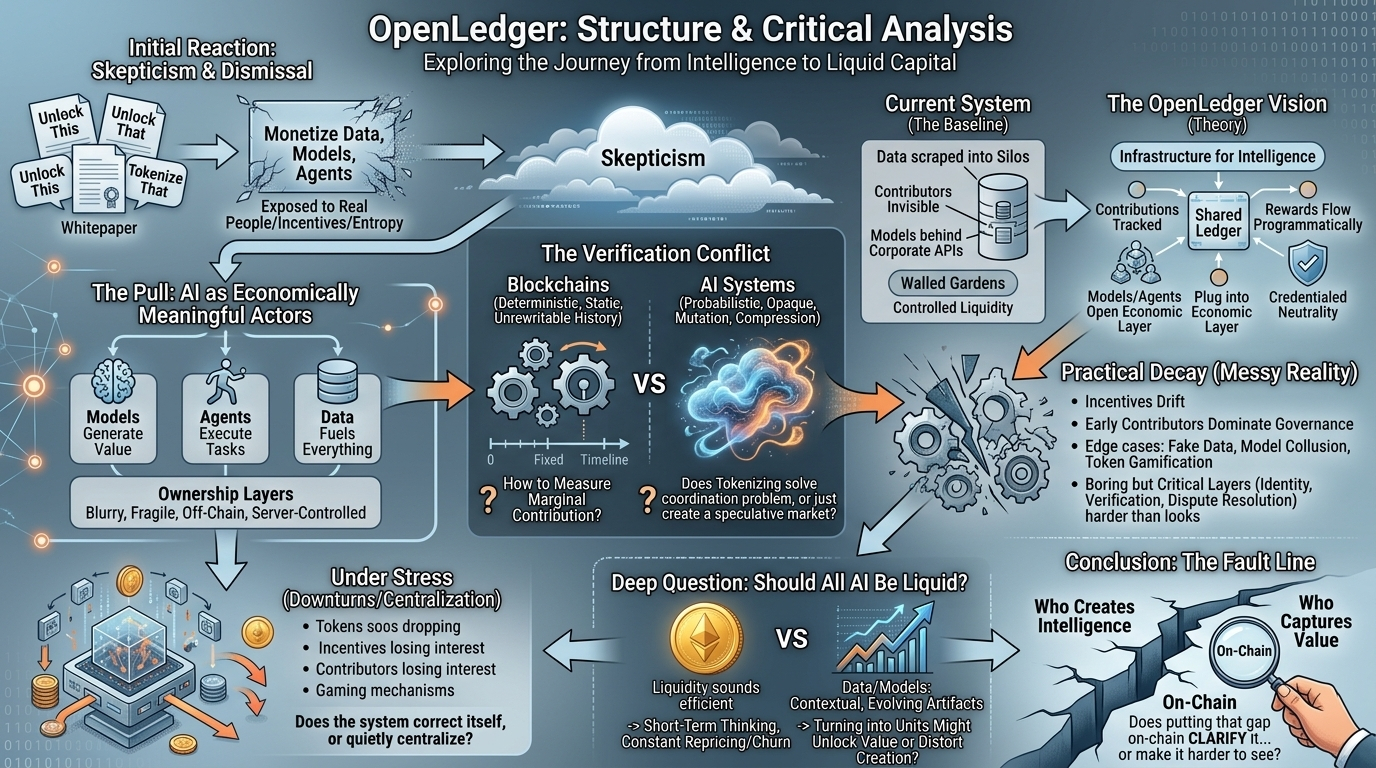
Maybe that’s unfair. But after enough cycles, enough whitepapers about “unlocking” this or “tokenizing” that, your default setting becomes skepticism. Especially when the pitch circles around monetizing data, models, agents — all the invisible machinery behind AI — as if liquidity is the missing ingredient holding everything back.
I’ve watched this space try to financialize almost everything Storage Bandwidth Compute Attention. Most of it works beautifully in controlled demos and then slowly frays at the edges when exposed to real people real incentives, real entropy. So when OpenLedger started framing itself as infrastructure for turning intelligence into something tradable I instinctively grouped it with the rest
But I keep coming back to it
Not because of the surface idea liquidity for data and models sounds almost predictable at this point but because of the underlying tension it’s poking at. AI systems are becoming economically meaningful actors Models generate value Agents execute tasks. Data fuels everything. And yet the ownership the attribution, the compensation layers are blurry Fragile Mostly off chain mostly trust based mostly controlled by whoever owns the server rack
That’s where things start to feel uncomfortable
Blockchains are good at one thing: recording state changes in a way that doesn’t easily rewrite history But AI systems are probabilistic, opaque and constantly mutating How do you verify a model’s contribution? How do you measure the marginal value of a dataset when models remix, compress, and abstract it beyond recognition? And if you somehow can does putting a token around it actually solve the coordination problem or does it just create a market for speculation layered on top of an already fragile supply chain
Maybe that’s too harsh
Because when I zoom out the current system isn’t exactly clean. Data is scraped, aggregated, siloed. Contributors are invisible. Models are centralized behind APIs. Agents these semi-autonomous scripts doing real work operate in walled gardens There is liquidity, yes, but it’s controlled liquidity Permissioned liquidity You don’t really participate unless you’re already inside
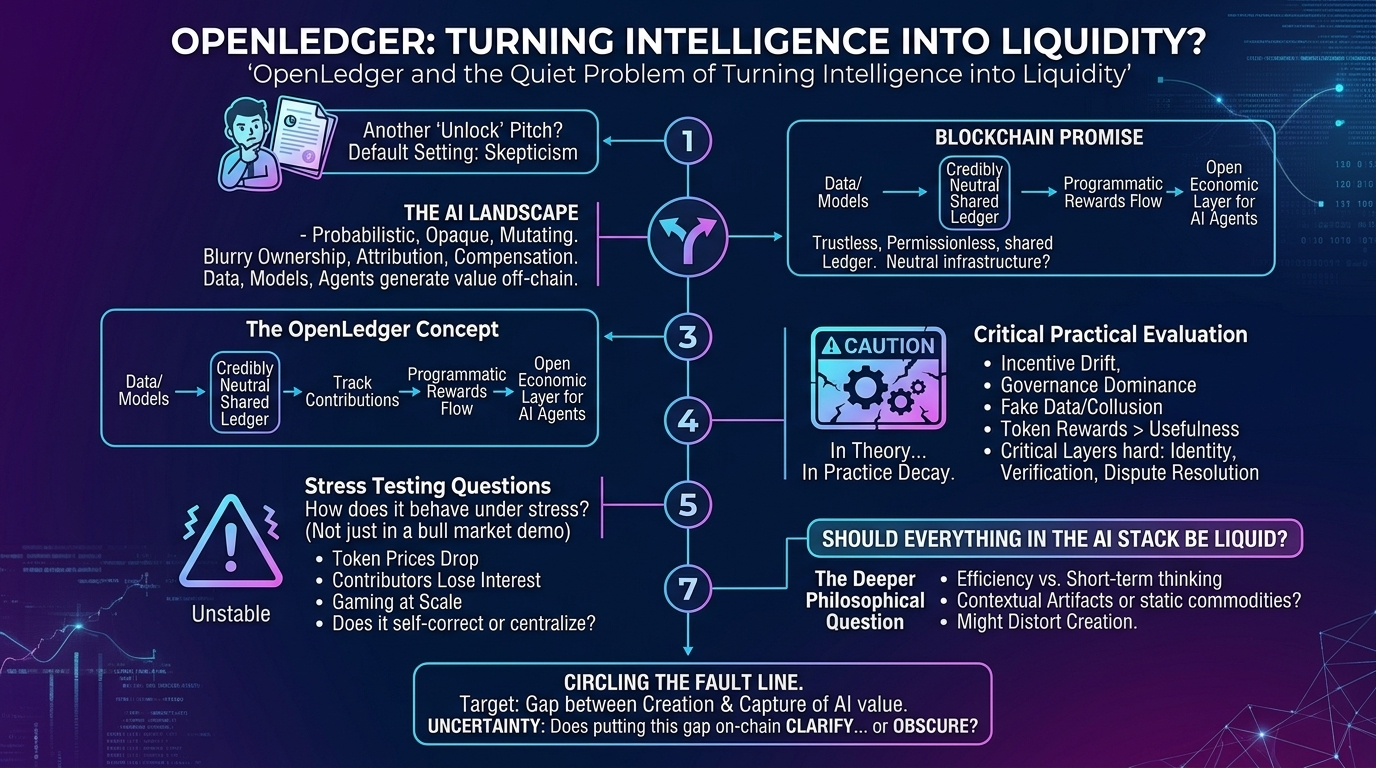
So I understand the instinct behind OpenLedger. If intelligence is becoming infrastructure then the infrastructure beneath it needs to be neutral Or at least credibly neutral A shared ledger where contributions are tracked rewards flow programmatically and models or agents can plug into an open economic layer instead of a corporate backend
In theory
In practice these systems decay in subtle ways. Incentives drift Early contributors dominate governance. Edge cases pile up fake data submissions, model collusion, agents optimizing for token rewards instead of usefulness. The boring but critical layers identity, verification, dispute resolution are always harder than they look. That’s usually where projects stall. Not in the big vision but in the slow grind of handling messy reality
I find myself wondering how OpenLedger behaves under stress Not in a bull market demo environment but in a downturn. When token prices drop When contributors lose interest. When someone figures out how to game the reward mechanism at scale. Does the system correct itself, or does it quietly centralize around whoever can afford to keep it running
And then there’s the deeper question: should everything in the AI stack be liquid
Liquidity sounds efficient. But it also encourages short-term thinking. Constant repricing Constant churn. Data and models aren’t static commodities they’re contextual evolving artifacts. Turning them into tradeable units might unlock value yes Or it might distort how they’re created in the first place
I’m not dismissing OpenLedger If anything I’m circling it more than I expected It’s aiming at a real fault line the gap between who creates intelligence and who captures its value
I just can’t tell yet whether putting that gap on chain clarifies it or makes it even harder to see