
“
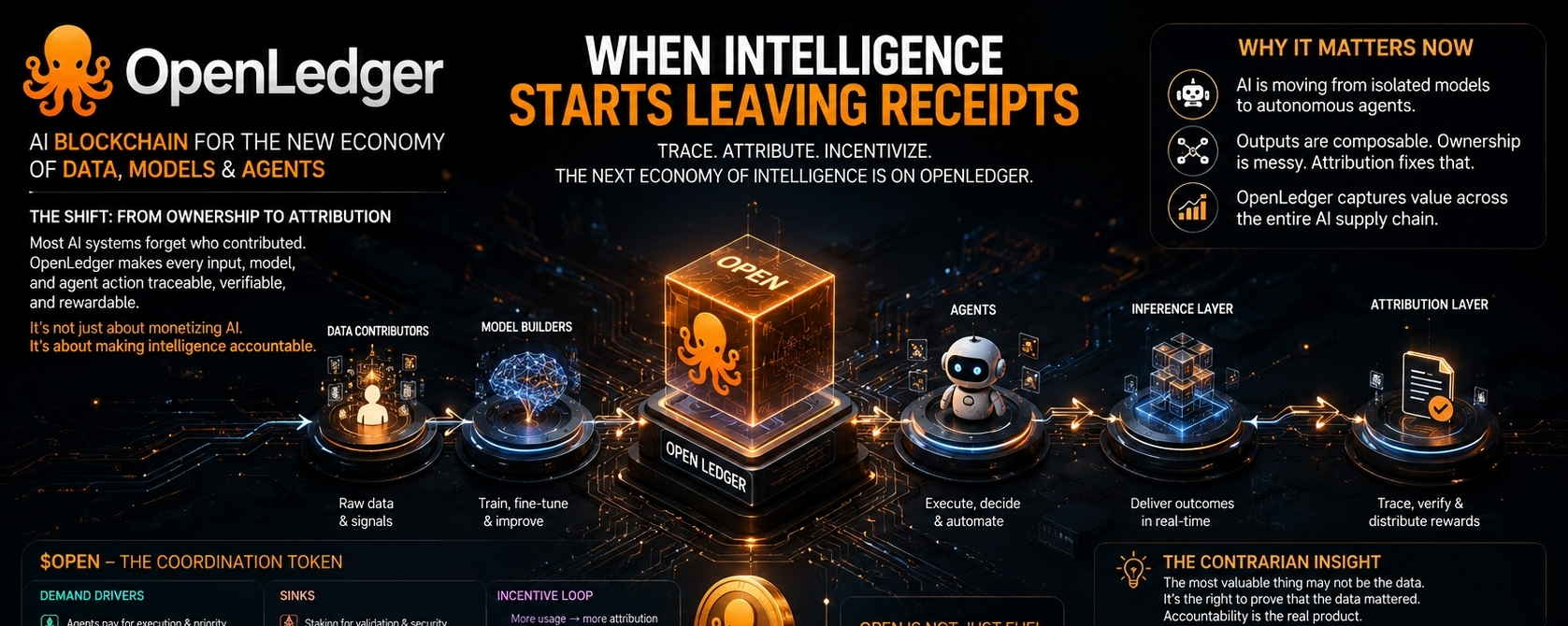
OpenLedger doesn’t feel like another AI blockchain project trying to fit into the usual narrative of data ownership and model monetization. The more interesting reading is that it is trying to make intelligence trace itself. Not in a philosophical sense, but in a practical, economic one where every useful output leaves behind a record of who and what made it possible.
Most AI systems today behave like they are designed to forget. Data goes in, outputs come out, and the internal chain of contribution dissolves into abstraction. OpenLedger pushes against that default. It suggests a world where contribution doesn’t disappear at the moment of generation but continues to exist as something measurable, rewardable, and reusable. That shift sounds small until you realize how much of AI economics depends on invisibility.
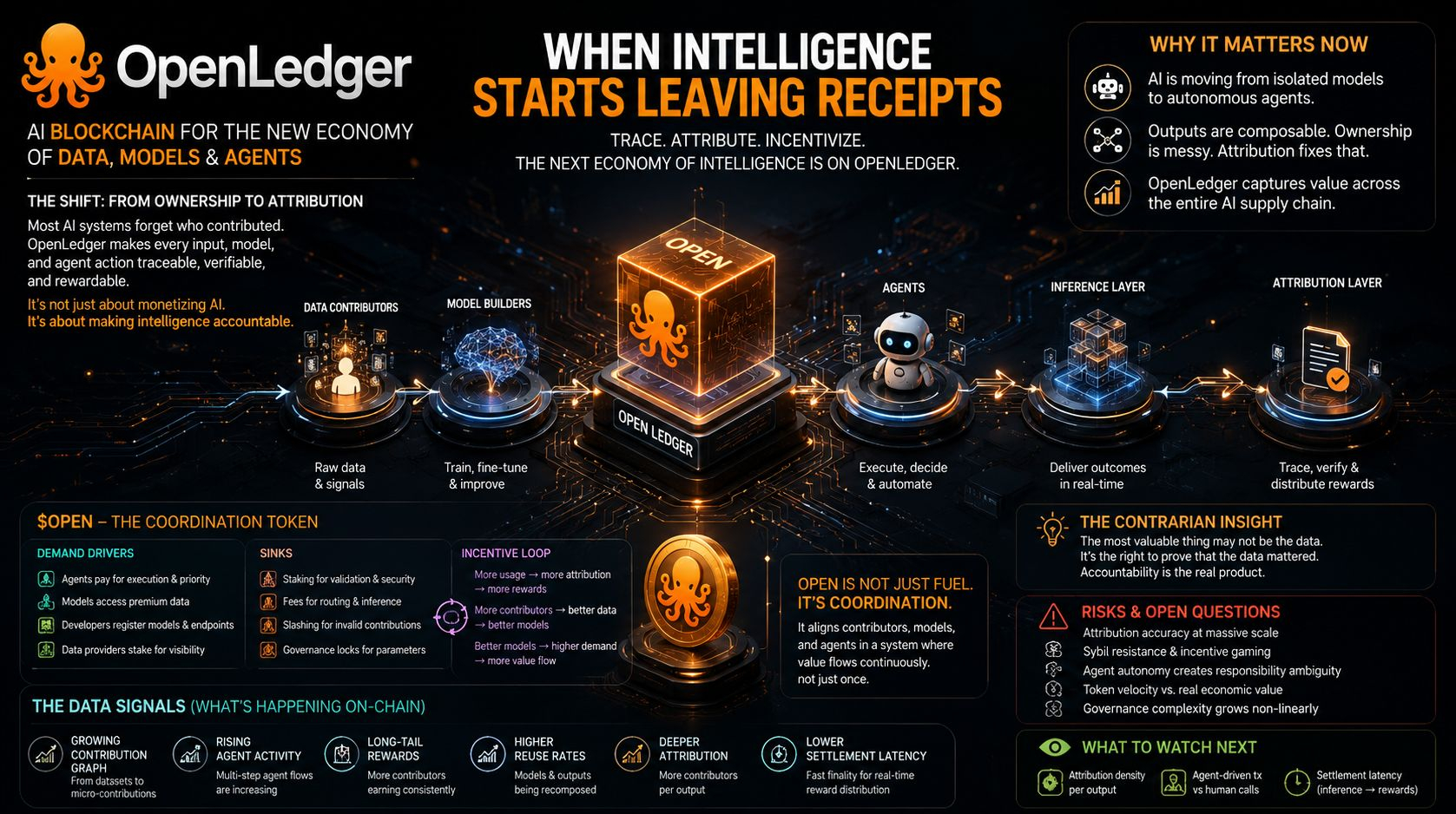
What makes this more relevant right now is the direction AI itself is taking. We are moving from isolated models toward agent-based systems that act, decide, and execute across multiple layers. In that kind of environment, a single output is rarely the result of a single actor. It is closer to a chain reaction involving datasets, models, routing logic, and autonomous agents. OpenLedger’s idea is that this chain should not collapse into a single owner at the end.
There is a subtle but important reframing happening here. Instead of treating AI as a product, it starts to look like a continuous supply chain of intelligence. One dataset feeds a model. A model powers an agent. An agent triggers an action. And each step carries some form of contribution that can, in theory, be traced back and rewarded. The system becomes less about owning AI and more about participating in its flow.
A useful way to think about it is not a marketplace, but a kind of “credit bloodstream.” Value doesn’t sit still; it circulates through every interaction. Another way to see it is like a shipping network where every package quietly records who helped move it, not just who delivered it. That difference matters because AI outputs are becoming composable. They are reused, remixed, and layered far more than they are created from scratch.
The OPEN token sits inside this structure as more than a simple utility asset. Its role is closer to coordination than consumption. It helps decide how attention, computation, and attribution are routed across the system. Demand comes from participation agents executing tasks, models being used, data being accessed. But the real weight is in how rewards flow backward through the chain of contributors rather than stopping at the final output.
At the same time, the design introduces tension. The more precise attribution becomes, the more complex the system gets. And the more granular the rewards are, the easier it becomes for noise to enter the system. In other words, fairness improves, but simplicity suffers. That tradeoff is not cosmetic; it defines whether this kind of architecture can scale without becoming fragile.
There is also a more contrarian angle here that is easy to miss. The real product may not be data monetization at all. It may be accountability in machine intelligence. In most AI systems, value is extracted from data but not continuously attributed back to it. OpenLedger flips that expectation and suggests that proving contribution might eventually matter more than the raw contribution itself. That is a strange idea, but it becomes more intuitive in a world where AI outputs are endlessly reused across systems.
The biggest uncertainty is whether this traceability can survive real scale. Attribution systems tend to look clean in design diagrams and messy in production. If OpenLedger can keep the chain of contribution reliable while agent activity grows, then it becomes more than an experiment in incentives. It becomes infrastructure for how AI economies might actually settle value.
In the end, the most important shift OpenLedger hints at is not technical but conceptual. Intelligence stops being a finished product and starts becoming a recorded process. And once that happens, every output begins to carry something like a receipt of its own creation.
The takeaway is simple. OpenLedger is not just about monetizing AI it is about making AI accountable, traceable, and economically continuous. Its token is a coordination layer for that idea, and its long-term relevance depends on whether the system can keep attribution meaningful as complexity scales.
