
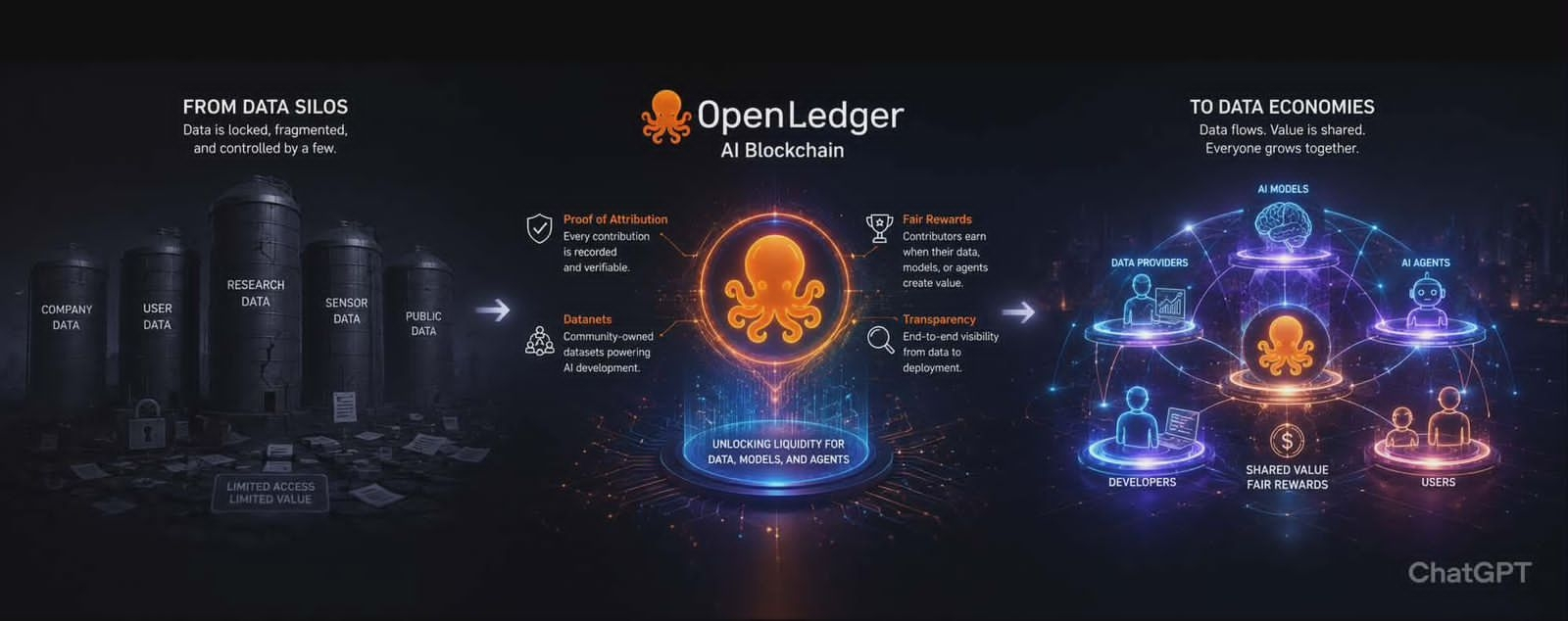
From Data Silos to Data Economies
@OpenLedger I’ve been around crypto long enough to get suspicious whenever a project says it is going to “fix” something big. Usually, that means a lot of confident language, a token, a few dashboards, and not much else. So when I first looked at OpenLedger, I didn’t feel excited. I mostly felt that familiar tiredness. But I kept reading anyway, because sometimes a project is not interesting for the reason it wants to be interesting. Sometimes it is interesting because it is circling a problem that really does exist. OpenLedger is pitching itself as an AI blockchain built around data, models, applications, and agents, with community-owned datasets called Datanets and a system that tries to track where value comes from. That is the part that made me stop and pay attention.
The more I think about it, the #OpenLedger more I come back to the same annoying truth: AI runs on a lot of invisible work. Data gets collected, cleaned, mixed, filtered, trained on, and quietly folded into something bigger. Then the output gets sold, used, or praised, and the origin story gets blurry fast. That has always bothered me. Not because I think every dataset deserves a medal, but because the whole system feels lopsided. OpenLedger is trying to push back against that by making data contribution visible and traceable, and by tying rewards to the parts of the system that actually get used. That idea sounds simple on paper. In real life, it is messy, hard to police, and probably full of arguments nobody wants to have.
I keep noticing that $OPEN crypto loves the word “ownership” but gets uncomfortable when ownership has to mean something specific. Who owns the data. Who can reuse it. Who gets paid. Who decides what counts as valuable. Who gets left out. Those questions are not new, but AI makes them harder to ignore. OpenLedger’s Proof of Attribution system is supposed to connect data contributions to model outputs and preserve that trail on-chain. That is the kind of mechanism that sounds tidy until it runs into the real world, where data is noisy, contributions overlap, and incentives tend to drift the second money shows up.
That is why I do not trust the “data economy” phrase on its own. It sounds good, but so did a lot of things in this market that turned out to be mostly smoke. A real data economy would have to survive more than a whitepaper. It would have to make people care about quality, not just quantity. It would have to make attribution useful without making the whole thing unbearably complicated. It would have to convince builders that paying for data is worth it, and convince contributors that their work will still matter after the hype fades. OpenLedger seems to understand that this is an infrastructure problem, not just a branding problem. Its public materials describe an Ethereum L2 built on OP Stack with EigenDA for data availability, and Binance Research says OPEN is meant to serve as gas, rewards, settlement, staking, and governance inside the network. That sounds like an attempt to build a functioning system, not just a story. But a functioning system still has to be wanted.
I’ve seen enough cycles to know that being technically coherent is not the same as being economically alive. Plenty of crypto projects are neat in the abstract and dead in practice. The market does not reward elegance by default. It rewards momentum, timing, and sometimes pure noise. Still, there is something about OpenLedger that feels less abstract than the usual AI-plus-chain pitch. It is not just saying that AI should be decentralized. It is saying that the value chain behind AI is broken in a very specific way, and that data should not disappear into a model without leaving a trace. That feels closer to a real problem than a marketing angle.
At the same time, I don’t fully trust the happy version of this story. I don’t trust that people will rush to contribute better data just because there is a reward system. I don’t trust that attribution will stay clean once the network gets busy. I don’t trust that governance will mean much if most users are just there for the upside. And I definitely don’t trust any project that acts like it has already solved the hard parts before the first serious adoption cycle even starts. I’ve seen too many projects confuse a working demo with a working economy. Those are not the same thing at all.
Still, I can admit when something feels a little different. OpenLedger doesn’t feel like it is chasing the same old “AI agent” noise for the hundredth time. It feels more grounded in the ugly, practical question underneath all of that noise: if data creates value, who gets to capture it? That’s not a flashy question. It’s not the kind of thing people chant on social media. But it is the kind of question that matters once the surface level excitement wears off. I think that is why this project stays in my head more than most. It is not promising magic. It is pointing at friction. And in crypto, friction is usually where the truth hides.
CoinDesk reported that OpenLedger committed $25 million through OpenCircle to fund AI and Web3 developers, which tells me the team is trying to turn the idea into an actual ecosystem, not just a token narrative. That still does not prove anything. Money never does. But it does mean the project is trying to build around the idea of contribution, not just around speculation. I’ve watched enough projects to know that this distinction matters more than people like to admit.
So that is where I land with OpenLedger: cautious, interested, and still not sold. The pitch is cleaner than most, but I have learned not to trust clean pitches too quickly. What I do trust is the problem it is aiming at. Data in AI is messy, valuable, and usually treated too casually. If OpenLedger can make that value visible without turning the whole thing into another empty crypto ritual, then maybe it will have found something real. I’m not ready to call it that yet. I just know it is one of the few current stories that does not feel completely like noise.
