

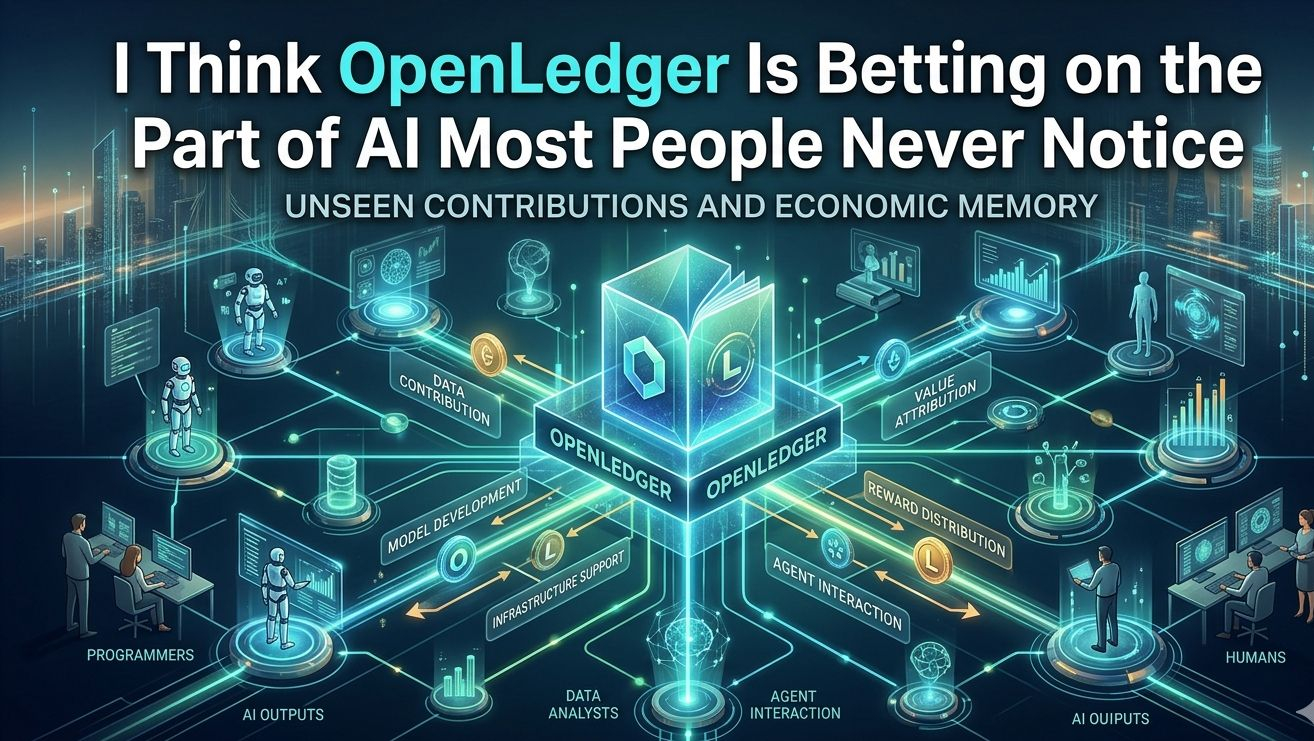
The more time I spend studying AI and blockchain projects, the more I realize that most conversations focus on the visible layer. People talk about smarter models, faster inference, autonomous agents, and the next breakthrough in artificial intelligence. But after looking deeper into OpenLedger, I found myself thinking about something entirely different.
What happens after intelligence creates value?
It sounds like a simple question, yet it may become one of the biggest challenges in the AI era.
Every AI output is built on countless unseen contributions. Data providers, model developers, infrastructure operators, and increasingly autonomous agents all play a role. But once the final result reaches a user, the connection between contribution and reward often disappears. The output remains visible, while the people and systems behind it fade into the background.
That is why OpenLedger caught my attention.
I don't see it as another project trying to attach blockchain to AI. I see it as an attempt to create an economic memory for intelligence itself. Instead of focusing only on generating value, it focuses on tracking where that value came from and how it should move through an ecosystem.
The best analogy I can think of is a music streaming platform. Millions of people can enjoy a song, but behind every play there are writers, producers, musicians, and rights holders who need to be recognized and compensated. Without a system connecting creation to rewards, the entire industry becomes difficult to sustain. OpenLedger seems to be applying a similar idea to AI.
Recent ecosystem developments make this vision feel more tangible. New agent-focused products, expanding data networks, cross-chain integrations, and growing partnerships suggest the project is building infrastructure rather than simply building narratives. The goal appears to be creating an environment where data, models, and agents can interact while preserving accountability along the way.
What I find especially interesting is the role of the OPEN token. Most people evaluate tokens by price movement alone, but I think the more important question is whether a token helps coordinate behavior. In OpenLedger's case, the token sits at the center of network activity, rewards, participation, and ecosystem incentives. Its value proposition depends less on speculation and more on whether real economic activity continues flowing through the system.
Here's the part I think many people miss.
As AI becomes more powerful, intelligence itself may become abundant. When something becomes abundant, attention shifts toward whatever remains scarce. In the future, the scarce resource might not be intelligence—it might be attribution. Knowing who contributed, what was used, and how value should be distributed could become just as important as generating the output itself.
Of course, there are still open questions. The attribution model must prove it can work efficiently at scale. Ecosystem growth must translate into actual usage. Token incentives must remain sustainable over time. These are challenges that cannot be solved by marketing alone.
Still, what keeps me watching OpenLedger is its focus on a problem that grows larger as AI succeeds. Most projects are competing to create intelligence. OpenLedger appears to be preparing for a world where intelligence is everywhere and accountability becomes the real challenge.
If that future arrives, the projects that connect creation to value may become just as important as the systems creating the intelligence in the first place. And that is why I believe OpenLedger is pursuing one of the most overlooked opportunities in the entire AI economy.
