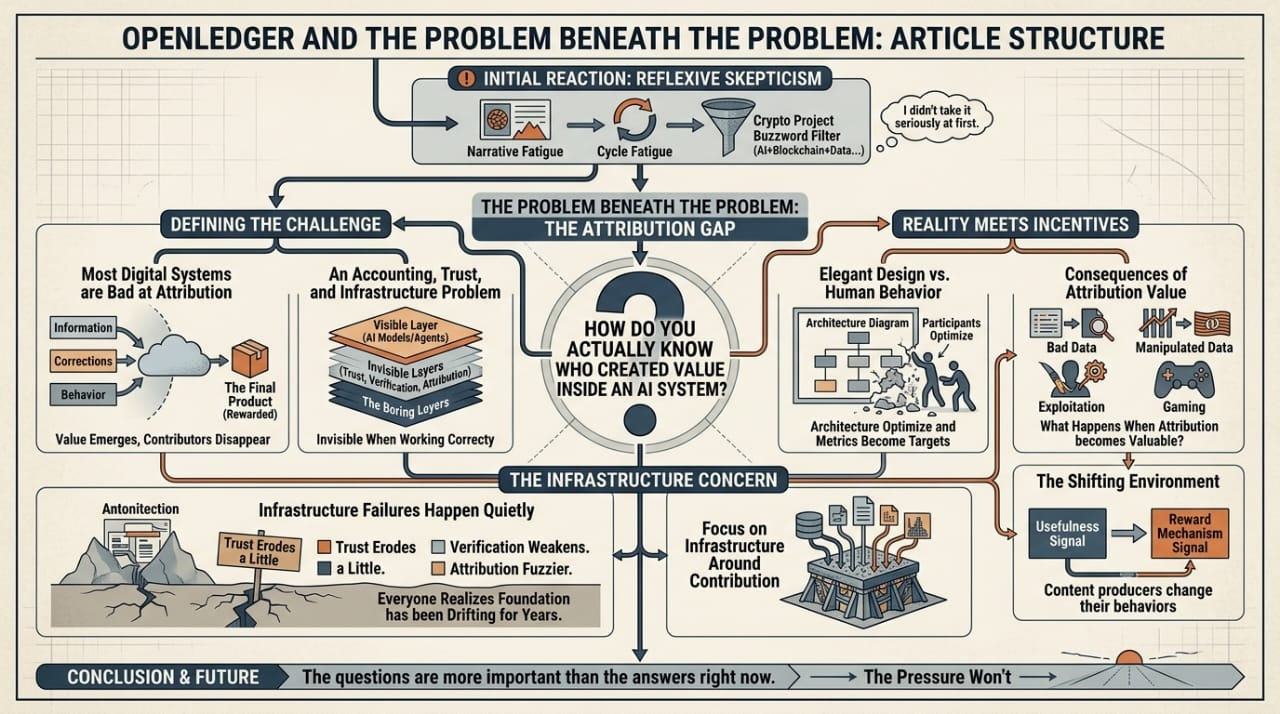
I didn't take it seriously at first.
Maybe that's unfair Maybe it's just fatigue
After enough cycles in crypto you develop a reflex whenever a project combines multiple narratives into one sentence AI Blockchain Data Incentives Ownership I've watched enough of these stories appear disappear and then quietly reappear with different branding that skepticism almost arrives automatically now
So when I first came across OpenLedger my reaction was mostly to ignore it
But I keep coming back to it and not because of the obvious pitch
What interests me isn't the idea of monetizing data or models. We've heard versions of that before. What keeps pulling my attention back is the uncomfortable question sitting underneath it all: how do you actually know who created value inside an AI system
Not in theory In reality
Because that's where things start to feel uncomfortable
Most digital systems are surprisingly bad at attribution People contribute information context, corrections behavior attention and somehow value emerges from the mixture Years later nobody can really explain where that value came from The final product gets rewarded The infrastructure gets rewarded The contributors usually disappear into the background
OpenLedger seems to be circling around that problem
Or maybe wrestling with it
And the more I think about it the less it feels like an AI problem and more like an accounting problem A trust problem An infrastructure problem
The boring layers
The layers nobody wants to talk about because they're difficult and often invisible when they work correctly
It's easy to imagine a world where data contributors are rewarded It's much harder to imagine the system surviving edge cases Bad data Manipulated data Duplicate data Coordinated gaming Slow decay over time
What happens when attribution becomes valuable enough that people actively try to exploit it
That question hangs over almost every incentive system I've ever seen
The thing about crypto infrastructure is that most designs look elegant before they encounter actual human behavior Then reality arrives Participants optimize Shortcuts emerge Metrics become targets
Suddenly the clean architecture diagram starts looking very different
And honestly that's the part I find myself thinking about when I look at OpenLedger
Not the models
Not the agents
Not even the economics
It's whether attribution remains meaningful
under pressure
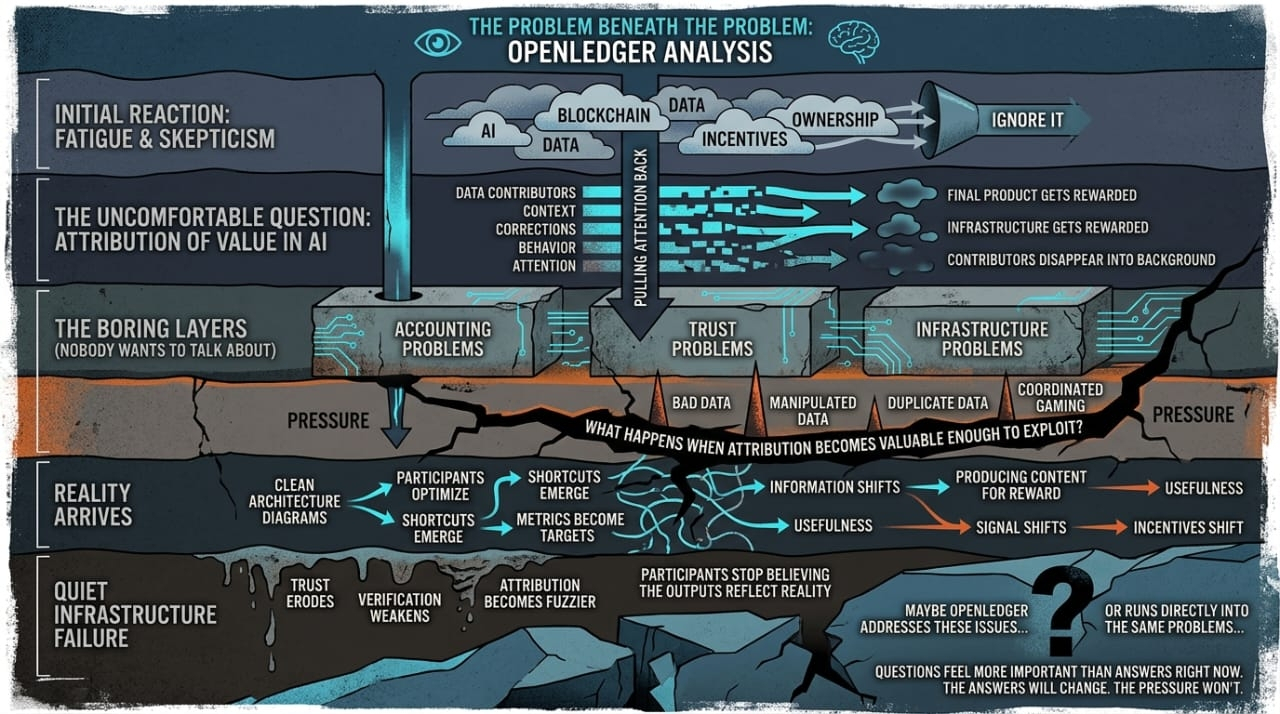
Because once money becomes attached to information the information itself changes People begin producing content for the reward mechanism rather than for usefulness The signal shifts The incentives shift The entire environment shifts
Maybe that's too harsh
Every system faces that problem eventually
Traditional AI platforms face it Social networks face it Search engines face it Open systems probably face it more than most
Still, there's something interesting about seeing a project focus on the infrastructure around contribution rather than assuming contribution will simply happen
The longer I spend around this space, the more convinced I become that infrastructure failures rarely happen in dramatic ways. They happen quietly Trust erodes a little Verification becomes weaker Attribution becomes fuzzier Participants stop believing the outputs reflect reality
Then one day everyone realizes the foundation has been drifting for years
Maybe OpenLedger is attempting to address some of those issues
Or maybe it's running directly into the same problems from a different angle
I'm not entirely sure yet
And perhaps that's why I keep reading about it
Because the questions feel more important than the answers right now
The answers will change
The pressure won't