
I started looking at @OpenLedger OctoClaw framework. I'd seen it mentioned a few times in passing, usually in the context of "AI + blockchain = future," which is the kind of framing I instinctively scroll past. But I kept seeing it come up in on-chain discussions specifically, not just marketing threads, so I figured I'd actually look.
Here's where something clicked for me — and I'm still working through whether this is actually significant or if I'm pattern-matching noise into signal.
Most of the AI agent infrastructure conversation treats the problem like a routing problem. You have agents, they need to talk to each other, you build pipes between them. OctoClaw seems to be built around a different assumption: that the bottleneck isn't communication, it's verification. The framework is oriented around the idea that before an agent acts on another agent's output, there needs to be an on-chain record of why that output should be trusted.
I kept thinking about it like a trading desk. You can have ten analysts all feeding signals to a portfolio manager. The question isn't whether the signals arrive — it's whether the portfolio manager knows which analyst has been right, under what conditions, and whether that track record is auditable or just something someone told you over Slack.
That's kind of the gap OctoClaw seems to be targeting. Not "can agents communicate" but "can agents establish credibility with each other in a trustless environment."
The mechanism, roughly: task outputs from agents get logged with provenance data on-chain, and subsequent agents can query that history before acting. So instead of Agent B just trusting Agent A's output because they're both inside the same system, there's a verification layer that's external to both of them.
Which sounds reasonable. And that's actually what makes me hesitant.
Here's the part that bothers me — this framework only works if the on-chain records themselves are reliable. If Agent A is logging its own outputs and there's no external check on whether those logs accurately represent what the agent actually did, you've just moved the trust problem one layer deeper. You haven't solved it, you've abstracted it.
I thought at first the logging was being done by a neutral third party in the network. But from what I can tell, it's closer to self-reporting with economic incentives to be accurate — staking mechanisms, slashing for bad actors, that kind of design. Which can work. But "can work" and "works under adversarial conditions at scale" are different sentences, and I haven't seen enough evidence of the latter yet.
There's also a timing question. On-chain verification adds latency. For AI agents doing anything time-sensitive — and a lot of the interesting agent use cases are time-sensitive — there's a real tradeoff between auditability and responsiveness that I don't think OctoClaw has fully resolved in its current form. Or maybe it has and I'm missing it. Wouldn't be the first time.
What makes this feel meaningful though, even with the skepticism: if agent-to-agent trust becomes the core infrastructure problem as multi-agent systems scale, then whoever solves verification well ends up sitting at a pretty important layer. Not the agents themselves, not the tasks they perform, but the trust fabric underneath. That's a different kind of moat than most projects in this space are trying to build.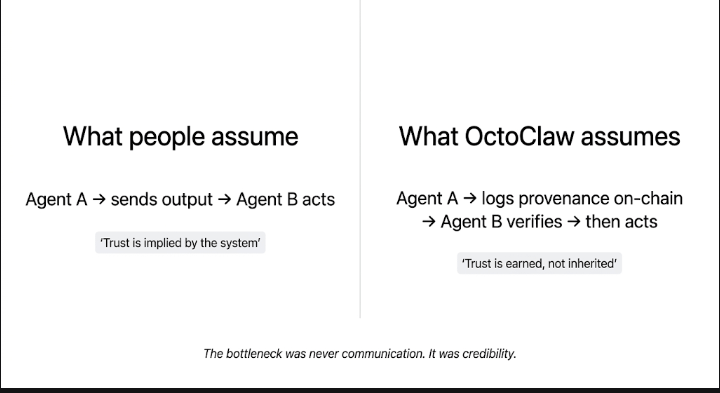
Whether OctoClaw is actually building that or just building the narrative around it — I genuinely don't know yet. The on-chain activity I've looked at suggests real development work, not just whitepaper theater. But it's early enough that the gap between what's claimed and what's been stress-tested is still wide.