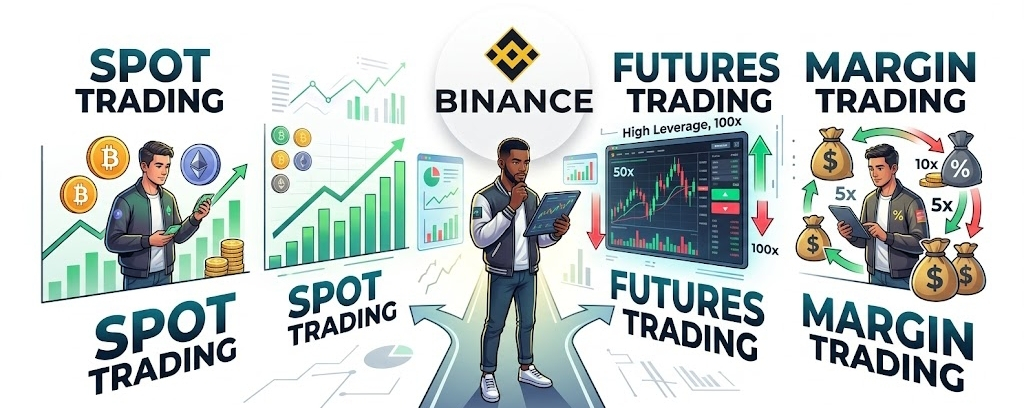
Every Binance trader eventually hits the same wall: three trading modes, three risk profiles, and no clear answer about which one matches their actual goals. Spot, margin, and futures aren't different flavors of the same thing — they're built on fundamentally different mechanics, and confusing them is one of the fastest ways to lose money in crypto.
This breakdown looks at how each mode actually works under the hood, not just the marketing pitch.
## Spot Trading: You Own What You Buy
Spot trading is the simplest concept on Binance — you exchange one asset for another at the current market price, and the asset lands in your wallet. If you buy Bitcoin on spot, you own Bitcoin. There's no contract, no expiry, no borrowed money sitting underneath the trade.
Binance's standard spot fee sits at 0.1% per trade for regular users, though this drops with BNB fee payments, referral discounts, and higher 30-day trading volume tiers. The platform supports hundreds of trading pairs with deep liquidity, and the interface scales from a simplified view for beginners to an advanced charting suite for experienced traders.
The defining feature of spot trading is that your downside is capped at what you paid. If Bitcoin drops 80%, you lose 80% of your investment — painful, but not infinite. There's no liquidation risk because there's no borrowed capital involved. This makes spot the natural starting point for anyone building a long-term position or simply wanting direct exposure to an asset without added complexity.
## Margin Trading: Borrowed Capital, Real Asset
Margin trading sits in the middle ground. You're still trading the actual underlying asset, but now you're borrowing funds from Binance to increase your position size beyond what your own capital would allow. Buy Bitcoin on 3x margin, and you control three times the Bitcoin your account balance would normally support.
This is where the math changes. Borrowing isn't free — margin positions accrue interest on the borrowed amount for as long as the position stays open, on top of the standard trading fee. That interest compounds the longer a position runs, which makes margin a poor fit for buy-and-hold strategies and a more natural fit for shorter, higher-conviction trades.
The bigger shift is risk. Because you're trading with borrowed money, losses are magnified in both directions, and liquidation becomes a real mechanism rather than a theoretical one. If the market moves against your position enough to erode your margin below a maintenance threshold, Binance will forcibly close it to recover the borrowed funds — regardless of whether you wanted to exit. Margin trading rewards discipline around position sizing far more than it rewards conviction about market direction.
## Futures Trading: Contracts, Not Coins
Futures trading is the most structurally different of the three. You're not buying or selling the underlying cryptocurrency at all — you're entering a contract that speculates on its future price. Binance Futures offers both perpetual contracts, which never expire, and quarterly contracts, which settle on a fixed date.
This separation from the underlying asset is what allows futures to support leverage up to 125x on certain pairs, far beyond what margin trading permits. It's also what makes futures usable for shorting — profiting when prices fall — in a way that feels more native than borrowing-and-selling does on margin.
Fee-wise, futures are typically cheaper per trade than spot, with maker fees starting around 0.02% and taker fees around 0.05% for standard accounts, dropping further at higher VIP tiers. But the real cost center on futures isn't the trading fee — it's the funding rate. Perpetual contracts charge or pay a funding fee every eight hours, determined by the imbalance between long and short positions in the market. Hold a position through enough funding cycles on the wrong side of that imbalance, and the cost can quietly exceed what you'd ever pay in trading fees.
Binance also splits futures into two margin modes: cross margin, which shares your entire futures balance across all open positions to absorb losses, and isolated margin, which walls off risk to only the capital assigned to that specific trade. New futures traders are generally better served starting with isolated margin — it caps the damage from miscalculating a single trade rather than allowing it to bleed into the rest of the account.
## Why the Three Modes Solve Different Problems
The mistake most new traders make isn't choosing the wrong mode outright — it's not realizing these tools were built for different jobs in the first place.
Spot trading solves the ownership problem. If the goal is holding an asset for months or years, spot is the only mode where time works in your favor instead of against you, since there's no interest accruing and no funding rate eating into returns while you wait.
Margin trading solves the amplification problem for traders who still want to hold an actual asset but believe their edge justifies more exposure than their capital alone provides. It works best on trades with a defined, relatively short time horizon, where the cost of borrowing doesn't have time to erode the upside.
Futures trading solves the directional and leverage problem. It's built for traders who want to express a view on price movement — up or down — without the friction of owning or borrowing the underlying asset, and who are equipped to manage funding costs and liquidation risk actively rather than passively.
## The Real Question Isn't "Which Is Best"
None of the three modes is objectively superior — they're answering different questions. Spot answers "what do I want to own." Margin answers "how much conviction do I have, for how long." Futures answers "what do I think will happen to the price, and how fast."
The traders who get hurt are rarely the ones who pick the "wrong" mode. They're the ones who bring a spot mindset — set it and forget it — into a futures position, where funding rates and liquidation thresholds don't forgive inattention. Matching the mode to the actual strategy, not the other way around, is what separates a calculated trade from a gamble.

Artikel
# Spot vs. Futures vs. Margin: Which Binance Trading Mode Actually Fits Your Strategy?
Haftungsausschluss: Enthält Meinungen von Drittanbietern. Keine Beratung. Binance Ai wird ohne Gewähr bereitgestellt. Siehe AGB.