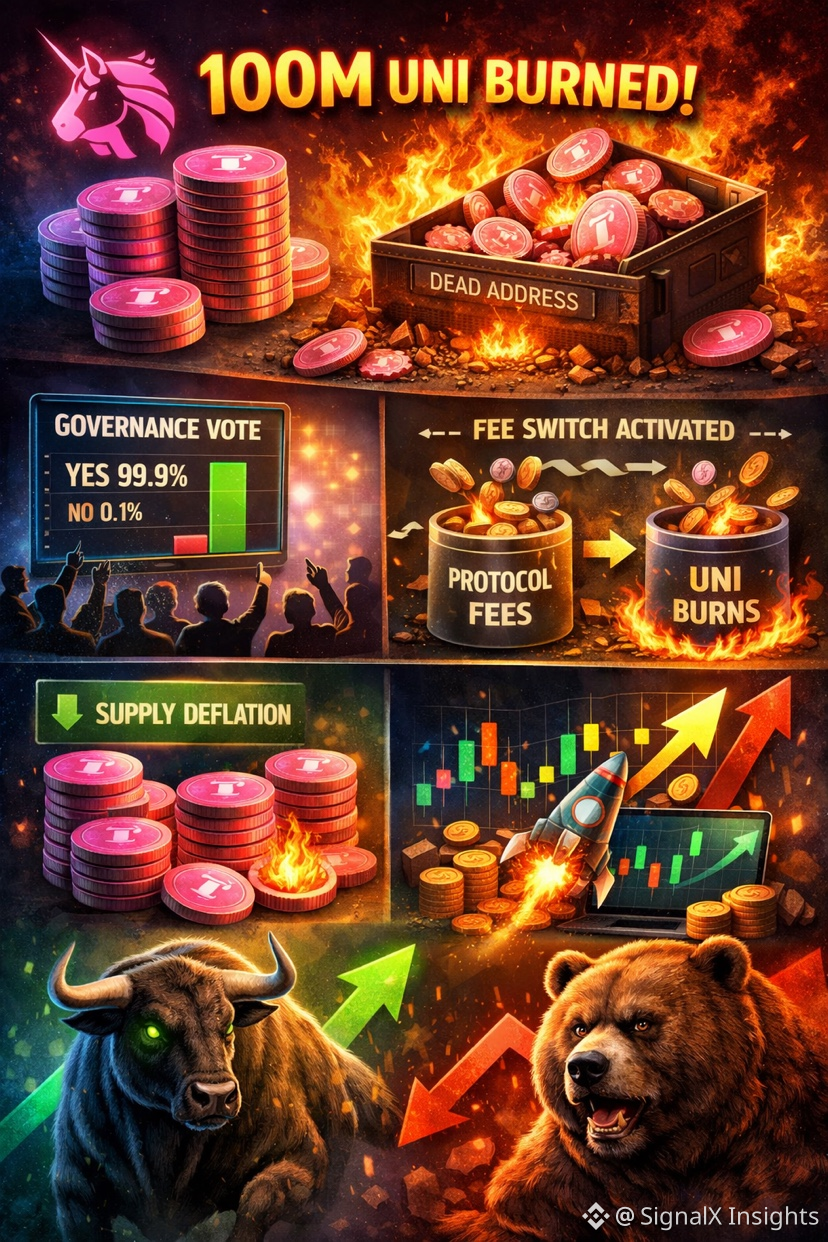
Uniswap has just executed one of the largest token burns in DeFi history, permanently removing 100 million UNI tokens from circulation. This event marks a major shift in Uniswap’s long-term tokenomics and governance direction.

⸻
🧾 What Happened?
• The Uniswap community overwhelmingly approved a governance proposal to burn 100,000,000 UNI.
• The tokens were sent to a dead address, making them irrecoverable and permanently reducing supply.
• This burn is closely tied to the long-awaited “fee switch” mechanism.
⸻
📉 Impact on Supply & Tokenomics
• ~100M UNI removed from circulation instantly.
• This represents a significant percentage of the effective circulating supply, introducing deflationary pressure.
• With the fee switch activated, a portion of protocol fees can now be captured by the protocol and potentially used for ongoing UNI burns in the future.
👉 UNI is no longer just a governance token — it is moving closer to a value-accruing asset.
⸻
📊 Market Reaction
• Following the announcement and execution:
• Social volume surged
• Trading activity increased
• UNI price showed strong volatility, reflecting rising speculation and long-term bullish expectations
• Investors are now re-pricing UNI based on reduced supply + sustainable fee capture
⸻
🧠 Why This Matters
This event changes the narrative for UNI:
• ❌ Before: Governance-only token, inflation concerns
• ✅ Now: Deflationary dynamics + protocol revenue alignment
Many analysts consider this burn a turning point that could:
• Strengthen UNI’s long-term valuation model
• Reignite interest in DeFi blue-chip tokens
• Set a precedent for other protocols to follow
⸻
⚔️ Community :
🔥 Bullish view:
“This is UNI’s Ethereum-style moment — real value capture finally begins.”
🐻 Bearish view:
“One-time burn hype won’t matter without sustained fee distribution.”
⸻
🧩 Bottom Line
Uniswap burning 100M UNI is not just symbolic — it’s structural.
Whether UNI becomes a true blue-chip DeFi asset now depends on how consistently the fee switch is used going forward.