
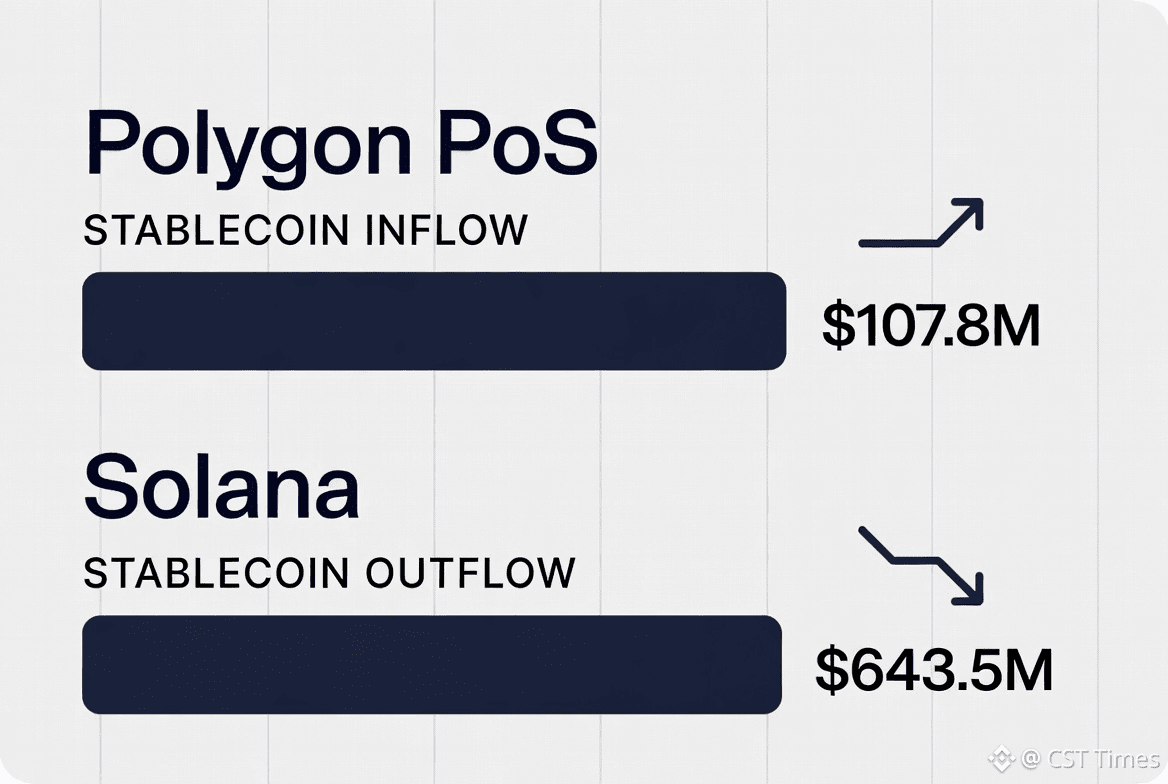
Polygon PoS Records $107.8M Stablecoin Inflows as Solana Faces Massive Outflows
Introduction
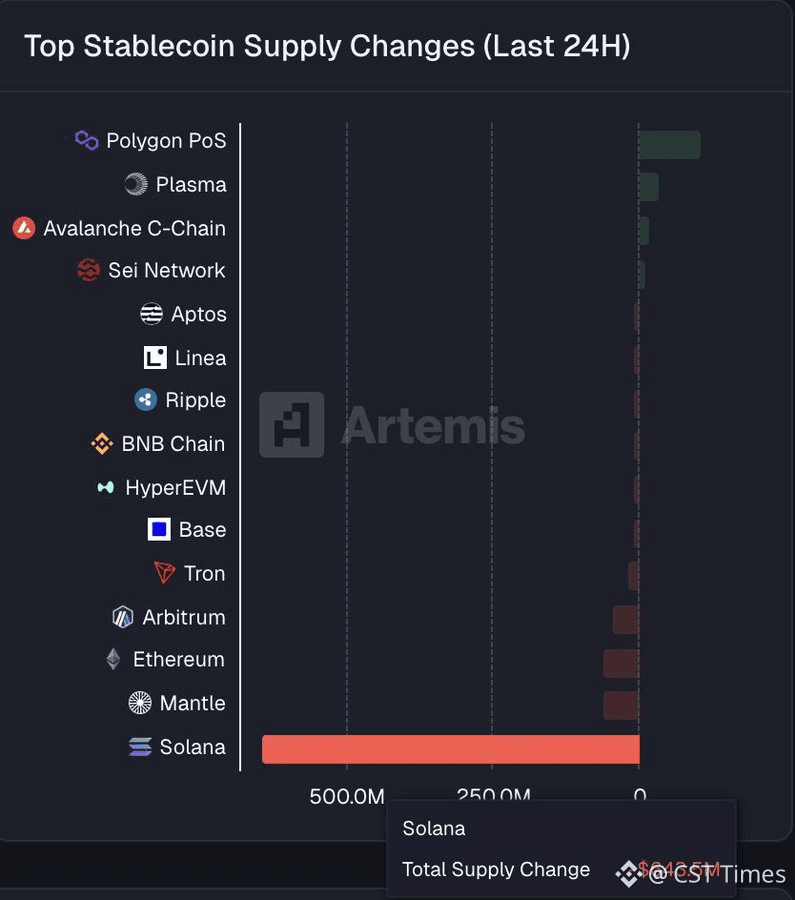
The cryptocurrency market is constantly shifting, and stablecoin movements often reveal where investor confidence is heading. In the last 24 hours, Polygon PoS has emerged as the top blockchain for stablecoin inflows, recording $107.8 million, while Solana experienced a sharp $643.5 million in outflows. This data highlights a significant change in short-term market sentiment.
This article explains what happened, why it matters, and what it could mean for crypto investors, in clear and simple terms.
What Are Stablecoin Inflows and Outflows?
Stablecoins like USDT, USDC, and DAI are cryptocurrencies that are pegged to the US dollar. Because their value stays stable, investors often move them between blockchains to prepare for trading, investing, or exiting positions.
Stablecoin inflows mean users are moving money into a blockchain
Stablecoin outflows mean users are moving money out of a blockchain
High inflows usually signal growing interest or confidence, while large outflows can indicate profit-taking, fear, or shifting capital to other networks.
Crypto Update: Polygon vs Solana – Big Stablecoin Moves!
Polygon PoS Leads with $107.8M Inflows
Polygon PoS recorded $107.8 million in stablecoin inflows over the past 24 hours, making it the top network by net inflows.
Why Polygon Is Attracting Capital
Several factors may be driving this surge:
Low transaction fees compared to other blockchains
Fast confirmation speeds, ideal for traders and DeFi users
Strong support for DeFi, NFTs, and gaming projects
Increasing adoption by developers and institutions
These inflows suggest that investors may be preparing to deploy capital on Polygon-based DeFi platforms or move funds into new projects on the network.
Solana Sees $643.5M in Outflows
On the other side, Solana recorded a massive $643.5 million in stablecoin outflows during the same 24-hour period.
Possible Reasons Behind Solana Outflows
This does not necessarily mean Solana is failing, but it does indicate short-term caution. Some possible reasons include:
Investors taking profits after recent price movements
Capital being rotated to other chains like Polygon or Ethereum Layer-2s
Reduced DeFi activity or liquidity migration
Traders moving funds to exchanges for selling or repositioning
Large outflows often happen during market uncertainty or before major price corrections.
What This Means for the Crypto Market
The contrast between Polygon’s inflows and Solana’s outflows highlights a shift in short-term liquidity preference.
Key Takeaways
Polygon PoS is currently seen as a safe and efficient network for deploying stablecoins
Solana may be experiencing temporary capital rotation, not long-term weakness
Stablecoin data helps traders predict upcoming market activity
When stablecoins move into a network, it often signals potential buying pressure or increased DeFi usage.
Should Investors Be Concerned?
Not necessarily.
Polygon’s inflows show growing confidence and usage
Solana’s outflows could be temporary and part of normal market cycles
Smart investors watch on-chain data, not just prices. Stablecoin flows provide early clues about where money is moving next.
Conclusion
The latest on-chain data shows Polygon PoS leading with $107.8M in stablecoin inflows, while Solana faced $643.5M in outflows over the last 24 hours. This shift suggests changing investor behavior, with capital moving toward networks offering lower fees, faster transactions, and active DeFi ecosystems.
As always, stablecoin movements should be watched closely, as they often signal the next big move in the crypto market.
For related post and more details:
Search in google: csttimes blogspot com

