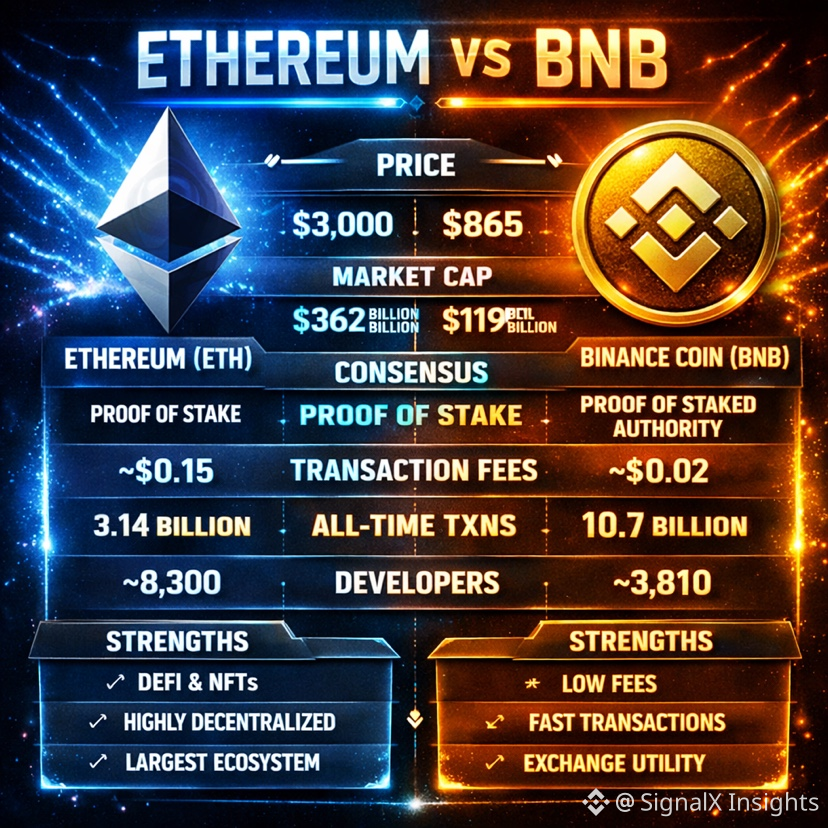
Ethereum (ETH) vs Binance Coin (BNB): A Data-Driven Comparison


1. Introduction
Ethereum and Binance Coin are two of the most influential cryptocurrencies in the market. ETH is the native token of the Ethereum blockchain — the leading programmable smart contract platform — while BNB is the native coin of the Binance ecosystem, including the Binance Smart Chain (now called BNB Chain). Both serve different purposes and have unique strengths. Below, we compare them using real metrics as of early 2026.
⸻
2. Price and Market Capitalization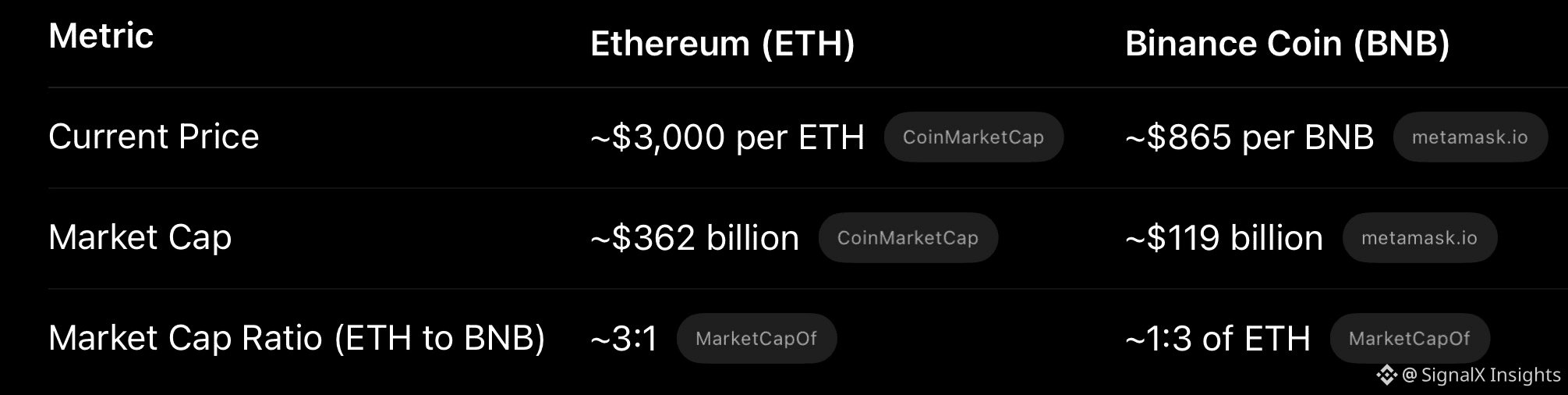
Interpretation:
Ethereum’s market capitalization is roughly 3x that of BNB, reflecting its broader adoption, deeper ecosystem, and larger total value locked. ETH also retains its position as the second-largest cryptocurrency behind Bitcoin.
⸻
3. Network and Technical Fundamentals
Launch Date
• Ethereum: Launched in 2015.
• BNB Chain: Launched in 2020.
Consensus Mechanism
• Ethereum: Proof of Stake (PoS) — energy efficient, decentralized validator set.
• BNB Chain: Proof of Staked Authority (PoSA) — faster but more centralized.
Validators & Stake
• Ethereum has ~988,900 validators and ~$104.4B in stake.
• BNB Chain has only ~45 validators with ~$21.2B in stake.
Decentralization & Security
• Ethereum’s validator count and PoS design provide higher decentralization and security. BNB Chain’s smaller validator set makes it faster but more centralized.
⸻
4. Transaction Metrics and Usage Interpretation:
BNB Chain processes more cumulative transactions and has much faster block times and significantly lower fees than Ethereum. However, Ethereum still dominates in total value locked and uses cases across DeFi and NFTs.
⸻
5. Ecosystem and Development Activity
Ethereum’s ecosystem remains vastly larger, with more developers, repos, and commits:
• Developers: ~8,300 (ETH) vs ~3,810 (BNB Chain)
• Commits: ~486,977 (ETH) vs ~166,440 (BNB Chain)
• Repos: ~397 vs ~145.
This suggests stronger long-term innovation and third-party project growth on Ethereum.
⸻
6. Historical Performance & Investor Returns
Historically, BNB has delivered higher percentage returns over certain periods:
• Over five years, BNB returns ~3,280% vs ETH ~1,050%.
Year-to-date and shorter term returns also often show periods where BNB outperforms ETH, driven by exchange activity, token burns and ecosystem growth.
⸻
7. Use Cases & Utility
Ethereum (ETH)
• Base layer for DeFi, NFTs, DAOs, and smart contracts.
• Vital for decentralized applications and programmable finance.
• Institutional interest is growing (e.g., ETFs).
Binance Coin (BNB)
• Utility token for trading fee discounts on Binance.
• Pays transaction fees on BNB Chain.
• Quarterly token burns reduce supply and can support price.
⸻
8. Pros & Cons at a Glance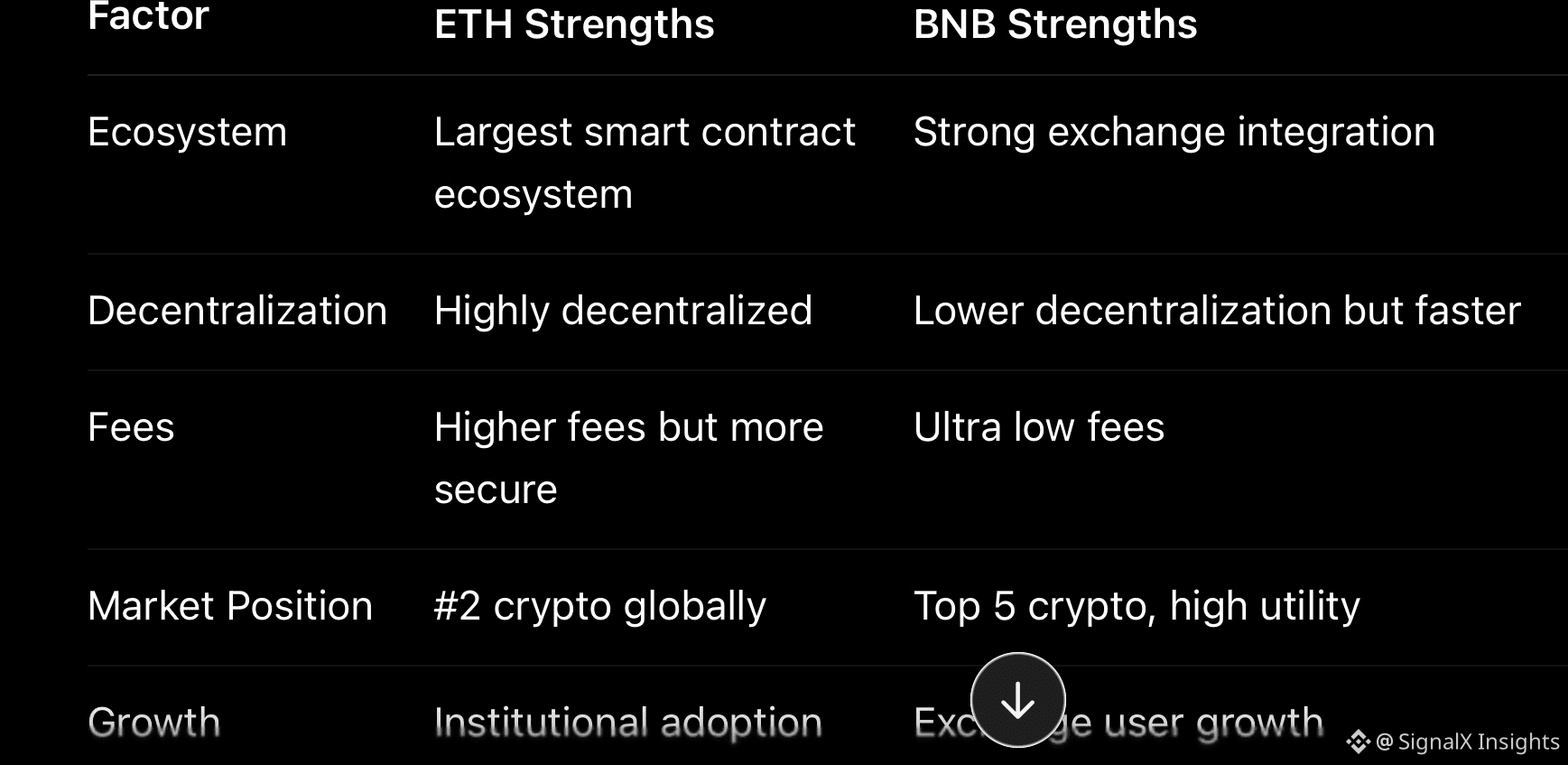
9. Conclusion
Both ETH and BNB have solid fundamentals, but they serve different roles:
• Ethereum is the backbone of DeFi and decentralized apps with unmatched developer activity and market cap.
• BNB excels in transaction speed, low fees, and exchange-centric utility.
From an investment and ecosystem perspective, ETH is broader and more foundational, while BNB offers strong performance and utility within the Binance ecosystem.