
As we begin 2026, social media and certain analyst circles are flooded with dramatic warnings about an alleged "global economic turning point" caused by the supposed synchronization of the 18-Year Real Estate Cycle and the 19th-century Benner Cycle.
These theories are being presented as near-certain predictors of a major peak followed by a crash. In reality, both frameworks are highly speculative, historically inconsistent, and often used selectively to fit narrative-driven fears rather than rigorous evidence.
Let’s critically examine why this "convergence" may be more myth than reality.
1- The 18-Year Real Estate Cycle: Pattern Recognition, Not Inevitable Law
The theory, popularized by Fred Harrison, claims property markets follow a predictable 18-year rhythm with a 14-year boom ending in a "winner’s curse" peak.
Reality check:
The cycle has failed or shifted significantly in multiple countries and eras (e.g., Japan’s prolonged stagnation, varying timing in Europe).
Post-2008 recovery was heavily distorted by unprecedented central bank intervention (near-zero rates, quantitative easing) — factors Harrison’s model never accounted for.
Current high interest rates and supply constraints are already cooling speculation without requiring a "cycle-mandated" crash. Markets adapt; they don’t obey a rigid calendar.
2- The Benner Cycle: A 150-Year-Old Farmer’s Chart in a Radically Different World
Samuel Benner’s 1875 diagram mapped commodity panics and price peaks based on 19th-century agricultural and industrial cycles.
Reality check:
The modern economy is dominated by technology, services, and financial innovation — not pig iron and wheat prices.
Benner’s predictions have missed or been retrofitted repeatedly (e.g., no major panic in several of his marked years).
Cherry-picking one "high prices" year (2026) while ignoring the chart’s many inaccuracies is classic confirmation bias.
Asset Analysis: Why Rigid Cycle-Based Predictions Often Fail
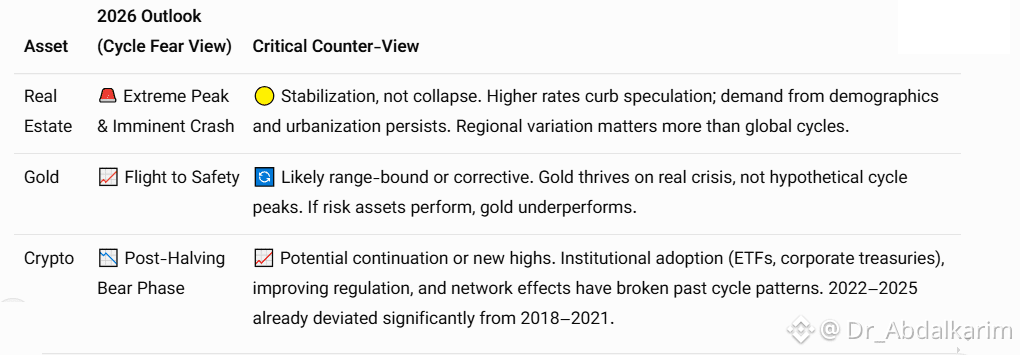
The Psychology of Cycle Mania
The most powerful force right now isn’t a hidden economic law — it’s narrative momentum. When enough influencers repeat "2026 = peak," retail investors panic-sell or hesitate at exactly the wrong moment, while others buy the fear.
True "smart money" focuses on fundamentals: earnings growth, technological disruption, monetary policy trends, and geopolitical stability — not 19th-century charts or loosely correlated historical patterns.
Conclusion: Cycles as Tools, Not Oracles
Historical patterns can offer perspective and humility, but treating them as precise timing mechanisms has led to countless missed opportunities and unnecessary losses.
2026 may bring volatility — markets always do — but there is no compelling evidence that two outdated, independently inconsistent frameworks suddenly align to guarantee a major downturn.
The Golden Rule for 2026: Stay invested in quality assets, ignore apocalyptic calendar-based predictions, and make decisions based on data and fundamentals, not fear of invisible cycles.
What do you think — are we heading for a crash, or is this just another recycled doomsday narrative? 👇
🔥 If this critical take helped you see through the hype, smash that LIKE button, FOLLOW for more no-nonsense market analysis, and drop your thoughts in the comments! Are we really heading for a crash, or is this just another recycled doomsday narrative? 👇💬
#2026Outlook #EconomicCycles #CryptoMyths #RealEstateCycle #BennerCycle #Investing2026 #MarketAnalysis #Crypto #Bitcoin #Gold #NoFUD #CriticalThinking #Finance #Trading $BTC $ETH $SOL


