
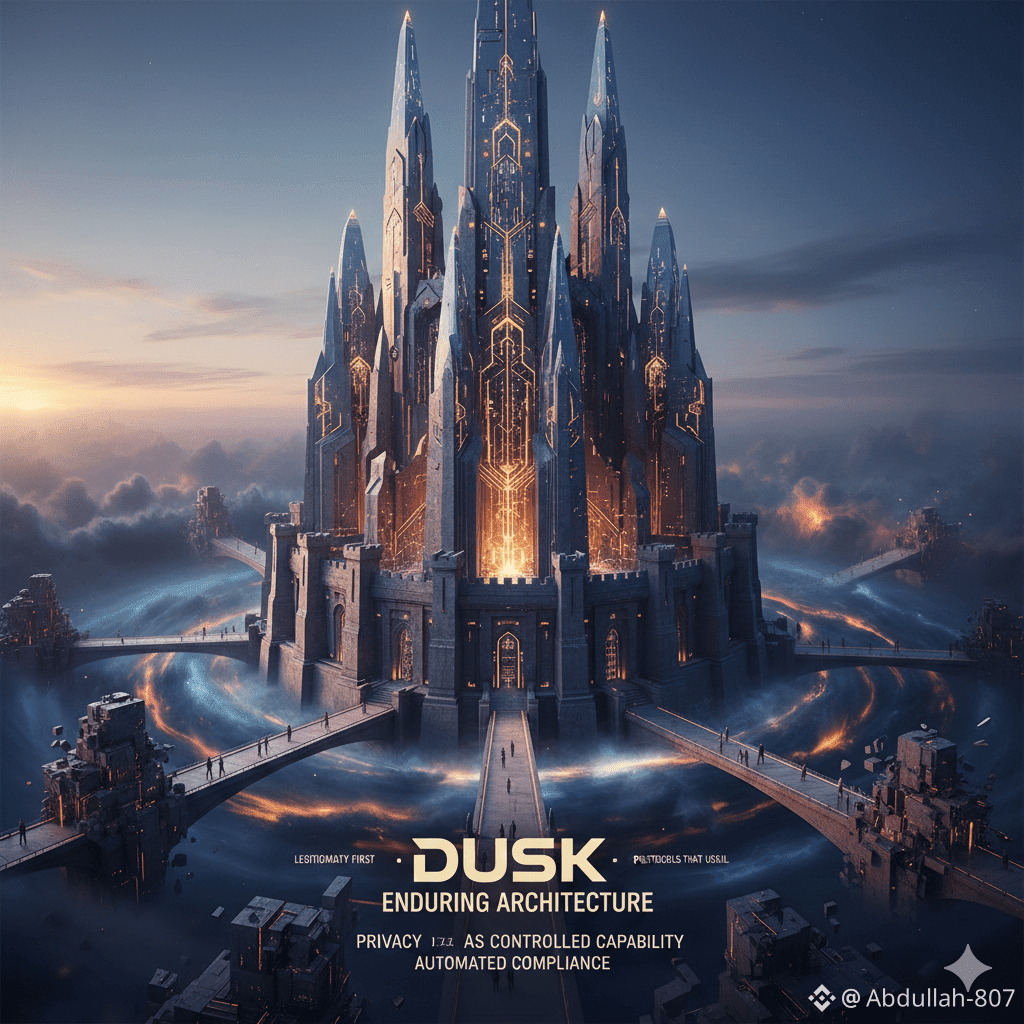
The Enduring Architecture: How Dusk Builds Finance for Regulation
In a sector that often treats regulation as an afterthought—or an adversary—Dusk chooses a different path: designing for oversight from day one. It does not fight gravity; it builds structures that can withstand it.
Regulation as a Force of Nature, Not an Enemy
Most financial systems are not built to survive attention. They sprint ahead, telling compelling stories, hoping hard questions arrive too late. Dusk begins with a different premise: regulation is a natural force—like gravity—that can't be argued away, only designed for. This single, quiet assumption reshapes everything about Dusk’s architecture and ethos.
Moving Past a False Binary
Early DeFi posited a fragile choice: be transparent and regulator-friendly but institutionally unusable, or be private and unaccountable—forced to hide in regulatory blind spots. Dusk dissolves this false binary. It assumes that finance at scale must support privacy and auditability simultaneously, not as add-ons, but as foundational principles. This is not just a technical choice—it’s a philosophical stand.
Building Trust Through Accountability
Regulation isn’t just about rules; it’s about trust. Institutions don’t fear decentralization—they fear opacity without accountability. Dusk doesn’t evade this fear; it absorbs and addresses it by embedding selective disclosure, compliance-friendly zero-knowledge proofs, and auditable privacy into its core. In doing so, it reframes blockchain from a rebellious alternative into a legitimate financial substrate, built to outlast, not just disrupt.
Patience as Strategy
Dusk’s philosophy is unusual in its patience. It does not optimize for viral adoption or short-term liquidity incentives. It optimizes for institutional time: the pace of legal clarity, risk committees, and long-term accountability. Where most protocols ask, “How fast can we grow?”, Dusk asks, “How long can this survive scrutiny?” This question leads to different engineering, governance, and a different definition of success.
Privacy as Controlled Capability
In Dusk’s view, privacy is not about hiding activity—it’s about protecting legitimate participants while maintaining verifiability. Many privacy projects equated secrecy with freedom, only to collapse under pressure. Dusk treats privacy as a controlled capability: something that can be proven, revealed, or restricted as context demands. This mirrors real finance, where confidentiality coexists with audit trails and legal frameworks.
Speaking Quietly, Enduring Loudly
Dusk doesn’t market itself as a revolution—revolutions attract resistance. It positions itself as infrastructure: invisible when working, indispensable when missing. By designing for regulation early, Dusk avoids the costly retrofitting that destroys many protocols when laws catch up.
Decentralization Without Irresponsibility
Decentralization does not remove obligations; it redistributes them. Dusk refuses to confuse decentralization with irresponsibility. Its architecture enables compliance without central control—rules enforced cryptographically, making compliance a property of the system, not permission from an authority. This is quietly radical: not rejecting regulation, but automating it.
Adaptability as Resilience
Regulation isn’t static—laws evolve, interpretations shift. Systems that hard-code today’s rules will fail tomorrow. Dusk’s modular, privacy-preserving design allows policies to adapt without compromising integrity. Survival in finance isn’t about perfection; it’s about resilience. Systems that adjust without breaking are the ones that endure.
Governance with Realism, Not Theater
Dusk avoids performative decentralization—governance that looks fair but collapses under pressure. In regulated environments, governance must balance participation with responsibility. Dusk creates space for structured governance that can interact with regulators without undermining decentralization. This is operational realism, not ideological purity.
The Competitive Advantage of Boredom
Regulated finance is not exciting—it’s repetitive, cautious, documented, and slow. Many crypto projects fail here, mistaking excitement for value. Dusk doesn’t. It treats boring reliability as a competitive advantage. Documentation, audits, compliance processes—these aren’t distractions. They are the innovation when the goal is longevity.
Legitimacy First, Growth Later
In much of crypto, legitimacy is negotiated after user acquisition and liquidity are secured. Dusk reverses this sequence: it builds legitimacy first, assuming growth will follow once trust is earned. This aligns with how real financial systems gain adoption—institutions adopt standards, not trends.
Operating Within Limits
Unlimited permissionlessness sounds attractive, but financial systems exist within social, legal, and ethical boundaries. Dusk does not try to transcend these boundaries. It operates within them, using cryptography to enforce fairness rather than escape oversight. Accepting limits isn’t weakness—it’s maturity.
Foresight, Not Compromise
As regulation becomes increasingly global and unavoidable, Dusk’s approach looks less like compromise and more like foresight. While others scramble to respond to regulatory pressure, Dusk treats that pressure as confirmation of its original assumptions. It doesn’t need to pivot because it was never built on denial.
Endurance Over Speed
Ultimately, Dusk’s philosophy isn’t about winning headlines or dominating charts. It’s about building a financial layer that regulators can interrogate, institutions can trust, and users can rely on—without sacrificing privacy or decentralization. In an ecosystem addicted to speed, Dusk chooses endurance. In a culture obsessed with disruption, it chooses continuity.
This choice may never feel exciting in the short term. But history rarely remembers the loudest systems—it remembers the ones that kept working after everyone stopped watching. Dusk is built for that moment.
