
The Institutional Turn: Why Dusk Is Leading the Quiet Rise of Regulated DeFi
The early DeFi era was defined by velocity and visibility—a vibrant, noisy race that prioritized growth over governance, speed over scrutiny, and speculation over sustainability. In that environment, Dusk chose a different path: one built not to outrun regulation, but to anticipate it.
From Noise to Necessity
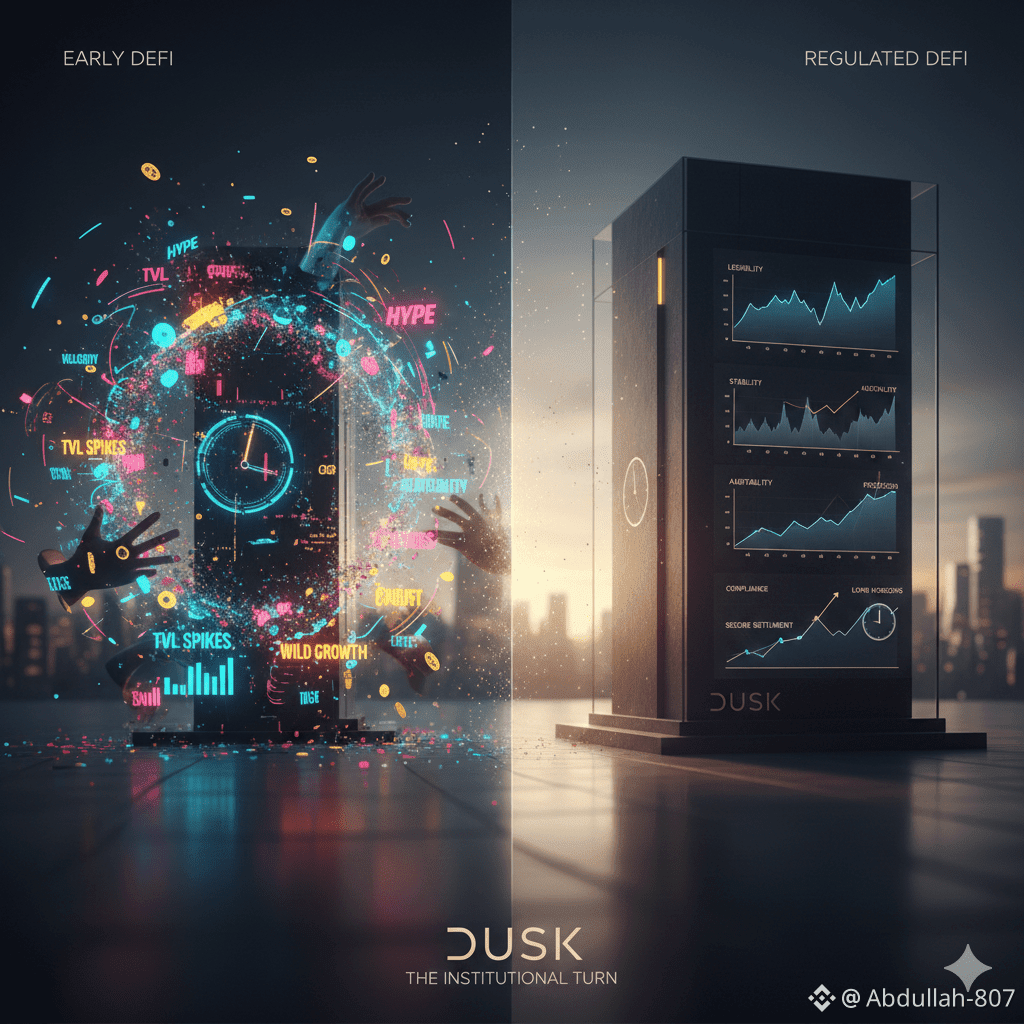
In the early days of DeFi, noise was the currency. Growth was measured in TVL spikes, hype cycles, and narrative dominance. Underneath the excitement lay an unspoken assumption: regulation was something to outrun, not engage with. That assumption guaranteed most of DeFi could never become real financial infrastructure. Dusk emerged without competing for attention—it understood that finance fails slowly, legally, and institutionally. The moment capital must answer to courts, regulators, and risk committees, most DeFi disappears from consideration—not because it’s malicious, but because it was never designed to survive that scrutiny.
Ambition Without Performance
The quiet rise of regulated DeFi isn’t a lack of ambition—it’s a refusal to perform. Dusk’s design reflects an understanding that the world’s most critical financial systems are almost invisible. Payment rails, settlement layers, custody frameworks—they don’t trend; they persist. Boredom in finance is often another word for reliability. Dusk doesn’t make privacy theatrical or compliance adversarial—it treats both as structural requirements in a world where institutions, laws, and capital with memory exist.
A Philosophical Shift: Openness + Accountability
Traditional DeFi assumes openness alone creates trust. Regulated finance assumes accountability creates trust. Dusk quietly argues the future belongs to systems that do both simultaneously—where privacy is preserved without becoming an excuse for opacity, and compliance is enforced without turning decentralization into a permissioned cage. This isn’t a compromise—it’s a harder design problem most protocols avoided.
Regulation as Formalized Responsibility
A misunderstood aspect of crypto regulation is the belief that it slows innovation. In reality, regulation exists to formalize responsibility. Institutions aren’t afraid of technology—they’re afraid of ambiguity. When something breaks, someone must be accountable. When a transaction occurs, its legitimacy must be provable. When privacy is used, its boundaries must be definable. Dusk is built around the idea that these constraints are not enemies of DeFi—they are the conditions required for it to grow beyond speculation.
Privacy as a Controlled Capability
In most crypto narratives, privacy is treated as absolute or meaningless—an unhelpful binary that fails when real financial actors enter the picture. Institutions require selective disclosure. They need to prove compliance without revealing proprietary information. They need confidentiality and auditability to coexist. Dusk’s architecture doesn’t treat this as a feature bolted on later—it’s a foundational principle. Zero-knowledge proofs aren’t used to impress; they’re used to reconcile conflicting requirements traditional finance has struggled with for decades.
Evolution, Not Rebellion
Dusk’s rise is quiet because it doesn’t frame itself as a rebellion—it frames itself as an evolution. Instead of asking how to replace the financial system, it asks how to upgrade it without breaking what already works. That question rarely excites retail traders, but it resonates deeply with institutions that have survived multiple crises. Banks, funds, and regulated entities don’t chase narratives—they chase survivability. They invest in systems designed to function under stress, not just optimism.
Regulation as an Internal Design Variable
The broader DeFi ecosystem often treats regulation as an external force imposed from the outside. Dusk treats it as an internal design variable. This changes everything. When compliance is anticipated rather than resisted, architecture becomes more disciplined. Smart contracts are written with clearer assumptions. Governance becomes more structured. Documentation matters. Upgrades slow down. Paradoxically, the system becomes stronger because it’s no longer trying to outrun its own responsibilities.
Confidence in Long Horizons
There’s subtle confidence in building something that doesn’t need to explain itself loudly. Dusk doesn’t promise overnight gains because it’s not built for overnight relevance. It’s built for long horizons—measured in operational years, legal precedents, and accumulated trust. In finance, trust is earned slowly and lost instantly. Systems that understand this don’t optimize for attention—they optimize for consistency.
A Demographic Shift, Not a Marketing Wave
The quiet rise of regulated DeFi isn’t a marketing wave—it’s a demographic shift. As capital matures, it becomes less tolerant of ambiguity. As institutions explore blockchain adoption, they aren’t looking for radical reinvention—they’re looking for continuity with improvement. Dusk positions itself precisely at that intersection. It doesn’t ask institutions to abandon their risk frameworks—it speaks their language, embeds their constraints, and offers a path forward that doesn’t pretend the real world doesn’t exist.
Out of Place, On Purpose
Dusk feels almost out of place in mainstream crypto discourse because it doesn’t fit neatly into narratives built around speed, disruption, or maximalism. Instead, it aligns itself with concepts that are harder to meme: legal clarity, predictable execution, and provable integrity. These aren’t features that trend—they’re features that endure.
Precision Over Speed
Regulated DeFi isn’t slower because it’s cautious—it’s slower because it’s precise. Precision takes time. It requires rejecting shortcuts, resisting premature optimization, and accepting that some growth is unhealthy. Dusk’s architecture reflects this discipline. It assumes failures will happen and designs for recovery. It assumes human error is inevitable and designs for containment. It assumes systems will be audited, challenged, and tested in hostile environments—and welcomes that scrutiny.
Infrastructure, Not Playground
Truly critical infrastructure rarely changes rapidly. Power grids, financial clearing systems, and communication networks evolve conservatively because the cost of instability is unacceptable. Dusk draws from this tradition rather than fighting it. It treats blockchain not as a playground, but as infrastructure. That mindset alone separates it from much of the ecosystem.
Quiet Adoption, Irreversible Integration
The rise of regulated DeFi won’t be marked by viral launches or explosive charts. It will be marked by quiet adoption, long procurement cycles, and slow but irreversible integration into existing financial workflows. Dusk doesn’t need to dominate headlines to succeed. It needs to become dependable—and in finance, dependability compounds in ways hype never can.
Legibility Over Visibility
In a market obsessed with visibility, Dusk chooses legibility. In an industry addicted to speed, it chooses stability. In a culture that celebrates disruption, it chooses continuity. These choices aren’t accidental—they’re signals not to retail crowds, but to serious capital that has learned the cost of fragility.
The Future: Institutional, Regulated, Boring
The future of DeFi won’t look like its past. It will look more institutional, regulated, and boring. In that future, the protocols that survive will be the ones that prepared quietly while others performed loudly. Dusk’s rise isn’t a revolution—it’s a re-alignment, a return to the idea that finance, at scale, is a discipline before it’s an experiment.
That is why Dusk doesn’t shout. It doesn’t need to. Its design already speaks to those who are listening.
