So, picture this. Your entire digital life your photos, that novel you’re secretly writing, your playlist of obscure music you swear no one else gets where does it actually live? If you said “the cloud,” you’re not wrong. But that “cloud” is usually just a fancy word for a massive, humming server farm in a place you’ve never been, owned by a company that probably just showed you an ad. Feels a bit.off, right?
This isn't just a philosophical tech gripe. Remember that day when half your apps just.stopped? That was likely one of those centralized points of failure having a bad Tuesday. It’s a system with a single, fragile neck, and we’re all putting our most important digital stuff right on the chopping block.
That feeling that there has to be a better, more resilient way is exactly why I got so interested in what’s happening on the Sui blockchain. It’s not just about moving money around anymore; it’s about moving the very fabric of the internet itself. And at the heart of that shift is something with a surprisingly charming name: Walrus Protocol.
Forget everything you think you know about “cloud storage.” Walrus isn’t just a new hard drive in the sky. It’s more like a collective, digital trust fall. Imagine you could take that precious family photo, split it into a thousand unique, encoded puzzle pieces, and give each piece to a trusted, anonymous neighbor all over the globe. Even if a bunch of them lose their piece, you’d only need a handful of the others to perfectly reconstruct the whole picture. That’s the spirit of Walrus. It’s storage that’s resilient by design, not by accident.
So, Who Built This Thing?
Walrus didn’t just spring from the crypto ether. It was built by Mysten Labs, the same architects behind the Sui blockchain itself. These aren’t fly by night devs; they’re thinking about the foundational layers of the next internet. They launched Walrus in 2024 with a deceptively simple mission: to make the world’s data reliable, valuable, and something you can actually govern.
That last bit is key. In today’s web, you “govern” your data by clicking “I Agree” to a 50 page terms of service. In the world Walrus is building, governance means you have a real, cryptographic say.
The Nuts and Bolts (Without Needing an Engineering Degree)
Okay, let’s get a tiny bit technical, but I promise to keep it human. How does Walrus actually work its magic?
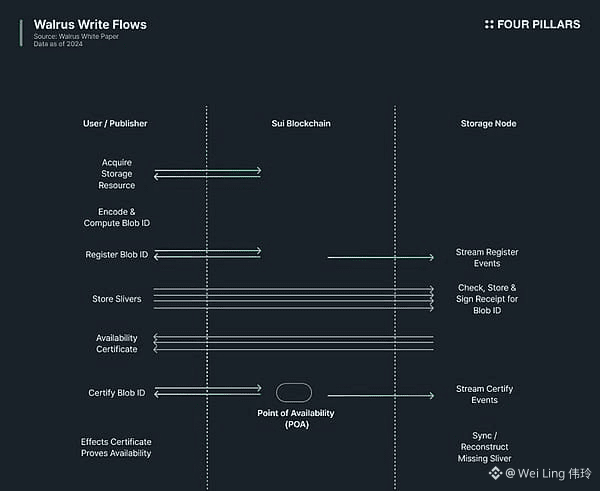
· The Sui Backbone: First, it’s built natively on Sui. This isn’t just a compatibility thing. Sui acts as the unshakable, trustless ledger for the whole operation. It’s the traffic cop that keeps track of where every single one of those “puzzle pieces” is, handles the micro payments, and verifies without needing to ask anyone that your data is safe and sound. This tight integration is a massive advantage.
· Erasure Coding The Smart Split: Instead of just making five full copies of your file (which is wildly inefficient), Walrus uses a brilliant technique called erasure coding. It splits your data into fragments, adds some clever “backup” math (parity data), and scatters those fragments. The beautiful part? You don’t need all the fragments to rebuild your file. You just need a certain number of them. This makes it incredibly robust and space-efficient.
· Programmable Data The Game Changer: This is where my mind was truly blown. On Walrus, your data isn’t a dead file in a folder. It’s a living, programmable asset on the blockchain. A smart contract can directly read from it, write to it, and interact with it. Think of an NFT that isn’t just a JPEG link but contains evolving art, a video game character whose gear updates on chain, or a musician’s album that unlocks bonus tracks based on community engagement. The data itself becomes part of the application logic.
A Quick, Honest Look at the Competition
It’s only fair to see how Walrus stacks up. The decentralized storage space has some big names, but they all have different philosophies.
The table below compares Walrus with other major players.
Feature Walrus Protocol Arweave Filecoin / IPFS
Core Goal Programmable, efficient storage for dynamic apps. Permanent, unchanging storage forever. Verifiable storage deals & file distribution.
How it Stores Erasure coding (smart, efficient splitting). Whole file replication across the entire network. Deal based storage with cryptographic proofs.
Best For dApps, AI data, interactive media, evolving NFTs. Archiving historical documents, static art. General file backup, hosting website assets.
The Vibe A live, interactive notebook. A carved stone tablet. A very secure, verified warehouse.
The takeaway? Walrus isn’t trying to be the best at storing everything forever. It’s aiming to be the best home for the living, breathing data of the next internet.
The Beating Heart: The WAL Token
You can’t talk about a protocol without its token, and WAL is the lifeblood of this ecosystem. It’s not just a coin to speculate on; it’s a utility token with clear, crucial jobs.
1. It’s How You Pay: Want to store your data? You pay for it in $WAL. The protocol has clever mechanics to keep real world storage costs stable, even if the token price jumps around.
2. It’s How You Secure (and Earn): This is the cool part. You can stake your WAL tokens to help secure the network. Most people will delegate their stake to a trusted storage node operator. Nodes with more stake get trusted with more data, and they share the rewards with their stakers. It’s a way to participate and earn yield by helping the network run smoothly.
3. It’s How You Govern: Holding WAL is like holding a share in the future of the protocol. Token holders get to vote on upgrades, fee changes, and the overall direction. It’s a truly community owned system.
A few quick facts on the token:
· There will only ever be 5 billion $WAL.
· The majority (over 60%) is dedicated to the community for grants, airdrops, and growing the ecosystem.
· It has deflationary pressures built in. For example, tokens can be “burned” (permanently destroyed) if a staker acts in a way that hurts network efficiency, which benefits long term holders.
This Isn't Theory: Walrus in the Wild
The most exciting part is seeing what builders are already creating with this.
For the AI World: Projects like Talus AI are using Walrus as the foundational layer for their AI agents. It gives them a verifiable, tamper-proof place to store training data and results crucial for trust in an AI-driven future.
· For Creators & Collectors: NFT platforms are using it to store rich metadata and high quality assets reliably. Imagine a video NFT that doesn’t just point to a risky off-chain server but lives securely on the decentralized network itself.
· For Uncensorable Apps: Developers are building entire website frontends, called “Walrus Sites,” hosted directly on the network. This means a blog, a social platform, or a tool that literally no central authority can take offline.
· For Private Storage: With added confidential computing layers, it’s becoming a powerful option for anyone who wants control back from Big Tech clouds.
The Road Ahead
Walrus has moved fast. It’s out of mainnet, backed by serious funding, and has a vibrant community building on it. But in many ways, this is just the beginning.
The big idea here the one that keeps me up at night is programmable data. We’re moving from an internet of static files to an internet of interactive assets. Your data won’t just be stored; it will do things, unlock things, and prove things all on its own.
Walrus Protocol, built on the speed and scalability of Sui, isn’t just a new place to put your files. It’s a declaration that our digital lives should be as resilient, sovereign, and dynamic as we are. It’s about unboxing your data from someone else’s warehouse and putting it back in your hands, scattered across a thousand friendly neighbors, safe and sound. And honestly? That’s a future worth building.