In the world of blockchain, finality is a concept that often gets overlooked by everyday users. For most individuals, probabilistic finality—where a transaction is “likely” permanent after a number of confirmations—is perfectly acceptable. A short wait for confirmations, or the rare chance of a chain reorganization, is a minor inconvenience. The cost of uncertainty is low, and life goes on.
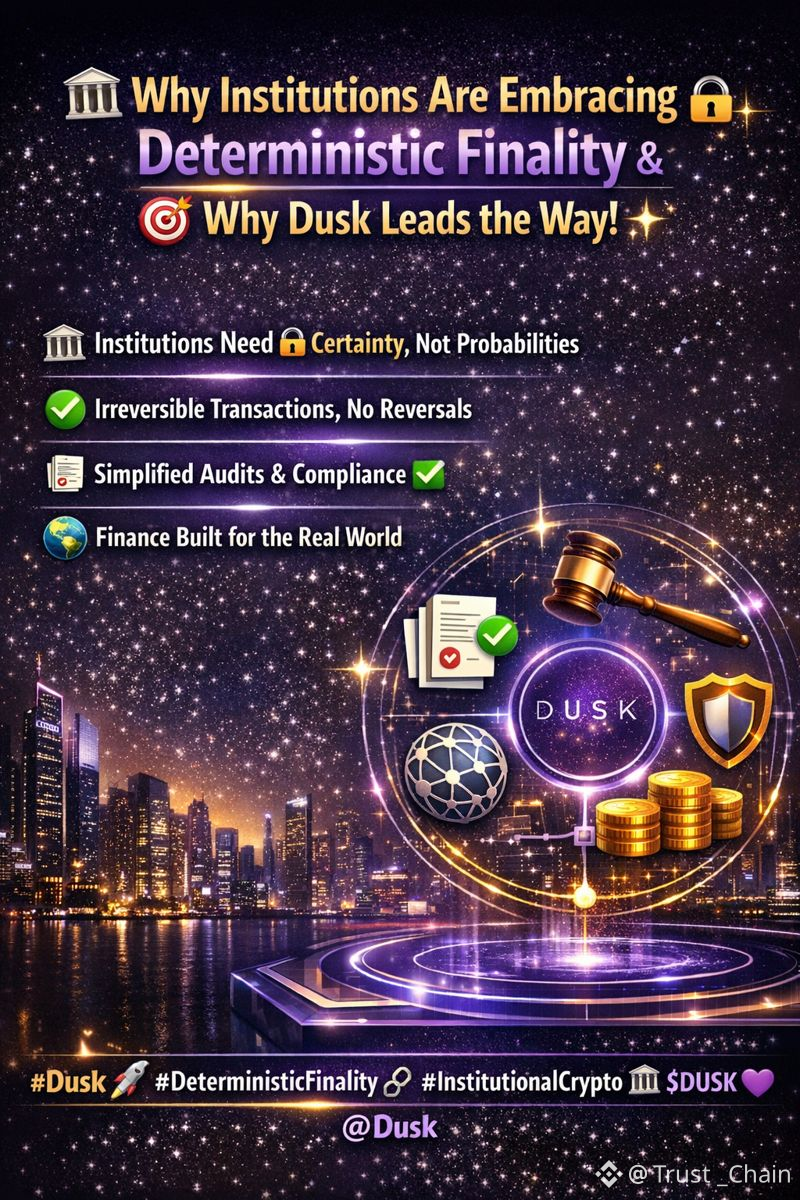
For financial institutions, however, the story is very different. Here, uncertainty is unacceptable. Legal ownership, transaction settlement, and compliance processes cannot operate on probabilities—they demand certainty. Once a transaction is finalized, it must remain irreversible, without exceptions. Even the smallest chance of a reversal introduces operational risk, additional reconciliations, and increased costs. Deterministic finality is not just a technical preference—it is a regulatory necessity.
This distinction shapes the very foundation of how blockchain infrastructure must be designed for institutional use. Many open, permissionless networks prioritize flexibility and decentralization over absolute finality. They rely on incentives and economic mechanisms to make chain reorganizations rare, but these reversals are never fully impossible. For retail users, this risk is manageable; for institutions, it’s a liability. Accounting systems, compliance audits, smart contracts, and legal frameworks all rely on outcomes that are final and verifiable. Probabilistic finality introduces friction at every step.
Deterministic finality, in contrast, simplifies operations enormously. When a transaction is committed on a network with deterministic finality, it is permanently recorded. Downstream systems—whether internal accounting, regulatory reporting, or interbank settlement—can rely on this certainty. There’s no need for additional “just in case” checks or contingency processes. Reconciliations become faster, audits become more straightforward, and the risk of disputes or errors drops dramatically. For institutions, this is a game-changer. Certainty enables efficiency, reduces operational overhead, and aligns blockchain infrastructure with the rigorous standards of regulated finance.
Dusk Network embodies this approach at its core. Unlike networks where finality is probabilistic, Dusk ensures that transaction outcomes are absolute. Finality is not an afterthought or a statistical probability—it’s a foundational principle. By guaranteeing that transactions are irreversible the moment they are confirmed, Dusk offers an experience closer to traditional financial infrastructure, but with the transparency, security, and programmability of blockchain technology.
This design has profound implications for institutional adoption. Financial organizations, investment firms, and regulated entities can deploy Dusk’s platform with confidence, knowing that each transaction aligns with compliance requirements and audit expectations. Smart contracts execute with certainty, tokenized assets move securely, and cross-border payments occur without ambiguity or risk of reversal. By removing the uncertainties inherent in many blockchain systems, Dusk allows institutions to focus on business innovation rather than constant operational mitigation.
Over time, deterministic finality builds trust and efficiency at every layer. Networks that guarantee certainty are easier to reason about, simpler to govern, and more resilient to disputes or errors. For institutions, certainty is not just a convenience—it is a necessity. Dusk’s commitment to this principle demonstrates why it is quickly becoming the preferred choice for enterprises seeking blockchain solutions that meet the stringent demands of the real world.
In summary, while probabilistic finality may suffice for casual users, institutions require certainty, security, and predictability. Dusk Network delivers this through deterministic finality, enabling financial organizations to operate seamlessly while embracing the transformative potential of blockchain. For institutions ready to step confidently into the future of digital finance, Dusk is not just a platform—it’s the standard.