
Sometimes the crypto market makes too much noise. New tokens appear every week, influencers push many narratives a day, and hype cycles last only a few days before attention jumps somewhere else. In moments like this the smartest thing anyone can do is take a step back and look at what actually survives in the long run. The projects that keep growing are not the loud ones. They are the ones that quietly build infrastructure that solves a real problem. That is the reason I keep coming back to Walrus every time I try to understand where the next decade of Web3 storage is headed.
The more you look at the internet today the more obvious it becomes that storage is the real foundation behind almost everything. Every AI model depends on huge datasets. Every NFT platform needs reliable media. Every app that wants to scale must store user content somewhere safe and cheap. Centralized cloud works today but everyone knows it comes with limits. It is expensive at scale. It introduces single points of failure. It forces trust in a provider. And it does not match the principles of decentralization that Web3 is supposed to stand on. This is the gap Walrus is quietly filling with a design that feels both practical and ambitious.
The interesting part is that Walrus is not trying to push dreamy marketing language. They are not claiming to reinvent the entire internet or replace every cloud provider in one go. They are doing something more grounded. They built a way to store large files in a decentralized way without the usual pain points. Most decentralized storage networks become slow or difficult when files get bigger. Walrus took a different path by separating how data is cut, encoded, and distributed. This approach is one of the reasons people inside the Sui ecosystem respect what the team has achieved. They solved the real engineering problem first before creating a narrative around it.
What makes Walrus stand out is how it handles large content in a way that developers can use without stress. Instead of forcing apps to adjust everything for decentralized storage, Walrus behaves more like a reliable storage backend that fits into existing workflows. When a creator uploads a heavy file or when an AI application writes training data, Walrus ensures the content is broken into pieces that are stored across different hosts. These pieces are coded in a way that even if several hosts fail the content can still be recovered easily. This gives reliability similar to a strong cloud system while also removing the central point of failure that Web2 suffers from.
Another thing I like about Walrus is how it removes the fear of rising storage bills. Traditional cloud platforms punish growth. If your platform becomes popular you pay more. If your users upload too much data you pay more. If your app starts scaling fast you pay even more. Decentralized storage should not work like this. Walrus seems to understand this problem deeply. By distributing the load across a network and focusing on efficient coding they reduce the dependency on expensive centralized infrastructure. This approach lets the system scale without dramatic price jumps that developers hate.
When Walrus announced upgrades in their protocol it became even clearer that they are preparing for large scale usage. The new version improves encoding efficiency and reduces the cost of storing heavy files. It also increases the performance of retrieval. This is extremely important for real world apps because users do not wait. If a video takes too long to load or an image fails to appear people drop the platform. A decentralized storage network that behaves like a slow antique server is not useful. Walrus is avoiding that trap by focusing on speed and experience rather than pure idealistic decentralization.
The most powerful part of Walrus is how it fits into the wider Sui ecosystem. Sui has always focused on speed and experience. They want developers to build apps that feel as smooth as Web2 while still gaining the benefits of Web3. Walrus matches that philosophy almost perfectly. It gives the missing piece that Sui needed for heavy content applications. Gaming studios need storage. NFT projects with high quality art need storage. AI driven platforms need storage. Social platforms need storage. Walrus offers that base layer without forcing developers to compromise on performance.
I find it interesting that the Walrus narrative is not built on loud marketing but on quiet progress. When you look at their updates you see a pattern. Each upgrade is about stability. Each improvement is about making the network more usable for developers. Each milestone is about turning a good idea into something scalable. This is the behavior of infrastructure projects. Infrastructure does not scream for attention. It silently powers everything from behind the scenes. When people look back years later they realize how critical it was.
This happens in every cycle. When hype fades the infrastructure remains. It is always the essential parts of the ecosystem that end up shaping the next generation of applications. Blockchains need storage solutions that can support real usage. They need networks that handle files reliably. They need systems that are built to last. Walrus is doing exactly that. It is slowly building the kind of backbone that future developers will rely on without even thinking about it.
The reason infrastructure outlasts noise is simple. Hype gives short term attention but infrastructure gives long term value. Anyone can make a token trend for a day but only a few teams can create something that developers trust for years. Walrus has built a reputation inside the Sui community as a serious project with serious engineering behind it. They raised significant funding and they are backed by groups that understand the importance of long term design. That alone tells you something about their vision.
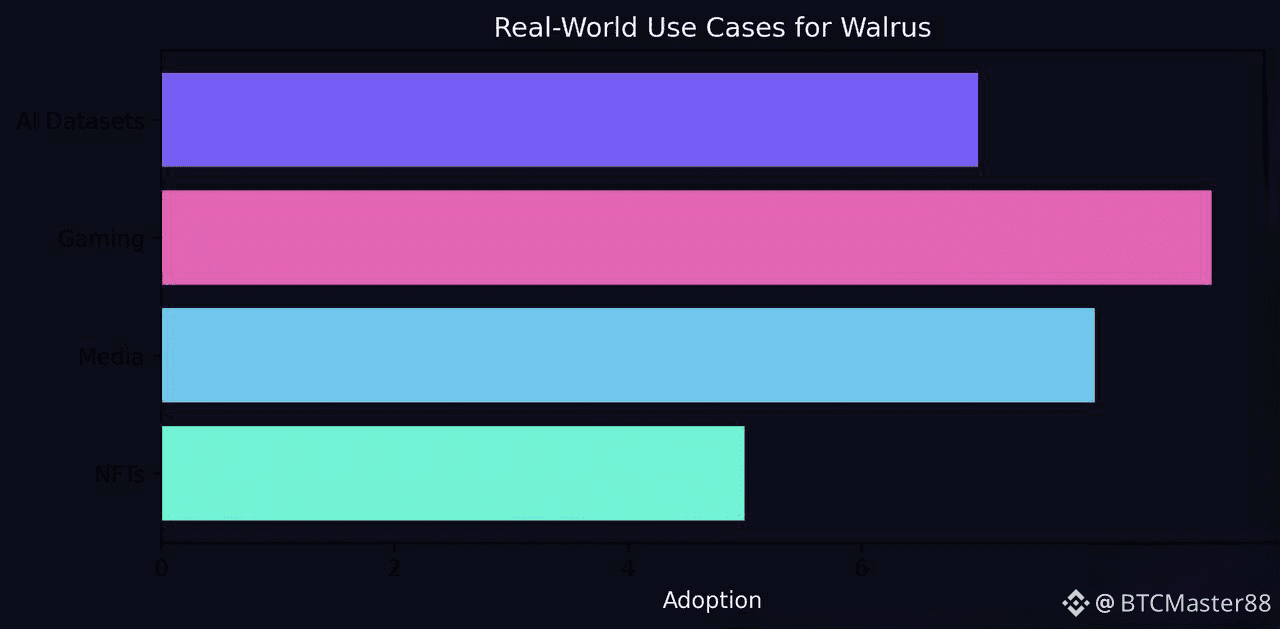
What I also appreciate is how Walrus does not limit itself to a small niche. Their technology can power many sectors. Think about AI applications that need massive storage for datasets. Think about gaming studios that want to store high resolution assets securely. Think about NFT marketplaces that need to guarantee that artwork or videos will always be accessible. Think about content platforms that want censorship resistant storage. All these use cases benefit from what Walrus offers. The beauty is that the same infrastructure can support all of them without needing separate systems.
Today the market is full of projects that want instant recognition. Some try to attach themselves to the latest narrative even if they do not fit. Others produce features quickly without thinking about long term durability. Walrus takes the opposite approach. They focus on slow and consistent progress. They follow a roadmap that aligns with real technical needs. They ship improvements that strengthen the foundation instead of chasing attention.
This is why Walrus feels like an infrastructure layer rather than a hype project. You can see it in the way they talk about their updates. You can see it in the seriousness of their development. You can see it in the quality of the work they share. The project is not trying to dominate your timeline with loud marketing. They are letting the product and engineering speak for itself.
If we look ahead to the next years the demand for storage will increase massively. AI will produce more data. NFTs will become heavier. Social networks will generate more media. Onchain gaming will need high quality asset storage. Every major sector of tech is moving toward a world where reliable and scalable storage becomes essential. In that world the value of Walrus becomes even more obvious. A decentralized network that can handle large content with efficiency and trust is not just useful. It becomes a requirement.
This is why infrastructure outlasts noise. Market cycles will continue to move up and down. New projects will keep appearing. Narratives will shift again and again. But the underlying need for storage will always grow. Walrus is building for that future. They are not chasing the moment. They are building the rails that future applications will depend on.
People who understand this pattern know that infrastructure wins silently. It grows without screaming. It matures without drama. And one day everyone suddenly realizes that the quiet project they ignored is now powering the entire ecosystem. Walrus has all the signals of that kind of project. Reliable engineering. Practical design. Scalable architecture. Real world use cases.
The noise fades but the infrastructure remains. And Walrus is positioning itself as one of the strongest storage infrastructures in Web3.


