
@Dusk : In has taken a different path from most blockchain projects by focusing on one of the most complex yet important challenges in the industry: building a Layer 1 blockchain that can support regulated, privacy-focused financial infrastructure. While many networks are optimized for open experimentation or speculative DeFi.
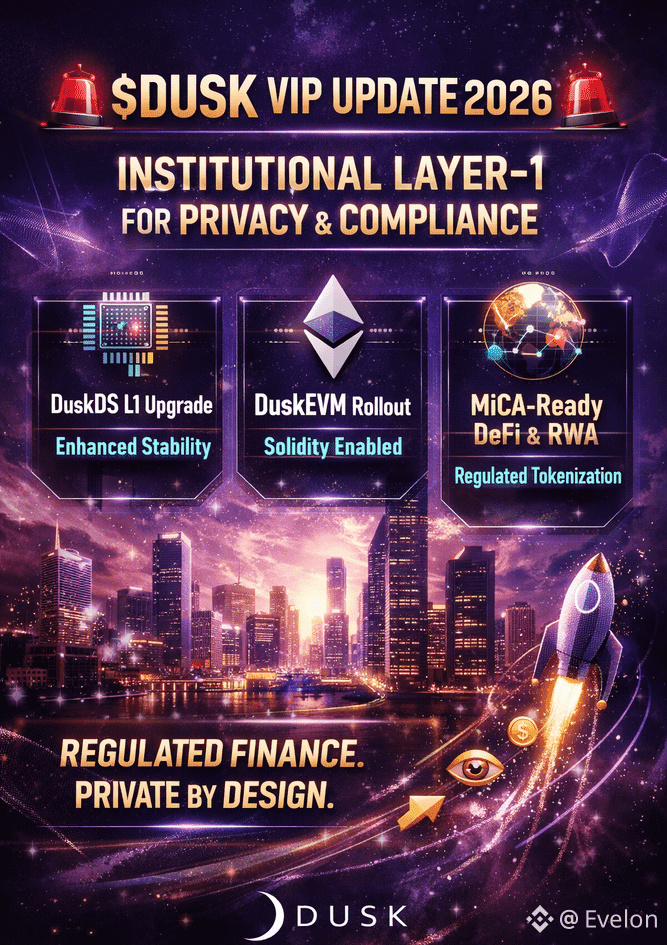
Dusk was designed with real-world financial markets in mind, where compliance, confidentiality, and trust are essential.
This long-term vision positions #Dusk as a bridge between traditional finance and decentralized technology rather than a competitor to existing systems.
At the heart of the Dusk network lies a carefully designed modular architecture that separates execution, settlement, and privacy components. This structure allows the blockchain to remain scalable and adaptable while maintaining strong security guarantees. By supporting EVM compatibility.
Dusk enables developers to deploy smart contracts using familiar Ethereum tooling, lowering the barrier to entry and encouraging ecosystem growth. At the same time, the network introduces privacy-preserving features that are not commonly available on standard EVM chains, making it suitable for applications that require confidentiality without sacrificing transparency where it matters.
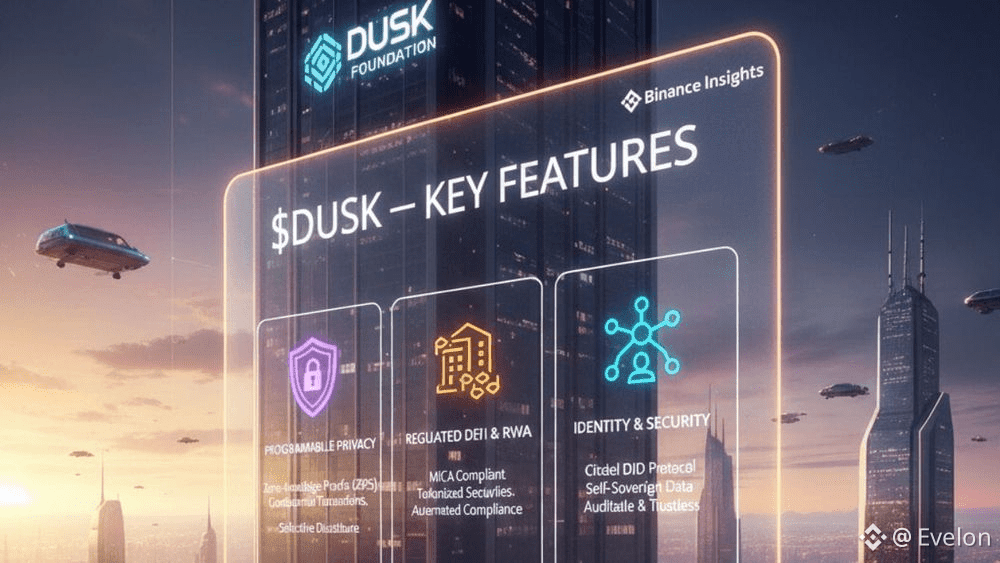
Privacy on Dusk is not about obscuring everything by default but about giving users and institutions control. Through advanced cryptographic techniques such as zero-knowledge proofs, transactions can remain confidential while still being auditable by authorized parties. This selective disclosure model is especially important for regulated financial instruments, where transaction data must be protected from public exposure yet accessible for compliance checks, audits, or legal requirements. Rather than avoiding regulation.
Dusk integrates compliance directly into its design, enabling on-chain enforcement of rules like identity verification, permissioned access, and asset restrictions.
One of the most promising use cases for the Dusk ecosystem is the tokenization of real-world assets. Assets such as equities, bonds, funds, and other financial instruments can be issued and managed on chain in a way that aligns with existing legal frameworks. This opens the door to more efficient settlement, reduced operational costs, and global accessibility while preserving investor protections. Alongside this Dusk supports compliant decentralized finance, allowing institutions to explore lending, trading, and settlement solutions without exposing sensitive data or violating regulatory standards.
The $DUSK K token serves as the backbone of the network, powering transaction fees, staking, and overall network security. Validators are incentivized to maintain the integrity of the chain, while users rely on Dusk to interact with applications across the ecosystem. As adoption increases, the token becomes deeply embedded in every layer of the network, reinforcing its role in governance, settlement, and long-term sustainability.
In an industry filled with short-term narratives @undefined stands out for its patient, infrastructure-first approach. By prioritizing privacy, compliance, and institutional readiness.
Dusk addresses real limitations that have slowed blockchain adoption in traditional finance. As global regulations around digital assets continue to mature, platforms that are built with these realities in mind are likely to gain a significant advantage. For anyone interested in the future of compliant DeFi, tokenized real-world assets, and privacy-preserving financial systems, the evolution of $DUSK is a story worth following close.
