
For a long time, stablecoins have been pitched as an easier form of money. They mirror the dollar, function like the dollar, and move across the internet with software-level speed. In reality, though, using them has rarely felt effortless. Transaction fees can spike unpredictably, networks slow down under heavy load, and users are often required to hold unfamiliar gas tokens just to send what should be simple digital cash. Plasma emerged to address this mismatch. It is a Layer 1 blockchain built around a focused premise: if stablecoins are meant to function as global money, the underlying network should be optimized for settlement rather than speculation.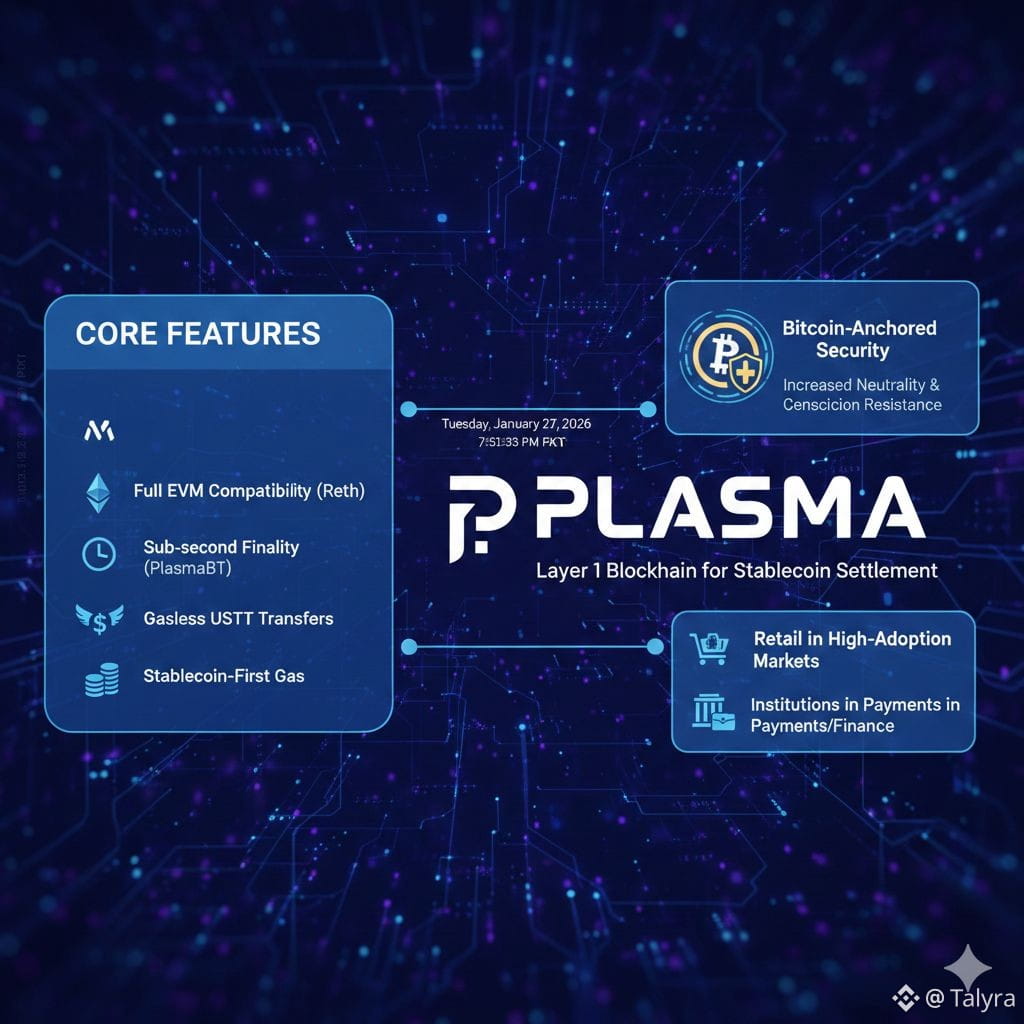
Plasma is built on full EVM compatibility using Reth, a modern Ethereum execution client written in Rust. This immediately situates Plasma within the broader Ethereum ecosystem. Developers can deploy existing smart contracts and use familiar tools without needing to rebuild from the ground up. Wallets, infrastructure providers, and applications that already support Ethereum can integrate with Plasma with minimal friction. This continuity is critical, especially for teams working on financial products where speed, reliability, and predictability are essential.
Plasma distinguishes itself most clearly in its performance characteristics. With its custom consensus mechanism, PlasmaBFT, the network is designed to achieve finality in under one second. This is more than a technical benchmark—it fundamentally changes how payments behave. Sub-second finality allows transactions to be treated as settled almost instantly, which is crucial for point-of-sale payments, payroll systems, and high-throughput payment flows. In these contexts, waiting multiple blocks or dealing with reorg risk is not viable. Plasma treats fast, deterministic settlement as a core design goal, not an afterthought.
Perhaps the most user-centric aspect of Plasma lies in its fee model. Rather than requiring users to manage a separate native token just to pay for transactions, Plasma adopts a stablecoin-first approach to gas. Fees can be paid directly in stablecoins, and common actions like USDT transfers can even be gasless through integrated paymaster support. For everyday users, this removes one of the most confusing aspects of crypto. You can simply hold, send, and receive stablecoins without worrying about gas balances or failed transactions. The experience begins to resemble how money is supposed to work.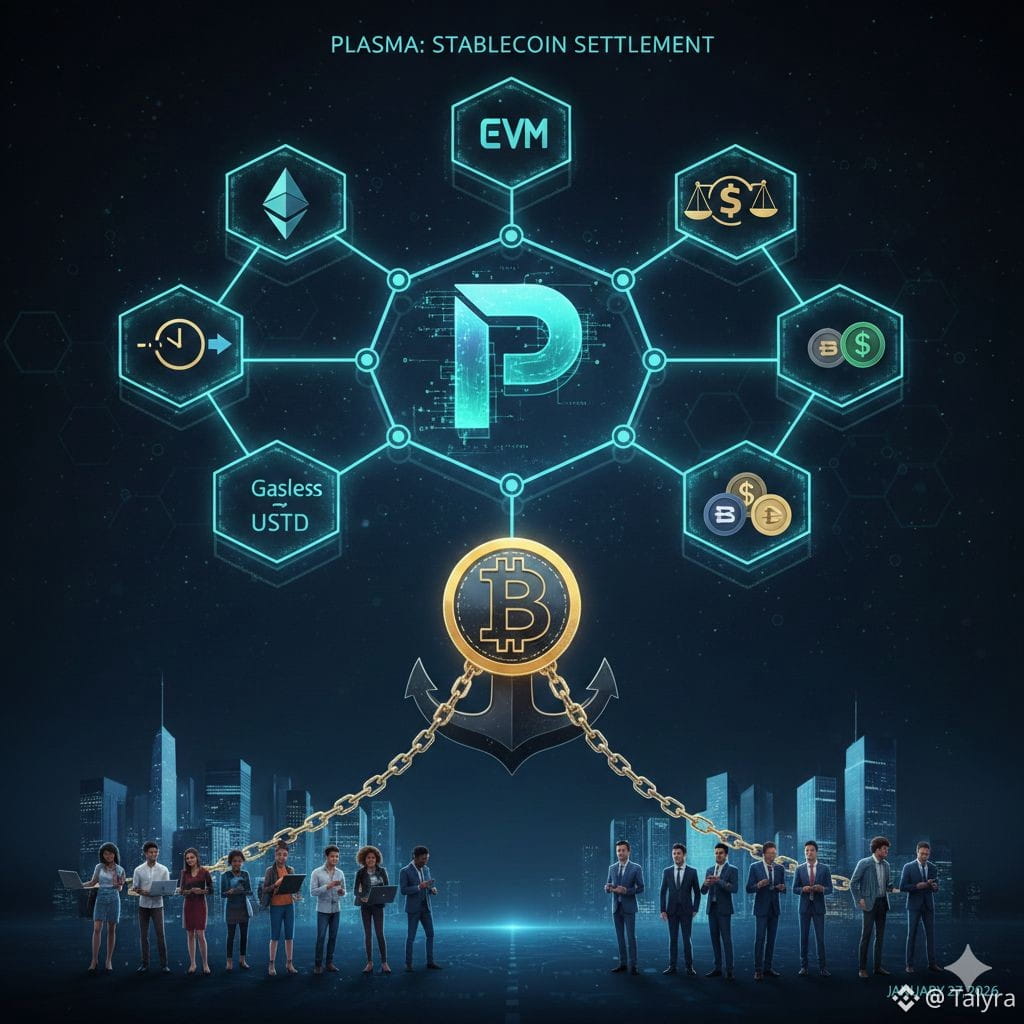
Plasma also places strong emphasis on security and neutrality. The network anchors its state to Bitcoin, using it as a foundation for long-term security and censorship resistance. By checkpointing to the most established and battle-tested blockchain, Plasma reduces dependence on any single validator group or centralized governance structure. This approach is particularly appealing to institutions and payment companies that value neutrality and durability. Anchoring to Bitcoin reinforces the idea that Plasma is shared infrastructure, not a chain controlled by a small set of insiders.
Because Plasma is designed specifically for stablecoin settlement, its audience spans a wide range of users. In regions where stablecoins are already used for savings and everyday transactions, Plasma enables faster, cheaper, and more intuitive transfers that are accessible even to non-technical users. At the same time, banks, fintech firms, and payment processors gain a blockchain environment with predictable costs, rapid settlement, and familiar EVM-based programmability. This reflects a broader evolution in crypto, where the same infrastructure must support both small peer-to-peer payments and large-scale institutional flows.
Plasma is intentionally narrow in scope. It does not attempt to be a universal platform for every experimental use case. Instead, it focuses deeply on one of the most critical problems in crypto today: moving stable value efficiently and reliably at scale. By combining Ethereum compatibility, near-instant finality, gasless stablecoin transactions, and Bitcoin-anchored security, Plasma offers a coherent vision for turning stablecoins from a promising idea into real financial infrastructure.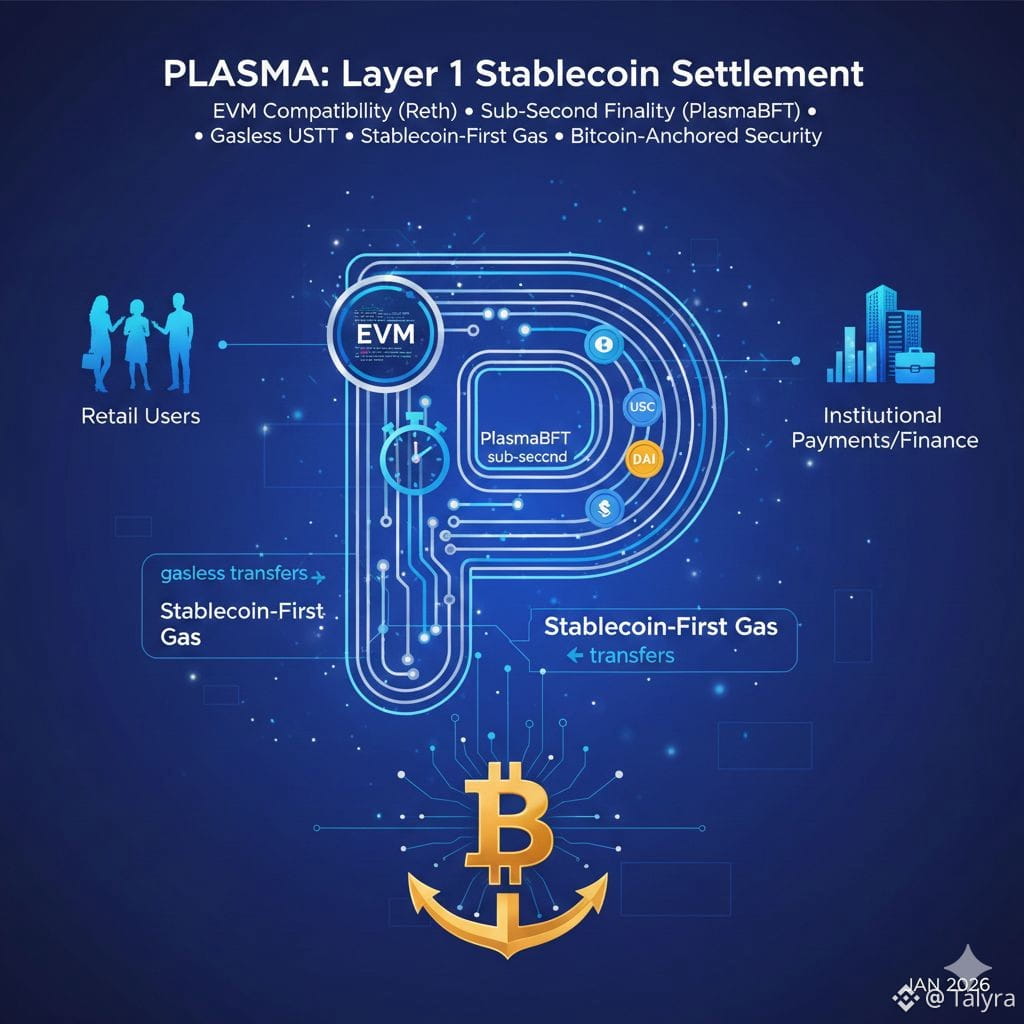
If blockchains are the rails and stablecoins are the trains, Plasma is raising a question the industry has often overlooked: what changes when the rails are designed specifically for the train everyone is already riding? The answer could determine whether stablecoins remain a tool mainly for crypto insiders or finally evolve into the global settlement layer they were always intended to become.

