
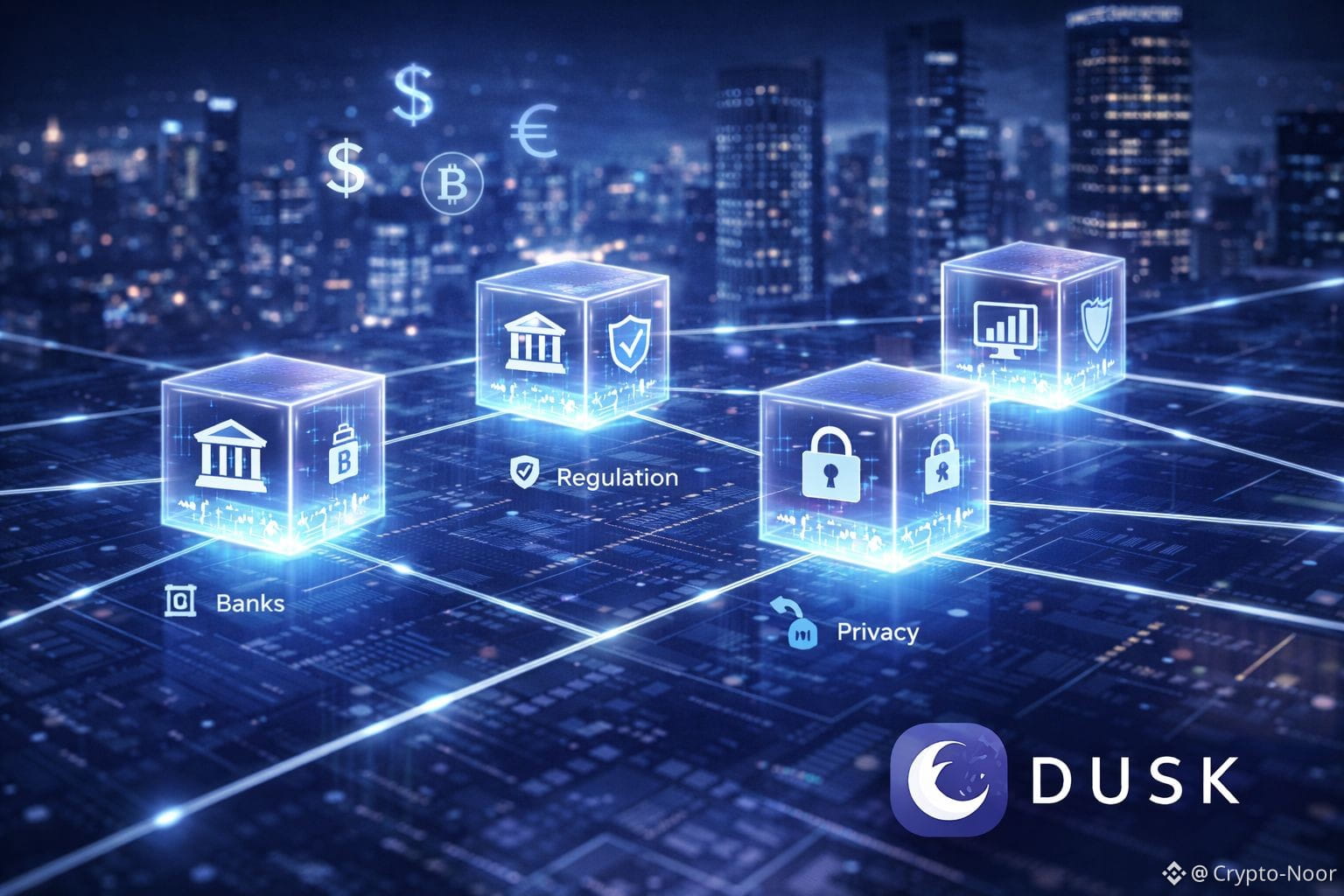
I remember sitting at a café, paying my bills on my laptop, and wondering how much of my financial information was quietly being tracked behind the scenes. That little twinge of unease knowing your transactions are visible somewhere makes the idea of a privacy-first blockchain appealing. Dusk, founded in 2018, approaches this problem in a thoughtful way. It’s a layer 1 blockchain designed specifically for financial applications that need both privacy and regulatory compliance. Think of it as building a digital financial neighborhood where the streets are visible enough for oversight, but your front door is yours alone.
The system is modular, which might sound like a buzzword, but in practice it means developers can assemble the parts they need for specific applications without reinventing the wheel. Tokenized assets, compliant DeFi products, or other financial instruments can be built on Dusk with privacy and auditability already baked in. It’s a bit like constructing a house from pre-made, certified components: you know it meets safety standards, but you still get flexibility in design.
One of the things I find quietly impressive is how Dusk balances privacy with transparency. Privacy isn’t just a feature slapped on after the fact; it’s part of the architecture. Users can transact without revealing more than necessary, while auditors or regulators can still verify the system works as intended. It’s a careful balancing act that reminds me of walking a tightrope—you have to look ahead, but also pay attention to every small step.
The platform also opens doors for institutions and businesses. Banks or investment firms often hesitate to engage with standard DeFi products because of unclear compliance standards. Dusk provides a space where such entities can experiment with tokenized real-world assets or digital financial products while staying within legal frameworks. For someone like me, who occasionally worries about the intersection of regulation and innovation, this kind of architecture feels reassuring.
On the personal side, I like imagining how this could change everyday interactions. Maybe one day buying a house or transferring shares could happen on a blockchain that keeps sensitive details private but still fully compliant. It’s not just about cryptos or speculation; it’s about practical financial processes done smarter. I’ve tried using other platforms where privacy is claimed but feels half-baked, and it’s frustrating. Dusk seems intent on building the foundation properly from the start.
That said, there are limitations. Being a regulated, privacy-oriented blockchain isn’t as simple as flipping a switch. Adoption takes time, and the ecosystem is still developing. Some features might be slow to integrate, and regulatory landscapes can shift, affecting how flexible the system remains. And even though attention gathers on exchanges like Binance for Dusk listings, trading interest can fluctuate independently of the protocol’s underlying utility. It’s worth remembering that being technically solid doesn’t automatically translate to widespread use overnight.
I also find it interesting how Dusk approaches risk versus convenience. Unlike typical DeFi platforms that prioritize speed and flashy yield opportunities, Dusk emphasizes structural soundness. It might not grab headlines with every update, but it builds a foundation that could support more complex financial applications without compromising privacy or compliance. In a way, it’s like preferring a sturdy backpack over a flashy designer bag: the latter looks appealing, but the former reliably carries your essentials where you need them.
Another subtle benefit is clarity for developers. A lot of blockchains ask programmers to navigate a maze of tools and inconsistent rules. Dusk’s modular design provides clear building blocks, making it easier to create applications that adhere to both legal standards and privacy principles. For someone who enjoys tinkering with tech, that predictability is a relief. It’s not glamorous, but it’s practical and I often feel those are the qualities that matter most when real money and assets are at stake.
Even for casual users or smaller investors, there’s something to appreciate. Transactions feel more thoughtful because privacy is considered at every step. It’s not about hiding for the sake of secrecy; it’s about maintaining control over what’s shared, which is surprisingly comforting in a world where oversharing online is normal. You can participate without worrying that every move is instantly public, which, for me, is a refreshing change of pace.
I’ve seen discussions online where people question whether a privacy-oriented, regulated blockchain can truly thrive in a fast-moving crypto world. It’s a valid concern. Systems like Dusk may not have the immediate thrill of high-volatility tokens or headline-grabbing launches, but they do offer a different kind of value: stability, auditability, and trust. For institutions, that’s a feature, not a flaw. And for individual users like me, it’s a subtle reassurance that technology can respect boundaries without sacrificing functionality.
It’s hard not to think about the bigger picture. If platforms like Dusk gain traction, we might see a shift in how financial services are delivered digitally. Private yet auditable transactions, tokenized assets, and compliant DeFi could become part of everyday banking or investing experiences, instead of just niche experiments. I’m curious to see how this balance of privacy, compliance, and modular flexibility will evolve as more developers and users explore the network. Do you ever wonder if financial privacy can realistically coexist with regulation in the digital age?
