Let’s pause the noise and look at what markets have actually done, not what fear keeps screaming.
Every cycle, the same headlines dominate:
“Financial collapse incoming”
“Dollar is finished”
“Markets about to implode”
“War, debt, global instability”
The reaction is predictable: 👉 Investors panic
👉 Money rushes into gold
👉 Risk assets get dumped
Feels sensible — but history tells a very different story. 📊
📉 How Gold Really Behaves in Crises
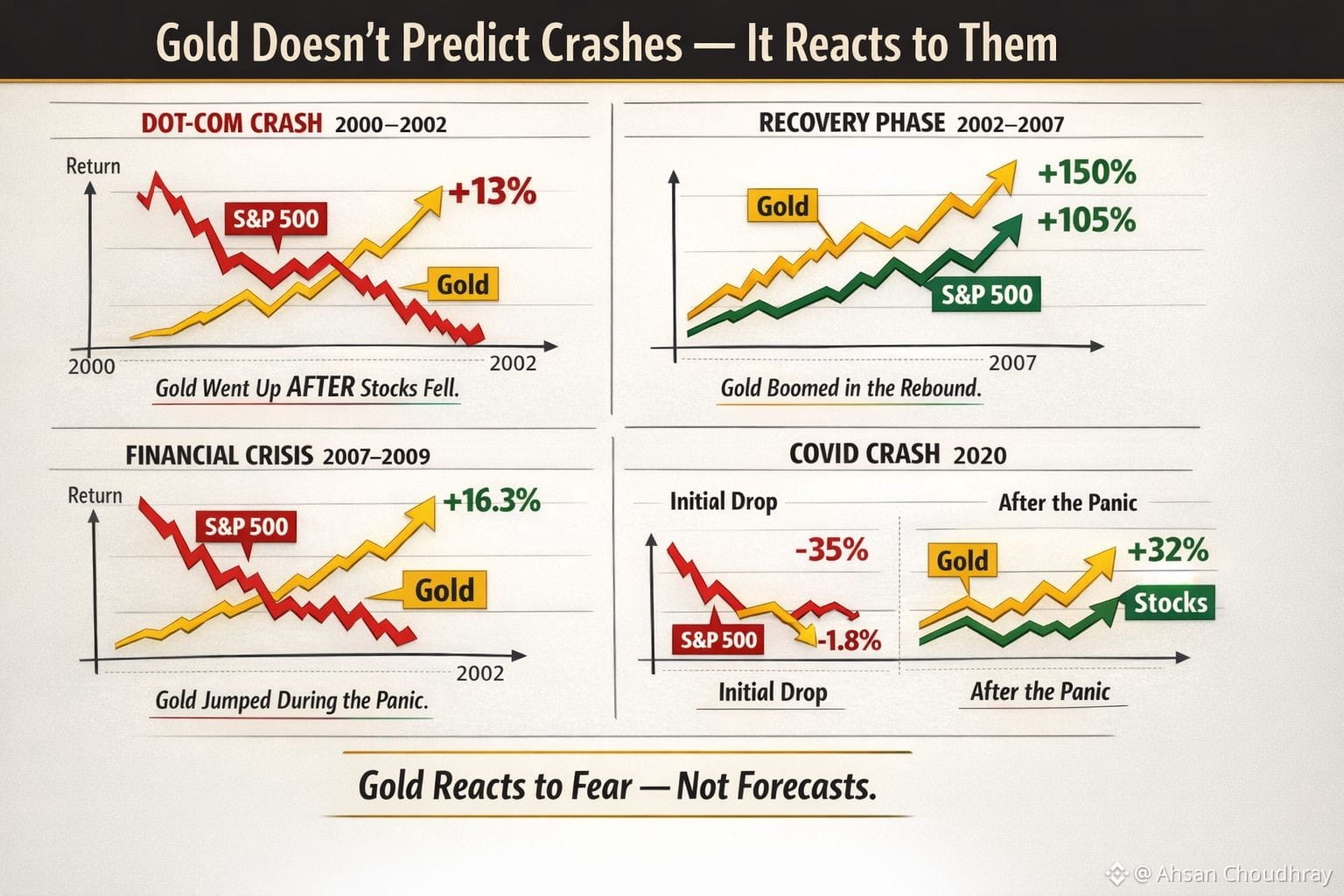
Dot-Com Bust (2000–2002)
S&P 500: -50%
Gold: +13%
➡️ Gold didn’t lead the move. It rose after stocks were already bleeding.
Post-Crash Recovery (2002–2007)
Gold: +150%
S&P 500: +105%
➡️ Fear lingered, and gold benefited during the healing phase.
Global Financial Crisis (2007–2009)
S&P 500: -57.6%
Gold: +16.3%
➡️ Gold worked — but as a panic hedge, not a warning signal.
🪤 The Part Most People Ignore
2009–2019 (No Crash, Just Expansion)
Gold: +41%
S&P 500: +305%
➡️ A full decade where gold holders paid the opportunity cost.
COVID Shock (2020)
S&P 500: -35%
Gold: -1.8% initially
After panic settled:
Gold: +32%
Stocks: +54%
➡️ Same pattern again — gold moved after fear peaked.
⚠️ What’s Driving Gold Now?
Markets are overloaded with worries:
US debt & deficits 💰
AI bubble fears 🤖
Wars & geopolitics 🌍
Trade tensions 🚢
Political instability 🗳️
And once again, investors are piling into metals before any real breakdown.
That’s the mistake.
🚫 The Hidden Risk No One Talks About
If a major crash doesn’t happen:
Capital stays trapped in gold
Stocks, crypto, and real estate keep compounding
Fear-driven buyers miss years of upside
🧠 The Takeaway
Gold isn’t a crystal ball.
It doesn’t predict crashes — it reacts to them.
Treat it as insurance, not a prophecy.
Gold = response asset, not timing tool.