
In the sprawling world of blockchain, Walrus is quietly emerging as a transformative force. At first glance, it might seem like just another cryptocurrency, yet it’s much more than a token—it serves as the lifeblood of a decentralized storage ecosystem poised to redefine how we handle data. Built on the Sui blockchain, Walrus allows anyone to store, share, and protect information with a level of privacy and resilience that traditional systems can’t match. Instead of merely duplicating files across nodes, it employs sophisticated erasure coding to break data into fragments, dispersing them across a network of independent storage providers. This ensures that even if parts of the network fail, the data can be seamlessly reconstructed without loss.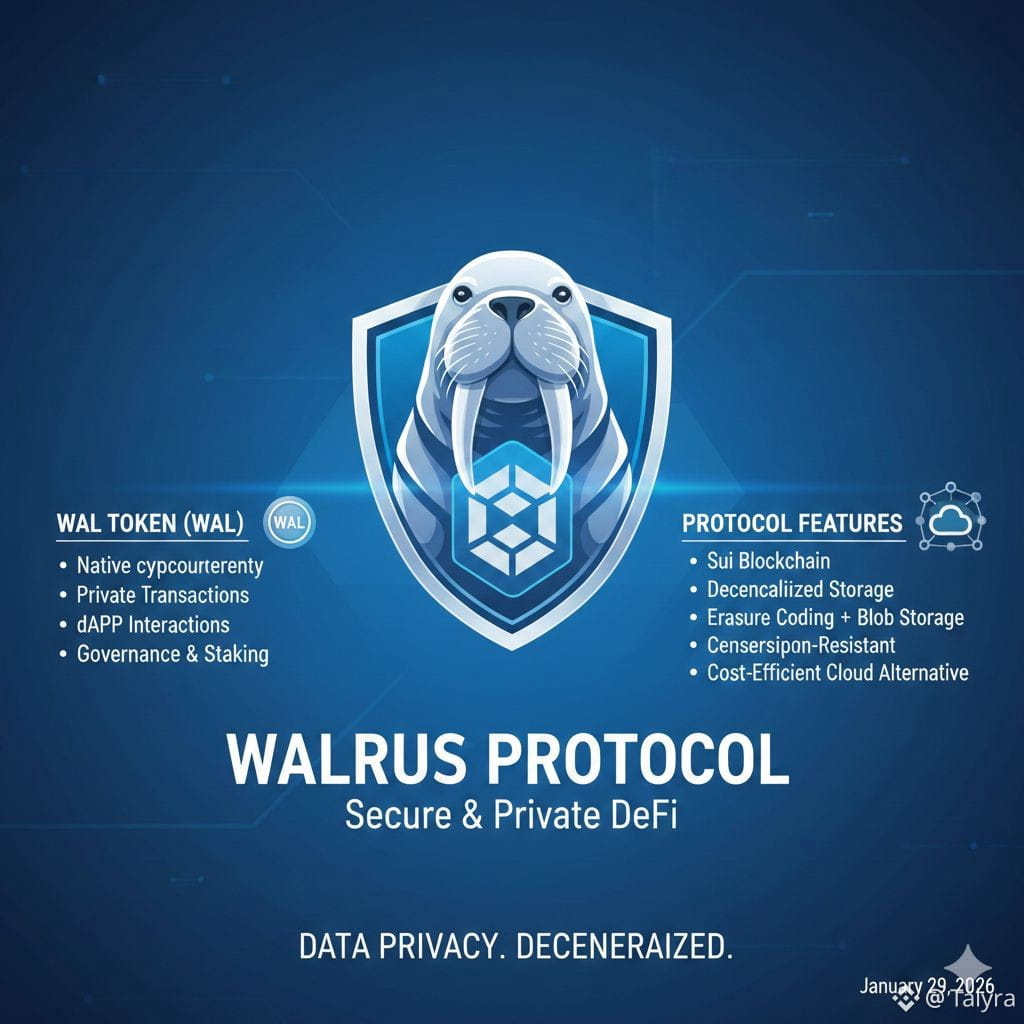
At the heart of this ecosystem is the WAL token. It powers payments for storage, rewards those who maintain the network, and gives holders a say in the protocol’s development. By staking WAL, users not only earn rewards but also help fortify the network, keeping the decentralized storage infrastructure robust and reliable. Unlike conventional cloud services—which are often costly and susceptible to censorship—Walrus provides a model that is both affordable and resistant to interference, appealing to developers, businesses, and everyday users alike.
But Walrus goes beyond mere data storage; it opens doors to new possibilities. Developers can integrate it into applications that demand secure, persistent storage, while dApps can rely on it to host content, assets, or datasets without depending on a centralized provider. It can handle large-scale data for AI training or high-resolution media, proving that decentralized solutions need not compromise on speed or performance. In doing so, Walrus is quietly reshaping Web3, forging a landscape where privacy, ownership, and security coexist with practical scalability.
What makes Walrus remarkable is its combination of simplicity and ambition. It doesn’t attempt to be everything for everyone; instead, it focuses on making decentralized storage not just feasible, but efficient, reliable, and genuinely useful. It illustrates that the future of data need not reside in distant cloud servers—it can be distributed, resilient, and controlled by the very people who generate and use it. Walrus may operate quietly, but its influence is profound, laying the groundwork for a decentralized internet where data flows freely, securely, and without compromise.

