
Many blockchains are designed to be performative. Radical transparency is treated as a feature in itself, exposing every transaction, balance, and interaction to public view by default. Dusk takes the opposite approach. Its design is grounded in an understanding long embraced by traditional finance: valuable systems do not require universal visibility, but they do require provability.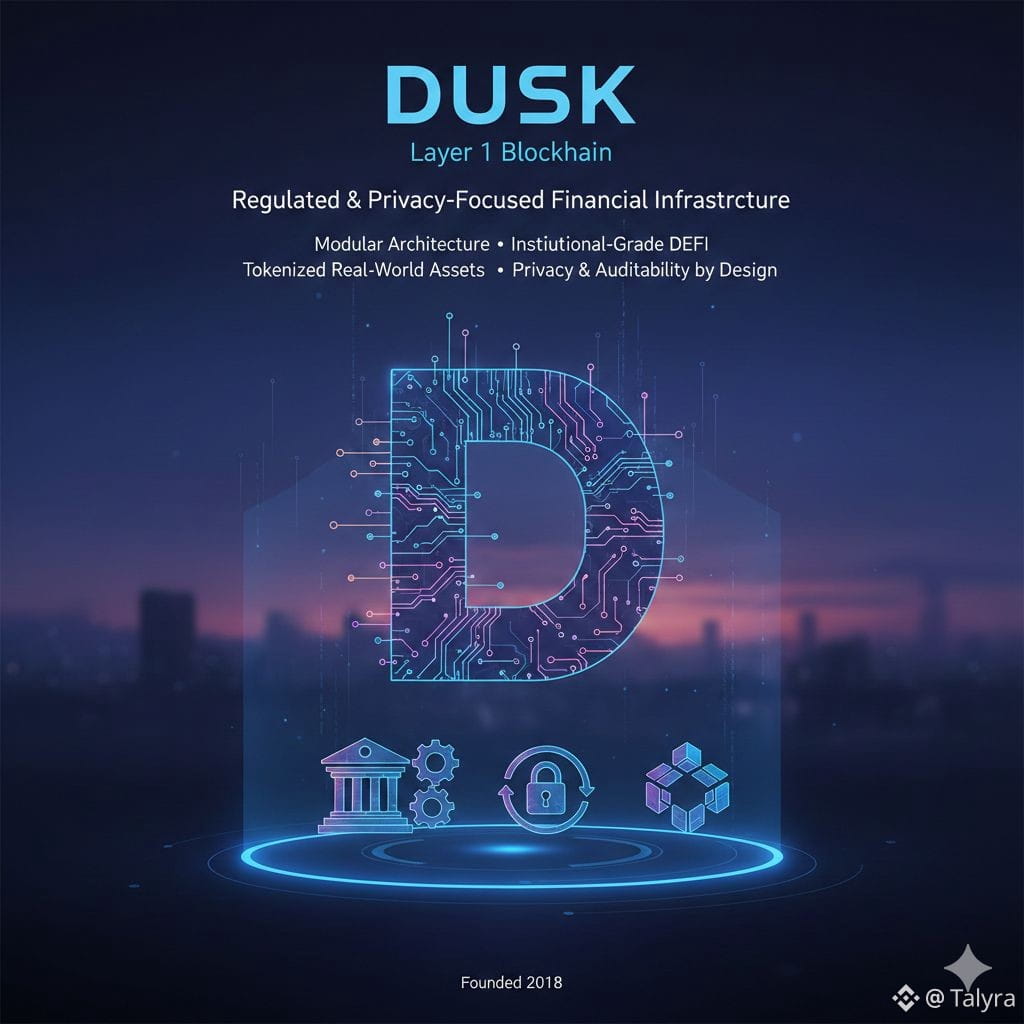
Dusk was launched in 2018, at a time when blockchain innovation was advancing far more rapidly than the regulatory frameworks surrounding financial markets. Early crypto culture often viewed regulation as something to bypass, while privacy was framed as either an optional enhancement or a way to evade oversight. Dusk challenged both narratives. From the outset, it set out to build a Layer 1 blockchain capable of supporting regulated financial activity without forcing participants to choose between confidentiality and compliance. Rather than accepting this tension as inevitable, Dusk treated it as a solvable design problem.
The protocol positions itself as foundational financial infrastructure, not as a venue for speculation. Its core purpose is to bring real-world financial instruments—such as securities, investment funds, and debt products—onto the blockchain in a way that mirrors their existing legal and operational realities. This approach treats tokenization as a systemic improvement, embedding settlement, ownership, and regulatory logic directly into the network instead of layering them across fragmented intermediaries.
Privacy within Dusk is structural, not superficial. It is embedded into transaction flows and smart contract execution rather than offered as an optional feature. Confidential transactions can occur while still generating cryptographic evidence that required rules have been satisfied. This allows institutions to prove regulatory compliance to auditors or authorities without publicly exposing sensitive information. For entities with legal obligations to safeguard client data, this capability is not merely beneficial—it is essential.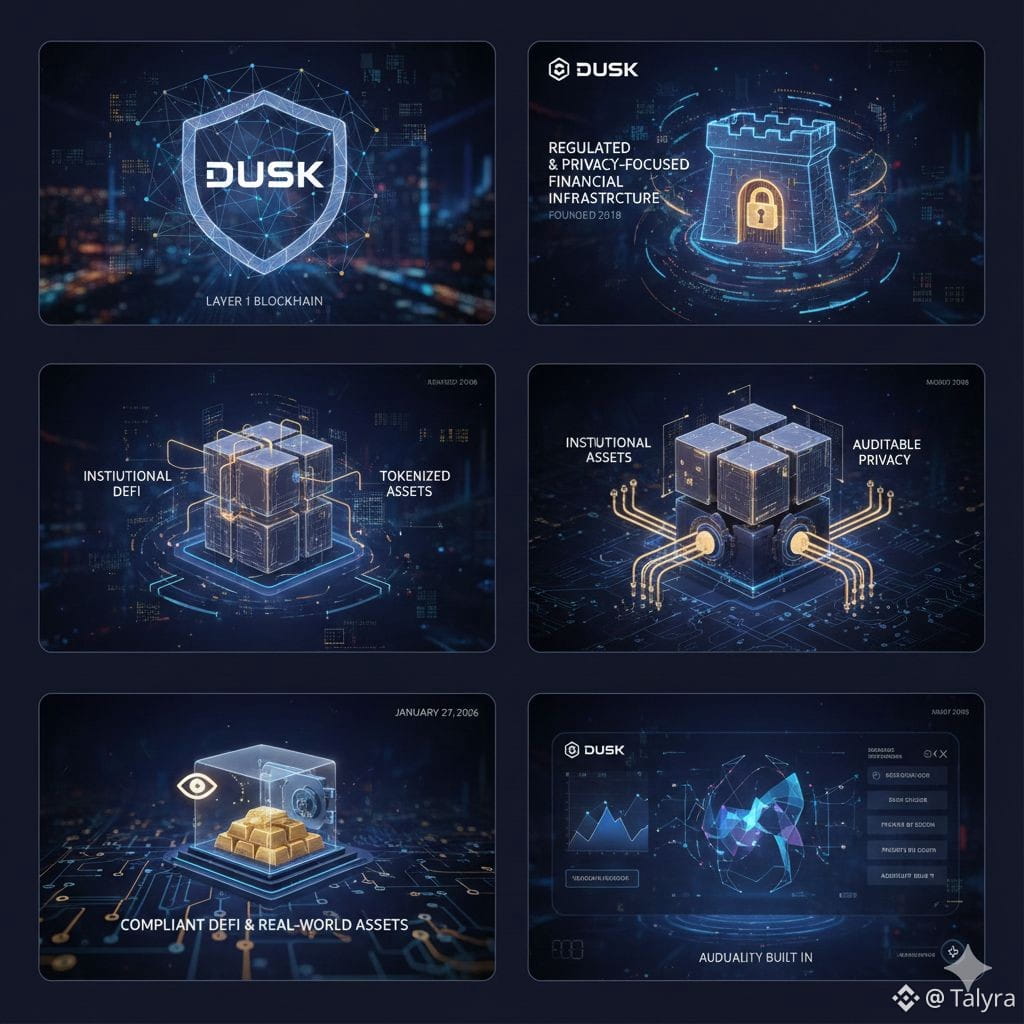
At the same time, Dusk avoids equating privacy with obscurity. The network is designed so that verification remains possible for permitted parties, ensuring accountability without compromising confidentiality. This dual emphasis enables Dusk to function as an interface between decentralized technology and regulated financial systems. It recognizes that market trust depends not only on discretion, but on the ability to demonstrate correctness when scrutiny is required.
Dusk’s modular architecture reflects a pragmatic view of financial evolution. Regulatory standards are not static, and neither are market structures. By decoupling key components, the network can adapt to legal and compliance changes without requiring disruptive overhauls. This adaptability is particularly important for institutional participants, who need stability today without locking themselves into infrastructure that may be outdated tomorrow.
While the DUSK token is essential for network security and operation, the project has never centered its identity on token speculation. Instead, the emphasis remains on functionality within a broader ecosystem that includes identity frameworks, confidential asset standards, and developer tooling designed specifically for regulated environments. This signals a focus on long-term utility rather than short-term attention—Dusk is concerned with building infrastructure, not generating noise.
What ultimately distinguishes Dusk is its restraint. It does not claim to overhaul global finance in one sweeping motion. Instead, it provides a realistic pathway for existing financial systems to adopt blockchain technology without abandoning regulatory responsibilities or ethical constraints. In doing so, it questions the assumption that decentralization must be disorderly, or that regulation inherently suppresses innovation.
As tokenized real-world assets shift from concept to standard practice, platforms like Dusk appear less experimental and more necessary. The financial systems of the future will not be defined by complete openness or total closure, but by nuance—the ability to balance discretion with verification. Dusk is built on the belief that the most effective blockchains will be those that understand when transparency is required, and when silence is the smarter choice.
