
For a long time, stablecoins have been doing much of crypto’s real work without much attention. They’re used to pay international freelancers, settle institutional trades, and transfer value in regions where traditional banking is slow, costly, or unreliable. Despite this, most stablecoin activity still runs on blockchains that were never purpose-built for money itself. Those networks were designed for general-purpose computing, speculation, or experimentation, and stablecoins had to adapt around those constraints. Plasma flips that model entirely. Instead of treating stablecoins as just another application, it assumes they are crypto’s most critical function and builds an entire Layer 1 blockchain specifically around that premise.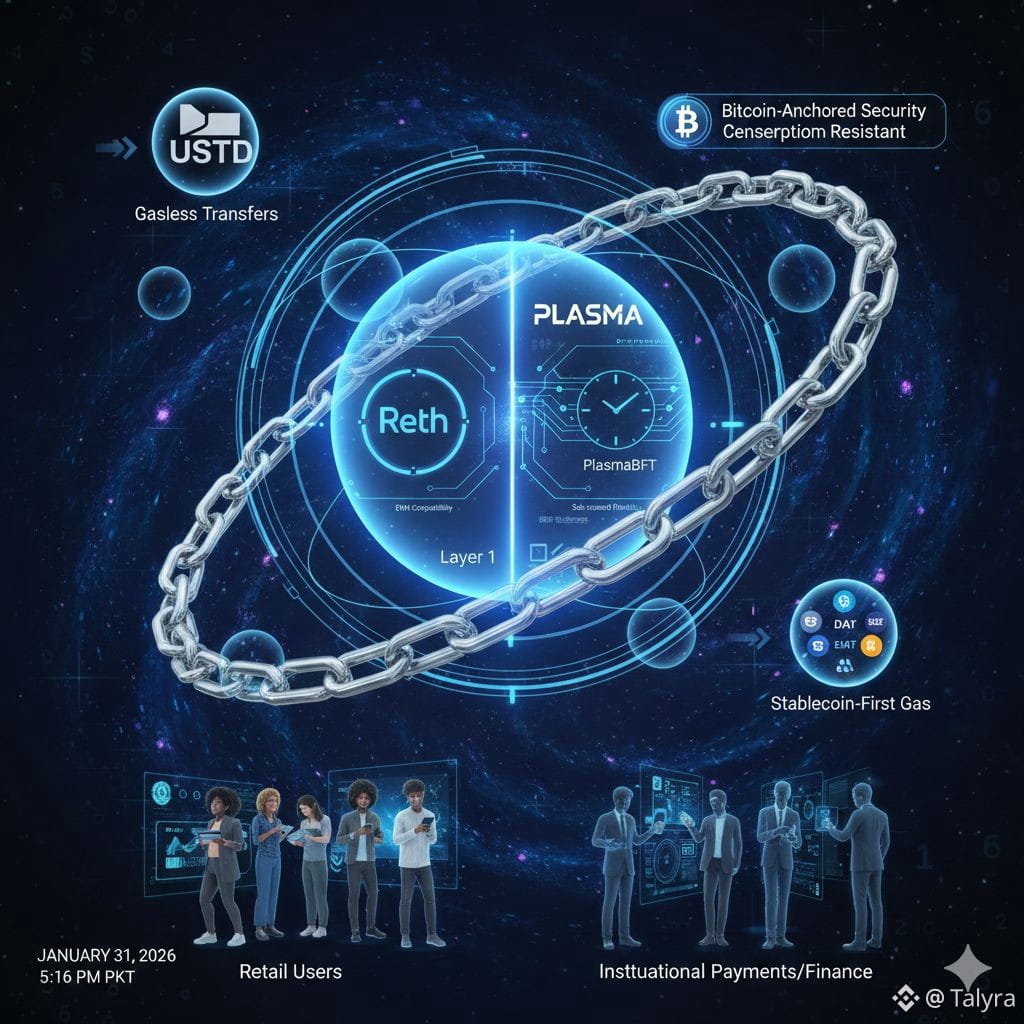
Plasma is a Layer 1 network designed from the ground up for stablecoin settlement, and that singular focus reshapes the user experience. Rather than forcing users to hold volatile native tokens just to move dollar-pegged assets, Plasma elevates stablecoins to first-class status. Transactions can be gasless, allowing users to send assets like USDT without owning anything beyond the stablecoin itself. Fees can be hidden behind abstractions or paid directly in stablecoins, eliminating one of the most common pain points for newcomers and businesses alike. From the first interaction with a wallet, Plasma feels less like traditional crypto and more like digital cash.
Behind the scenes, Plasma remains fully compatible with Ethereum. It uses a modern EVM execution client built on Reth, so developers can rely on familiar tooling, smart contracts, and workflows. There’s no need to learn an entirely new development environment just to build payment systems or financial applications. The difference lies in performance and finality. Plasma operates with its own consensus mechanism, PlasmaBFT, engineered for sub-second finality. Transactions don’t sit in limbo or risk reorganization; once a payment is made, it becomes final almost instantly. This level of certainty is crucial for retail payments, high-value transfers, and institutional processes where delays carry real costs.
Plasma also takes a distinctive approach to security and neutrality. It periodically anchors its state to Bitcoin, leveraging the most proven and secure blockchain as an external checkpoint. By committing cryptographic proofs to Bitcoin, Plasma gains additional protection against censorship and tampering without compromising speed. This design choice reflects a deeper philosophy: financial infrastructure should be dependable, apolitical, and resilient, not reliant on the discretion or goodwill of a single operator.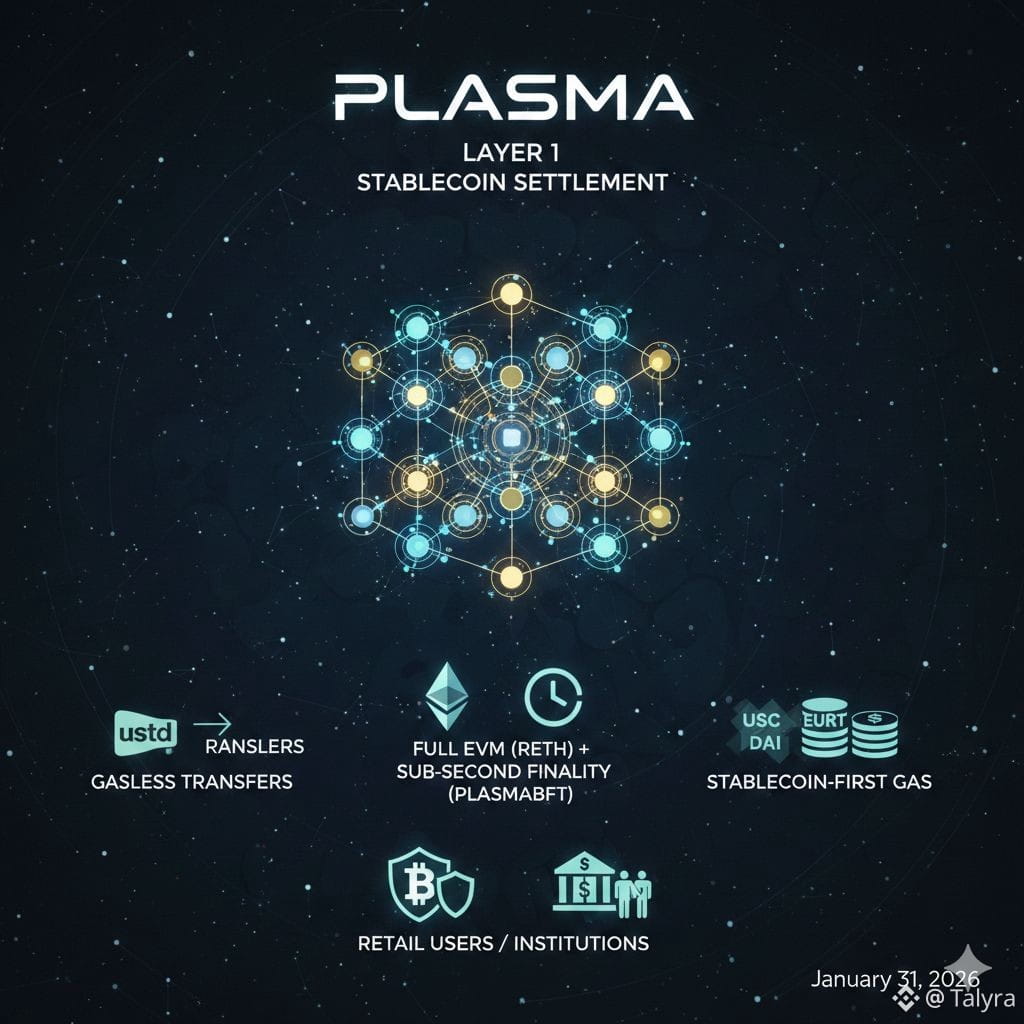
The network is clearly built with a specific audience in mind. Plasma is not optimized for hype-driven cycles or experimental trends. It targets people who already rely on stablecoins daily, as well as institutions seeking blockchain-based settlement without the usual complexity. Users in regions with high stablecoin adoption can transfer value without worrying about gas tokens or congestion. Payment processors and financial firms gain access to a fast, predictable settlement layer that behaves more like modern financial infrastructure than a speculative crypto network.
Scalability is another core consideration. Stablecoins already facilitate trillions of dollars in transactions each year, and that volume continues to rise. Supporting that level of activity requires a system that is inherently fast, low-cost, and consistent. By stripping away unnecessary friction, abstracting fees, and tailoring consensus specifically for payments rather than general computation, Plasma positions itself as foundational infrastructure rather than an experiment. It doesn’t ask users to wait for a hypothetical future where crypto becomes useful; it integrates seamlessly into the reality where stablecoins already play a central role.
In an ecosystem filled with blockchains that attempt to do everything at once, Plasma stands out for its restraint. It doesn’t aim to redefine finance in theory. Its goal is practical: to make digital dollars move smoothly, quickly, and reliably. For blockchains to support real-world payments at a global scale, they must fade into the background—reliable, predictable, and unremarkable. Plasma is designed precisely with that outcome in mind, quietly demonstrating what a stablecoin-native blockchain can achieve when money, rather than speculation, drives the design.

