The blockchain industry has reached a defining moment. After more than a decade of experimentation, innovation, and capital inflows, the promise of decentralized systems now faces its most persistent and visible obstacle: scalability. As adoption expands, transaction volumes surge, and real-world use cases demand reliability, many blockchain networks struggle under their own weight. Congestion, rising fees, delayed confirmations, and fractured user experiences have become familiar symptoms of systems never designed to operate at global scale. In this environment, solutions that merely optimize around the edges are no longer enough. What the market requires is infrastructure that fundamentally rethinks how blockchains process activity without compromising their core values. Plasma Coin enters this conversation not as a superficial enhancement, but as an architectural response to the scalability crisis shaping the future of decentralized networks.
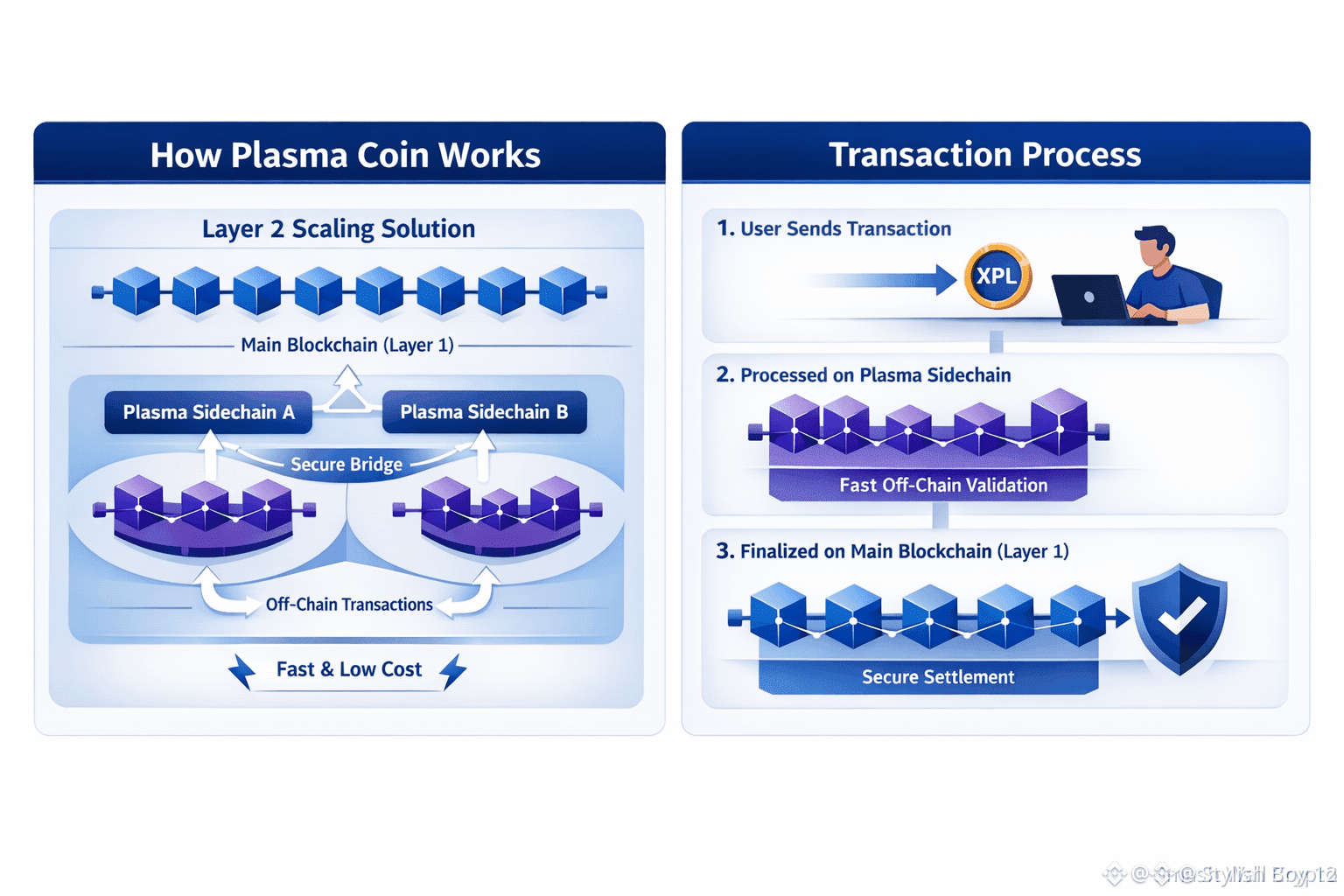
At its core, Plasma Coin operates through a layer-2 scaling framework built atop existing blockchain networks, a design choice that reflects both technical pragmatism and long-term vision. Rather than attempting to replace established blockchains or compete with them at the base layer, Plasma Coin leverages their security while shifting the bulk of transactional activity away from the congested main chain. This approach acknowledges a hard truth that the industry has increasingly come to accept: base layers are exceptionally good at security and decentralization, but inefficient when forced to handle every transaction directly. Plasma Coin’s architecture embraces this reality by separating transaction execution from settlement, allowing the system to scale without sacrificing integrity.
The mechanism that enables this separation is Plasma Coin’s use of off-chain processing through a network of sidechains. These sidechains function as semi-independent environments where transactions can be executed rapidly and at low cost, free from the bottlenecks that plague main chains during periods of heavy demand. By offloading activity in this way, Plasma Coin dramatically reduces network congestion while preserving the ability to anchor final outcomes back to the underlying blockchain. This balance between independence and accountability is what gives Plasma Coin its unique position within the layer-2 landscape. Transactions gain speed and efficiency, yet remain cryptographically linked to a secure base layer that enforces correctness.
Sidechains are not a new concept in blockchain discourse, but Plasma Coin’s implementation refines the idea with a clear focus on performance at scale. Each sidechain is capable of managing its own data and transactional logic, enabling parallel processing rather than forcing all activity through a single shared pipeline. This parallelism is essential for scaling systems that aspire to support millions of users and applications simultaneously. Instead of competing for limited block space, transactions are distributed across multiple execution environments, dramatically increasing throughput and reducing latency. The result is a system that feels responsive and fluid, even under sustained load.
Security, often the primary concern with off-chain solutions, is addressed through structured communication between sidechains and the main chain. Plasma Coin ensures that sidechains regularly commit proofs and state updates back to the base layer, creating a verifiable record of activity that can be audited or challenged if necessary. This design protects against malicious behavior while avoiding the computational overhead of validating every transaction on-chain. In effect, Plasma Coin transforms the main chain into a court of final appeal rather than an overworked transaction processor, a role far better suited to its strengths.
The economic implications of this model are significant. Transaction fees on congested networks have become a barrier to entry for everyday users and small developers, undermining the egalitarian ethos that once defined blockchain culture. Plasma Coin’s off-chain execution sharply reduces costs by minimizing the amount of data that must be recorded on the main chain. Lower fees do more than improve user experience; they expand the range of viable applications, from microtransactions and gaming to high-frequency financial activity and real-time data exchange. By making transactions economically accessible again, Plasma Coin reopens doors that congestion had quietly closed.
For developers, Plasma Coin offers a more forgiving and flexible environment in which to build. Scalability constraints often force developers to compromise functionality, limit user interactions, or accept unpredictable costs. Plasma Coin’s sidechain architecture allows applications to operate at full expressive capacity without worrying that success will become their undoing. As usage grows, additional sidechains can absorb demand, preserving performance without requiring fundamental changes to application logic. This scalability-by-design approach aligns with how modern software systems are built, making blockchain development more compatible with established engineering practices.
Beyond raw performance, Plasma Coin’s design also speaks to a deeper philosophical shift in how blockchain systems are evolving. Early networks pursued a monolithic ideal, attempting to solve security, decentralization, and scalability within a single layer. While admirable, this approach has proven increasingly untenable as real-world demands intensify. Plasma Coin represents a modular mindset, one in which different layers specialize in what they do best. Security and consensus remain anchored at the base, while speed and flexibility are delegated to higher layers. This separation of concerns mirrors successful architectures across the technology stack, from operating systems to cloud infrastructure.
However, no scaling solution is without trade-offs, and Plasma Coin’s architecture introduces complexities that must be acknowledged. Sidechains require robust coordination mechanisms to ensure consistency and prevent fragmentation. Users must trust that the system’s safeguards are sufficient to detect and resolve disputes, particularly in scenarios involving malicious actors or faulty execution. While the reliance on the main chain as an arbiter mitigates many risks, it also introduces dependency, meaning that the health and security of the underlying blockchain remain critical to Plasma Coin’s operation. These dynamics underscore the importance of rigorous design and ongoing oversight.
There are also challenges related to user experience and accessibility. Layer-2 systems can introduce additional steps for users, such as moving assets between chains or understanding different execution environments. Plasma Coin’s success depends not only on technical excellence but on thoughtful interfaces that abstract complexity without obscuring trust assumptions. As the system matures, simplifying these interactions will be essential to reaching audiences beyond technically proficient users. Scalability must feel intuitive, not intimidating, if it is to support mass adoption.
Despite these challenges, the broader trajectory favors solutions like Plasma Coin. The demand for scalable blockchain infrastructure is no longer speculative; it is immediate and growing. Financial applications require low latency and predictable costs. Consumer platforms need responsiveness comparable to centralized alternatives. Institutional users demand reliability and auditability. Plasma Coin’s architecture directly addresses these requirements by blending speed, security, and adaptability into a cohesive system. Rather than forcing users to choose between performance and trust, it offers a framework where both can coexist.
Looking ahead, Plasma Coin’s approach positions it well for an increasingly interconnected blockchain ecosystem. As interoperability improves and cross-chain communication becomes more common, sidechain-based systems can serve as high-performance hubs that interact seamlessly with multiple base layers. Plasma Coin’s emphasis on off-chain execution and on-chain settlement aligns with a future where blockchains specialize and collaborate rather than compete in isolation. In such an environment, scalability solutions are not peripheral enhancements but central components of network design.
The long-term implications extend beyond technical metrics. Scalable infrastructure reshapes incentives, enabling new business models and social applications that were previously impractical. It allows decentralized systems to move from experimental novelty to dependable public utility. Plasma Coin contributes to this transformation by demonstrating that scalability need not come at the expense of decentralization or security. Its architecture reflects a maturing industry that is learning from its limitations and building systems capable of sustaining real-world usage.
In the final analysis, Plasma Coin represents more than a faster way to process transactions. It embodies a shift in how blockchain networks are conceptualized and constructed, prioritizing modularity, efficiency, and resilience. By offloading execution to sidechains while anchoring trust in established blockchains, it offers a pragmatic path forward in an era defined by congestion and constraint. As decentralized technology continues its transition from theory to infrastructure, solutions like Plasma Coin will play a decisive role in determining whether blockchains can truly scale to meet global demand. The future of decentralized systems will not be decided by ideals alone, but by architectures capable of delivering on them, and Plasma Coin stands as a compelling step in that direction.